The simple quadratic equation
Page 4
by CH van der Westhuizen
y = Ax2 + Bx + C = 0
The best known method to solve for x in the Quadratic equation is by completing the square.
School children think or is made to think that this method is the only way to solve for the Quadratic.
There however exists other methods to solve for the simple quadratic equation. We will have a look at three of them.
The methods may be known or not, the Author had come upon these methods while searching for a method to solve
the Cubic equation ax3 + bx2 + cx + d = 0.
For the general Ax2 + Bx + C =0 we stipulate that A<>0 and A,B,C members of the real family.
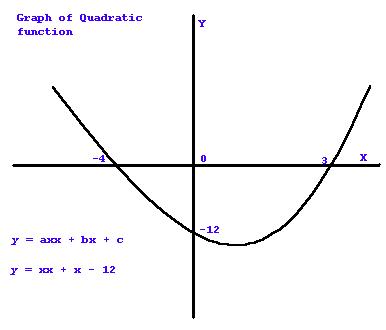
Example of a typical graph of the Quadratic function
Method one: Using a complex solution
Let x = u + iv , so x2 = u2 + 2iuv - v2
where "i" is the square root of -1 . We will also use sqrt to indicate "square root of"
Given Ax2 + Bx + C = 0 we divide by A
and get x2 + ax + b = 0 where a = B/A and b = C/A
So we substitute and get
u2 + 2iuv -v2 +au + aiv + b =0
We know for the above equation to be zero , that both the real and imaginary part must be zero.
For the imaginary part: 2uv + av =0
So 2u + a = 0 , u = -a/2 , u = -B/(2A)
For the real part: u2 - v2 +au + b = 0
Substitute u and we get B2/(4A2) - v2 +(B/A)(-B/(2A))+C/A = 0
So v2 = B2/(4A2) - 2B2/(4A2) + 4AC/(4A2)
So v2 = (-B2 + 4AC)/(4A2)
So iv = i*[SQRT(-B2 + 4AC)] / [2A]
So iv = SQRT(-1)*[SQRT(-B2 + 4AC)]/[2A]
So iv = [SQRT(B2 - 4AC)]/[2A]
But then x = u + iv = (-B + SQRT(B2 - 4AC))/(2A)
and we have one root. The other root is then just u-iv
We see our result is the same as the well known solution (-b +- sqrt(b2 - 4ac)) / (2a)
Method 2: Reducing the quadratic
Our object is to get the equation in a form y = x2 + k = 0 , because then it is very easy to solve.
Given Ax2 + Bx + C = 0 we divide by A and we have
x2 + ax + b = 0 where a = B/A , b = C/A
Let x = u+v , so x2 = u2 + 2uv + v2
So we have u2 + 2uv + v2 + au + av + b = 0
So u2 + u(2v + a) + (v2 + av + b) = 0
let 2v+a=0 , so v = -a/2 = -B/(2A)
Then u2 +( v2 + av + b ) = 0 and we have the equation in our desired form.
So u2 = -(B2)/(4A2) - (B/A)(-B/(2A)) - C/A
So u2 = B2 / (4A2) - 4AC/(4A2) = (B2 - 4AC)/(4A2)
So u = [sqrt(B2 - 4AC)]/[2A]
So x = u+v = [-B + sqrt(B2 - 4AC)]/[2A]
Method three: Solving using (x+g)(x-g)+h=0
Let Ax2 + Bx + C = 0
Then x2 + ax + b =0 where a = B/A , b = C/A
Let x = u+v
So we have (u+v)(u+v) + a(u+v) + b = 0
So (u+v)(u+v+a) + b = 0
Now let v+a = -v , so 2v = -a , so v = -a/2 = -B/[2A]
Then we have (u+v)(u-v)+b=0 , so u2 - v2 + b =0
So u2 = v2 - b = B2 / [4A2] - C/A = (B2 - 4AC)/(4A2)
So u = [sqrt(B2 - 4AC)]/[2A]
So x = v+u = [-B + sqrt(B2 - 4AC)]/[2A]
and so on
We see therefore that other methods do exist to solve for the quadratic.
The lesson to learn here is that one should never accept the taught method of any specific
subject in Mathematics as the Alpha and Omega. I think a lot of great discoveries
in existing branches of Mathematics is possible if we just do some exploring.
Go onwards to the Cubic on Page 5