INTRODUCTION
In
the sixth century before the Christian era, religion was
forgotten in India. The lofty teachings of the Vedas were thrown into
the background. There was much priestcraft everywhere.
The insincere priests traded on religion. They duped the
people in a variety of ways and amassed wealth for
themselves. They were quite irreligious. In the name of
religion, people followed in the footsteps of the cruel
priests and performed meaningless rituals. They killed
innocent dumb animals and did various sacrifices. The
country was in dire need of a reformer of Buddha's type.
At such a critical period, when there were cruelty,
degeneration and unrighteousness everywhere, reformer
Buddha was born to put down priestcraft and animal
sacrifices, to save the people and disseminate the
message of equality, unity and cosmic love everywhere.
BIRTH
Buddha's
father was Suddhodana, king of the Sakhyas. Buddha's
mother was named Maya. Buddha was born in B.C. 560 and
died at the age of eighty in B.C. 480. The place of his
birth was a grove known as Lumbini, near the city of
Kapilavastu, at the foot of Mount Palpa in the Himalayan
ranges within Nepal. This small city Kapilavastu stood on
the bank of the little river Rohini, some hundred miles
north-east of the city of Varnasi. As the time drew nigh
for Buddha to enter the world, the gods themselves
prepared the way before him with celestial portents and
signs. Flowers bloomed and gentle rains fell, although
out of season; heavenly music was heard, delicious scents
filled the air. The body of the child bore at birth the
thirty-two auspicious marks (Mahavyanjana) which
indicated his future greatness, besides secondary marks (Anuvyanjana)
in large numbers. Maya died seven days after her son's
birth. The child was brought up by Maya's sister
Mahaprajapati, who became its foster-mother.
ASTROLOGER'S
PREDICTION
On
the birth of the child, Siddhartha, the astrologers
predicted to its father Suddhodana: "The child, on
attaining manhood, would become either a universal
monarch (Chakravarti), or abandoning house and home,
would assume the robe of a monk and become a Buddha, a
perfectly enlightened soul, for the salvation of mankind".
Then the king said: "What shall my son see to make
him retire from the world ?". The astrologer replied:
"Four signs". "What four ?" asked the
king. "A decrepit old man, a diseased man, a dead
man and a monk - these four will make the prince retire
from the world" replied the astrologers.
SUDDHODANA'S
PRECAUTION
Suddhodana
thought that he might lose his precious son and tried his
level best to make him attached to earthly objects. He
surrounded him with all kinds of luxury and indulgence,
in order to retain his attachment for pleasures of the
senses and prevent him front undertaking a vow of
solitariness and poverty. He got him married and put him
in a walled place with gardens, fountains, palaces, music,
dances, etc. Countless charming young ladies attended on
Siddhartha to make him cheerful and happy. In particular,
the king wanted to keep away from Siddhartha the 'four
signs' which would move him to enter into the ascetic
life. "From this time on" said the king, "let
no such persons be allowed to come near my son. It will
never do for my son to become a Buddha. What I would wish
to see is, my son exercising sovereign rule and authority
over the four great continents and the two thousand
attendant isles, and walking through the heavens
surrounded by a retinue thirty-six leagues in
circumference". And when he had so spoken, he placed
guards for quarter of a league, in each of the four
directions, in order that none of the four kinds of men
might come within sight of his son.
RENUNCIATION
Buddha's
original name was Siddhartha. It meant one who had
accomplished his aim. Gautama was Siddhartha's family
name. Siddhartha was known all over the world as Buddha,
the Enlightened. He was also known by the name of Sakhya
Muni, which meant an ascetic of the Sakhya tribe.
Siddhartha
spent his boyhood at Kapilavastu and its vicinity. He was
married at the age of sixteen. His wife's name was
Yasodhara. Siddhartha had a son named Rahula. At the age
of twenty-nine, Siddhartha Gautama suddenly abandoned his
home to devote himself entirely to spiritual pursuits and
Yogic practices. A mere accident turned him to the path
of renunciation. One day he managed, somehow or the other,
to get out of the walled enclosure of the palace and
roamed about in the town along with his servant Channa to
see how the people were getting on. The sight of a
decrepit old man, a sick man, a corpse and a monk finally
induced Siddhartha to renounce the world. He felt that he
also would become a prey to old age, disease and death.
Also, he noticed the serenity and the dynamic personality
of the monk. Let me go beyond the miseries of this
Samsara (worldly life) by renouncing this world of
miseries and sorrows. This mundane life, with all its
luxuries and comforts, is absolutely worthless. I also am
subject to decay and am not free from the effect of old
age. Worldly happiness is transitory".
Gautama
left for ever his home, wealth, dominion, power, father,
wife and the only child. He shaved his head and put on
yellow robes. He marched towards Rajgriha, the capital of
the kingdom of Magadha. There were many caves in the
neighbouring hills. Many hermits lived in those caves.
Siddhartha took Alamo Kalamo, a hermit, as his first
teacher. He was not satisfied with his instructions. He
left him and sought the help of another recluse named
Uddako Ramputto for spiritual instructions. At last he
determined to undertake Yogic practices. He practiced
severe Tapas (austerities) and Pranayama (practice of
breath control) for six years. He determined to attain
the supreme peace by practicing self-mortification. He
abstained almost entirely from taking food. He did not
find much progress by adopting this method. He was
reduced to a skeleton. He became exceedingly weak.
At that
moment, some dancing girls were passing that way singing
joyfully as they played on their guitar. Buddha heard
their song and found real help in it. The song the girls
sang had no real deep meaning for them, but for Buddha it
was a message full of profound spiritual significance. It
was a spiritual pick-me-up to take him out of his despair
and infuse power, strength and courage. The song was:
"Fair goes the
dancing when the Sitar is tuned,
Tune us the Sitar neither low nor high,
And we will dance away the hearts of men.
The string overstretched breaks, the music dies,
The string overslack is dumb and the music dies,
Tune us the Sitar neither low nor high."
Buddha
realized then that he should not go to extremes in
torturing the body by starvation and that he should adopt
the golden mean or the happy medium or the middle path by
avoiding extremes. Then he began to eat food in
moderation. He gave up the earlier extreme practices and
took to the middle path.
ENLIGHTENMENT
Once
Buddha was in a dejected mood as he did not succeed in
his Yogic practices. He knew not where to go and what to
do. A village girl noticed his sorrowful face. She
approached him and said to him in a polite manner: "Revered
sir, may I bring some food for you ? It seems you are
very hungry". Gautama looked at her and said, "What
is your name, my dear sister ?". The maiden answered,
"Venerable sir, my name is Sujata". Gautama
said, "Sujata, I am very hungry. Can you really
appease my hunger ?"
The
innocent Sujata did not understand Gautama. Gautama was
spiritually hungry. He was thirsting to attain supreme
peace and Self-realization. He wanted spiritual food.
Sujata placed some food before Gautama and entreated him
to take it. Gautama smiled and said, "Beloved Sujata,
I am highly pleased with your kind and benevolent nature.
Can this food appease my hunger ?". Sujata replied,
"Yes sir, it will appease your hunger. Kindly take
it now". Gautama began to eat the food underneath
the shadow of a large tree, thenceforth to be called as
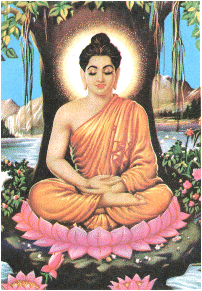
the great 'Bo-tree' or the tree of wisdom. Gautama sat in
a meditative mood underneath the tree from early morning
to sunset, with a fiery determination and an iron resolve:
"Let me die. Let my body perish. Let my flesh dry up.
I will not get up from this seat till I get full
illumination". He plunged himself into deep
meditation. At night he entered into deep Samadhi (superconscious
state) underneath that sacred Bo-tree (Pipal tree or ficus
religiosa). He was tempted by Maya in a variety of
ways, but he stood adamant. He did not yield to Maya's
allurements and temptations. He came out victorious with
full illumination. He attained Nirvana (liberation). His
face shone with divine splendour and effulgence. He got
up from his seat and danced in divine ecstasy for seven
consecutive days and nights around the sacred Bo-tree.
Then he came to the normal plane of consciousness. His
heart was filled with profound mercy and compassion. He
wanted to share what he had with humanity. He traveled
all over India and preached his doctrine and gospel. He
became a saviour, deliverer and redeemer.
Buddha
gave out the experiences of his Samadhi: "I thus
behold my mind released from the defilement of earthly
existence, released from the defilement of sensual
pleasures, released from the defilement of heresy,
released from the defilement of ignorance."
In the
emancipated state arose the knowledge: "I am
emancipated, rebirth is extinct, the religious walk is
accomplished, what had to be done is done, and there is
no need for the present existence. I have overcome all
foes; I am all-wise; I am free from stains in every way;
I have left everything and have obtained emancipation by
the destruction of desire. Myself having gained knowledge,
whom should I call my Master ? I have no teacher; no one
is equal to me. I am the holy one in this world; I am the
highest teacher. I alone am the absolute omniscient one (Sambuddho).
I have gained coolness by the extinction of all passion
and have obtained Nirvana. To found the kingdom of law (Dharmo)
I go to the city of Varnasi. I will beat the drum of
immortality in the darkness of this world".
Lord
Buddha then walked on to Varnasi. He entered the 'deer-park'
one evening. He gave his discourse there and preached his
doctrine. He preached to all without exception, men and
women, the high and the low, the ignorant and the learned
- all alike. All his first disciples were laymen and two
of the very first were women. The first convert was a
rich young man named Yasa. The next were Yasa's father,
mother and wife. Those were his lay disciples.
Buddha
argued and debated with his old disciples who had
deserted him when he was in the Uruvila forest. He
brought them round by his powerful arguments and
persuasive powers. Kondanno, an aged hermit, was
converted first. The others also soon accepted the
doctrine of Lord Buddha. Buddha made sixty disciples and
sent them in different directions to preach his doctrine.
Buddha
told his disciples not to enquire into the origin of the
world, into the existence and nature of God. He said to
them that such investigations were practically useless
and likely to distract their minds.
SPREADING THE
DOCTRINE
The
number of Buddha's followers gradually increased. Nobles,
Brahmins and many wealthy men became his disciples.
Buddha paid no attention to caste. The poor and the
outcastes were admitted to his order. Those who wanted to
become full members of his order were obliged to become
monks and to observe strict rules of conduct. Buddha had
many lay disciples also. Those lay members had to provide
for the wants of the monks.
In the
forest of Uruvila, there were three brothers - all very
famous monks and philosophers. They had many learned
disciples. They were honoured by kings and potentates.
Lord Buddha went to Uruvila and lived with those three
monks. He converted those three reputed monks, which
caused a great sensation all over the country.
Lord
Buddha and his disciples walked on towards Rajgriha, the
capital of Magadha. Bimbisara, the king, who was attended
upon by 120,000 Brahmins and householders, welcomed
Buddha and his followers with great devotion. He heard
the sermon of Lord Buddha and at once became his disciple.
110,000 of the Brahmins and householders became full
members of Lord Buddha's order and the remaining 10,000
became lay adherents. Buddha's followers were treated
with contempt when they went to beg their daily food.
Bimbisara made Buddha a present of Veluvanam - a bamboo-grove,
one of the royal pleasure-gardens near his capital. Lord
Buddha spent many rainy seasons there with his followers.
Every
Buddhist monk takes a vow, when he puts on the yellow
robe, to abstain from killing any living being. Therefore,
a stay in one place during the rainy season becomes
necessary. Even now, the Paramahamsa Sannyasins (the
highest class of renunciates) of Sankara's order stay in
one place for four months during the rainy season (Chaturmas).
It is impossible to move about in the rainy season
without killing countless small insects, which the
combined influence of moisture and the hot sun at the
season brings into existence.
Lord
Buddha received from his father a message asking him to
visit his native place, so that he might see him once
more before he died. Buddha accepted his invitation
gladly and started for Kapilavastu. He stayed in a forest
outside the city. His father and relatives came to see
him, but they were not pleased with their ascetic Gautama.
They left the place after a short time. They did not make
any arrangement for his and his followers' daily food.
After all, they were worldly people. Buddha went to the
city and begged his food from door to door. This news
reached the ears of his father. He tried to stop Gautama
from begging. Gautama said: "O king, I am a
mendicant - I am a monk. It is my duty to get alms from
door to door. This is the duty of the Order. Why do you
stop this ? The food that is obtained from alms is very
pure". His father did not pay any attention to the
words of Gautama. He snatched the bowl from his hand and
took him to his palace. All came to pay Buddha their
respects, but his wife Yasodhara did not come. She said,
"He himself will come to me, if I am of any value in
his eyes". She was a very chaste lady endowed with
Viveka (discrimination), Vairagya (dispassion) and other
virtuous qualities. From the day she lost her husband she
gave up all her luxuries. She took very simple food once
daily and slept on a mat. She led a life of severe
austerities. Gautama heard all this. He was very much
moved. He went at once to see her. She prostrated at his
feet. She caught hold of his feet and burst into tears.
Buddha established an order of female ascetics. Yasodhara
became the first of the Buddhistic nuns.
Yasodhara
pointed out the passing Buddha to her son through a
window and said, "O Rahula! That monk is your father.
Go to him and ask for your birthright. Tell him boldly, 'I
am your son. Give me my heritage'". Rahula at once
went up to Buddha and said, "Dear father, give me my
heritage". Buddha was taking his food then. He did
not give any reply. The boy repeatedly asked for his
heritage. Buddha went to the forest. The boy also
silently followed him to the forest. Buddha said to one
of his disciples, "I give this boy the precious
spiritual wealth I acquired under the sacred Bo-tree. I
make him the heir to that wealth". Rahula was
initiated into the order of monks. When this news reached
the ears of Buddha's father, he was very much grieved
because after losing his son, he now lost his grandson
also.
Buddha
performed some miracles. A savage serpent of great
magical power sent forth fire against Buddha. Buddha
turned his own body into fire and sent forth flames
against the serpent. Once a tree bent down one of its
branches in order to help Buddha when he wanted to come
up out of the water of a tank. One day five hundred
pieces of firewood split by themselves at Buddha's
command. Buddha created five hundred vessels with fire
burning in them for the Jatilas to warm themselves on a
winter night. When there was flood, he caused the water
to recede and then he walked over the water.
Ananda,
one of Buddha's cousins, was one of the principal early
disciples of Buddha and was a most devoted friend and
disciple of Buddha. He was devoted to Buddha with a
special fervour in a simple childlike way and served him
as his personal attendant till the end of his life. He
was very popular. he was a very sweet man with pleasant
ways. He had no intellectual attainments, but he was a
man of great sincerity and loving nature. Devadatta, one
of Ananda's brothers, was also in the Order. Devadatta
became Buddha's greatest rival and tried hard to oust
Buddha and occupy the place himself. A barber named Upali
and a countryman called Anuruddha were admitted into the
Order. Upali became a distinguished leader of his Order.
Anuruddha became a Buddhistic philosopher of vast
erudition.
THE END
Buddha
went to Sravasti, the capital of the kingdom of Kosala.
Here a wealthy merchant gave him for residence an
extensive and beautiful forest. Buddha spent many rainy
seasons there and delivered several grand discourses.
Thus Lord Buddha preached his doctrine for over forty-five
years traveling from place to place.
Buddha
died of an illness brought on by some error in diet. He
became ill through eating Sukara-maddavam,
prepared for him by a lady adherent named Cundo. The
commentator explains the word as meaning 'hog's flesh'.
Subadhara Bhikshu thinks it means something which wild
boars are fond of and says that it has something of the
nature of a truffle. Dr. Hoey says that it is not boar's
flesh but Sukarakanda
or hog's root, a bulbous root found chiefly in the jungle
and which Hindus eat with great joy. It is a Phalahar
that is eaten on days of fasting.
Buddha
said to Ananda, "Go Ananda, prepare for me, between
twin Sal trees, a couch with the head northward. I am
exhausted and would like to lie down". A wonderful
scene followed. The twin Sal trees burst into full bloom
although it was not the blossoming season. Those flowers
fell on the body of Buddha out of reverence. Divine coral
tree flowers and divine sandalwood powders fell from
above on Buddha's body out of reverence.
Lord
Buddha said, "Come now, dear monks. I bid you
farewell. Compounds are subject to dissolution. Prosper
ye through diligence and work out your salvation".
A
FEW EPISODES
The
spirit of Ahimsa (non-violence) was ever present
with Gautama from his very childhood. One day, his cousin
Devadatta shot a bird. The poor creature was hurt and
fell to the ground. Gautama ran forward, picked it up and
refused to hand it over to his cousin. The quarrel was
taken up before the Rajaguru who, however, decided in
favour of Gautama to the great humiliation of Devadatta.
In his
wanderings, Gautama one day saw a herd of goats and sheep
winding their way through a narrow valley. Now and then
the herdsman cried and ran forward and backward to keep
the members of the fold from going astray. Among the vast
flock Gautama saw a little lamb, toiling behind, wounded
in one part of the body and made lame by a blow of the
herdsman. Gautama's heart was touched and he took it up
in his arms and carried it saying, "It is better to
relieve the suffering of an innocent being than to sit on
the rocks of Olympus or in solitary caves and watch
unconcerned the sorrows and sufferings of humanity".
Then, turning to the herdsman he said, "Whither are
you going, my friend, with this huge flock so great a
hurry ?". "To the king's palace" said the
herdsman, "We are sent to fetch goats and sheep for
sacrifice which our master - the king - will start
tonight in propitiation of the gods." Hearing this,
Gautama followed the herdsman, carrying the lamb in his
arms. When they entered the city, word was circulated
that a holy hermit had brought the sacrifices ordered by
the king. As Gautama passed through the streets, people
came out to see the gracious and saintly figure of the
youth clad in the yellow robes of a Sadhu (renunciate)
and all were struck with wonder and awe at his noble mien
and his sweet expression. The king was also informed of
the coming of the holy man to the sacrifice. When the
ceremonies commenced in the presence of the king, there
was brought a goat ready to be killed and offered to the
gods. There it stood with its legs tied up and the high
priest ready with a big bloodthirsty knife in his hand to
cut the dumb animal's throat. In that cruel and tragic
moment, when the life of the poor creature hung by a
thread, Gautama stepped forward and cried, "Stop the
cruel deed, O king!". And as he said this, he leaned
forward and unfastened the bonds of the victim. "Every
creature" he said, "loves to live, even as
every human being loves to preserve his or her life".
The priest then threw the knife away like a repentant
sinner and the king issued a royal decree throughout the
land the next day, to the effect that no further
sacrifice should be made in future and that all people
should show mercy to birds and beasts alike.
Kisagotami,
a young woman, was married to the only son of a rich man
and they had a male child. The child died when he was two
years old. Kisagotami had intense attachment for the
child. She clasped the dead child to her bossom, refused
to part with it, and went from house to house, to her
friends and relatives, asking them to give some medicine
to bring the child back to life. A Buddhist monk said to
her: "O good girl! I have no medicine. But go to
Lord Buddha. He can surely give you a very good medicine.
He is an ocean of mercy and love. The child will come
back to life. Be not troubled". She at once ran to
Buddha and said, "O venerable sir! Can you give any
medicine to this child ?". Buddha replied, "Yes.
I will give you a very good medicine. Bring some mustard
seed from some house where no child or husband or wife or
father or mother or servant had died". She said,
"Very good, sir, I shall bring it in a short time".
Carrying
her dead child in her bossom, Kisagotami went to a house
and asked for some mustard seed. The people of the house
said, "O lady, here is mustard seed. Take it".
Kisagotami asked, "In your house, has any son or
husband or wife, father or mother or servant died ?".
They replied, "O lady! You ask a very strange
question. Many have died in our house". Kisagotami
went to another house and asked the same. The owner of
the house said, "I have lost my eldest son and my
wife". She went to a third house. People of the
house answered, "We have lost our parents". She
went to another house. The lady of the house said, "I
lost my husband last year". Ultimately Kisagotami
was not able to find a single house where no one had died.
Viveka and Vairagya dawned in her mind. She buried the
dead body of her child. She began to reflect seriously on
the problem of life and death in this world.
Kisagotami
then went to Lord Buddha and prostrated at his lotus feet.
Buddha said to her, "O good girl! Have you brought
the mustard seed ?". Kisagotami answered, "I am
not able to find a single house where no one has died".
Then Buddha said, "All the objects of this world are
perishable and impermanent. This world is full of
miseries, troubles and tribulations. Man or woman is
troubled by birth, death, disease, old age and pain. We
should gain wisdom from experience. We should not expect
for things that do not and will not happen. This
expectation leads us to unnecessary misery and suffering.
One should obtain Nirvana. Then only all sorrows will
come to an end. One will attain immortality and eternal
peace". Kisagotami then became a disciple of Buddha
and entered the Order of Nuns.
Once
Buddha went to the house of a rich Brahmin with bowl in
hand. The Brahmin became very angry and said, "O
Bhikshu, why do you lead an idle life of wandering and
begging ? Is this not disgraceful ? You have a well-built
body. You can work. I plough and sow. I work in the
fields and I earn my bread at the sweat of my brow. I
lead a laborious life. It would be better if you also
plough and sow and then you will have plenty of food to
eat". Buddha replied, "O Brahmin! I also plough
and sow, and having ploughed and sown, I eat". The
Brahmin said, "You say you are an agriculturist. I
do not see any sign of it. Where are your plough,
bullocks and seeds ?". Then Buddha replied, "O
Brahmin! Just hear my words with attention. I sow the
seed of faith. The good actions that I perform are the
rain that waters the seeds. Viveka and Vairagya are parts
of my plough. Righteousness is the handle. Meditation is
the goad. Sama and Dama - tranquillity of the mind and
restraint of the Indriyas (senses) - are the bullocks.
Thus I plough the soil of the mind and remove the weeds
of doubt, delusion, fear, birth and death. The harvest
that comes in is the immortal fruit of Nirvana. All
sorrows terminate by this sort of ploughing and
harvesting". The rich arrogant Brahmin came to his
senses. His eyes were opened. He prostrated at the feet
of Buddha and became his lay adherent.
BUDDHA'S
TEACHINGS
Lord
Buddha preached: "We will have to find out the cause
of sorrow and the way to escape from it. The desire for
sensual enjoyment and clinging to earthly life is the
cause of sorrow. If we can eradicate desire, all sorrows
and pains will come to an end. We will enjoy Nirvana or
eternal peace. Those who follow the Noble Eightfold Path
strictly, viz., right opinion, right resolve, right
speech, right conduct, right employment, right exertion,
right thought and right self-concentration will be free
from sorrow. This indeed, O mendicants, is that middle
course which the Tathagata has thoroughly comprehended,
which produces insight, which produces knowledge, which
leads to calmness or serenity, to supernatural knowledge,
to perfect Buddhahood, to Nirvana.
"This
again, indeed, O mendicants, is the noble truth of
suffering. Birth is painful, old age is painful, sickness
is painful, association with unloved objects is painful,
separation from loved objects is painful, the desire
which one does not obtain, this is too painful - in short,
the five elements of attachment to existence are painful.
The five elements of attachment to earthly existence are
form, sensation, perception, components and consciousness.
"This
again, indeed, O mendicants, is the truth of the cause of
suffering. It is that thirst which leads to renewed
existence, connected with joy and passion, finding joy
here and there, namely, thirst for sensual pleasure, and
the instinctive thirst for existence. This again, indeed,
O mendicants, is the noble truth of cessation of
suffering, which is the cessation and total absence of
desire for that very thirst, its abandonment, surrender,
release from it and non-attachment to it. This again,
indeed, O mendicants, is the noble truth of the course
which leads to the cessation of suffering. This is verily
the Noble Eightfold Path, viz., right opinion, etc."
|