|
DENGUE
AND DENGUE HAEMORRHAGIC FEVER
Dengue is a
mosquito-borne infection which in recent years has become a
major international public health concern. Dengue is found
in tropical and sub-tropical regions around the world,
predominantly in urban and semi-urban areas.
Dengue
haemorrhagic fever (DHF), a potentially lethal complication,
was first recognized in the 1950s during the dengue
epidemics in the Philippines and Thailand, but today DHF
affects most Asian countries and has become a leading cause
of hospitalisation and death among children in several of
them.
There are
four distinct, but closely related, viruses that cause
dengue. Recovery from infection by one provides lifelong
immunity against that serotype but confers only partial and
transient protection against subsequent infection by the
other three. There is good evidence that sequential
infection increases the risk of more serious disease
resulting in DHF.
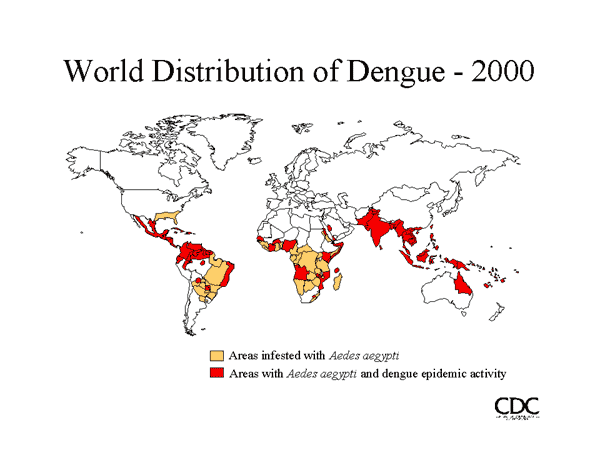
Prevalence
worldwide distribution of
dengue
The global
prevalence of dengue has grown dramatically in recent
decades. The disease is now endemic in more than 100
countries in Africa, the Americas, the Eastern
Mediterranean, South-east Asia and the Western Pacific.
South-east Asia and the Western Pacific are most seriously
affected. Before 1970 only nine countries had experienced
DHF epidemics, a number that had increased more than
four-fold by 1995.
Some 2500
million people — two fifths of the world's population —
are now at risk from dengue. WHO currently estimates there
may be 50 million cases of dengue infection worldwide every
year.
In 2001
alone, there were more than 609 000 reported cases of dengue
in the Americas, of which 15 000 cases were DHF. This is
greater than double the number of dengue cases which were
recorded in the same region in 1995.
Not only is
the number of cases increasing as the disease is spreading
to new areas, but explosive outbreaks are occurring. In
2001, Brazil reported over 390 000 cases including
more than 670 cases of DHF.
Some other
statistics:
- During epidemics of
dengue, attack rates among susceptibles are often 40 –
50%, but may reach 80 – 90%.
- An estimated 500 000
cases of DHF require hospitalisation each year, of whom
a very large proportion are children. At least 2.5% of
cases die, although case fatality could be twice as
high.
- Without proper
treatment, DHF case fatality rates can exceed 20%. With
modern intensive supportive therapy, such rates can be
reduced to less than 1%.
The spread
of dengue is attributed to expanding geographic distribution
of the four dengue viruses and of their mosquito vectors,
the most important of which is the predominantly urban
species Aedes aegypti. A rapid rise in urban
populations is bringing ever greater numbers of people into
contact with this vector, especially in areas that are
favourable for mosquito breeding, e.g. where household water
storage is common and where solid waste disposal services
are inadequate.
Transmission
Dengue
viruses are transmitted to humans through the bites of
infective female Aedes mosquitoes. Mosquitoes
generally acquire the virus while feeding on the blood of an
infected person. After virus incubation for 8-10 days, an
infected mosquito is capable, during probing and blood
feeding, of transmitting the virus, to susceptible
individuals for the rest of its life. Infected female
mosquitoes may also transmit the virus to their offspring by
transovarial (via the eggs) transmission, but the role of
this in sustaining transmission of virus to humans has not
yet been delineated.
Humans are
the main amplifying host of the virus, although studies have
shown that in some parts of the world monkeys may become
infected and perhaps serve as a source of virus for
uninfected mosquitoes. The virus circulates in the blood of
infected humans for two to seven days, at approximately the
same time as they have fever; Aedes mosquitoes may
acquire the virus when they feed on an individual during
this period.
Characteristics
Dengue
fever is a severe, flu-like illness that affects infants,
young children and adults, but seldom causes death.
The
clinical features of dengue fever vary according to the age
of the patient. Infants and young children may have a
non-specific febrile illness with rash. Older children and
adults may have either a mild febrile syndrome or the
classical incapacitating disease with abrupt onset and high
fever, severe headache, pain behind the eyes, muscle and
joint pains, and rash.
Dengue
haemorrhagic fever is a potentially deadly complication that
is characterized by high fever, haemorrhagic
phenomena—often with enlargement of the liver—and in
severe cases, circulatory failure. The illness commonly
begins with a sudden rise in temperature accompanied by
facial flush and other non-specific constitutional symptoms
of dengue fever. The fever usually continues for two to
seven days and can be as high as 40-41°C, possibly with
febrile convulsions and haemorrhagic phenomena.
In moderate
DHF cases, all signs and symptoms abate after the fever
subsides. In severe cases, the patient's condition may
suddenly deteriorate after a few days of fever; the
temperature drops, followed by signs of circulatory failure,
and the patient may rapidly go into a critical state of
shock and die within 12-24 hours, or quickly recover
following appropriate volume replacement therapy.
Treatment
There is no
specific treatment for dengue fever. However, careful
clinical management by experienced physicians and nurses
frequently saves the lives of DHF patients. With appropriate
intensive supportive therapy, mortality may be reduced to
less than 1%. Maintenance of the circulating fluid volume is
the central feature of DHF case management. [For detailed
advice on managing patients with DHF see http://www.who.int/emc/diseases/ebola/Denguepublication/index.html]
Immunization
Vaccine
development for dengue and DHF is difficult because any of
four different viruses may cause disease, and because
protection against only one or two dengue viruses could
actually increase the risk of more serious disease.
Nonetheless, progress is being made in the development of
vaccines that may protect against all four dengue viruses.
Such products may become available for public health use
within several years.
Prevention
and Control
At present,
the only method of controlling or preventing dengue and DHF
is to combat the vector mosquitoes.
In Asia and
the Americas, Aedes aegypti breeds primarily in
man-made containers like earthenware jars, metal drums and
concrete cisterns used for domestic water storage, as well
as discarded plastic food containers, used automobile tyres
and other items that collect rainwater. In Africa it also
breeds extensively in natural habitats such as tree holes
and leaf axils.
In recent
years, Aedes albopictus, a secondary dengue vector in
Asia, has become established in: the United States, several
Latin American and Caribbean countries, in parts of Europe
and in one African country. The rapid geographic spread of
this species has been largely attributed to the
international trade in used tyres.
Vector
control is implemented using environmental management and
chemical methods. Proper solid waste disposal and improved
water storage practices, including covering containers to
prevent access by egg laying female mosquitoes are among
methods that are encouraged through community-based
programmes.
The
application of appropriate insecticides to larval habitats,
particularly those which are considered useful by the
householders, e.g. water storage vessels, prevent mosquito
breeding for several weeks but must be re-applied
periodically. Small, mosquito-eating fish and copepods (tiny
crustaceans) have also been used with some success. During
outbreaks, emergency control measures may also include the
application of insecticides as space sprays to kill adult
mosquitoes using portable or truck-mounted machines or even
aircraft. However, the killing effect is only transient,
variable in its effectiveness because the aerosol droplets
may not penetrate indoors to microhabitats where adult
mosquitoes are sequestered, and the procedure is costly and
operationally very demanding. Regular monitoring of the
vectors' susceptibility to the most widely used insecticides
is necessary to ensure the appropriate choice of chemicals.
Active monitoring and surveillance of the natural mosquito
population should accompany control efforts in order to
determine the impact of the programme.
More
information
For more information on
dengue, including a list of those countries where outbreaks
have occurred, please consult the World Health
Organization's publication on the subject at the following
website: http://www.who.int/emc/diseases/ebola/Denguepublication/index.html |