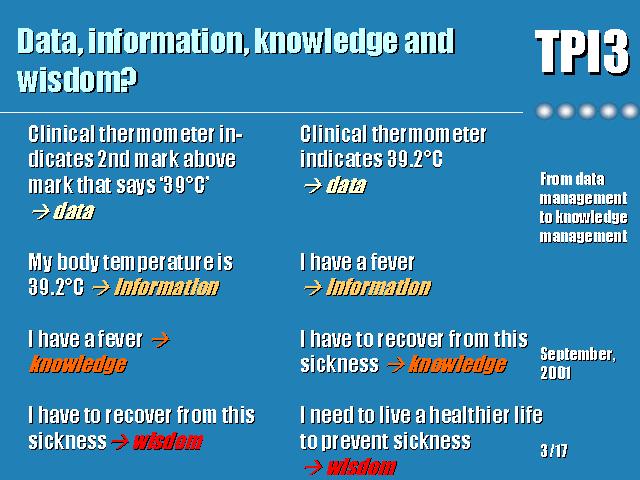
One cannot talk about Information Technology without first addressing what Information really is. Thus, this lecture focusses on addressing the differences between Data, Information, Knowledge, and Wisdom. There are a number of differing opinions on what each of these concepts are. What I hope to do is cover some of these varying theories in an attempt to address these concepts.
According to Russel Ackoff, who is a systems theorist and professor of organizational change, the content of the human mind can be classified into 5 categories:
1. Data
Data are symbols, numbers, characters, images, or any other method
of recording, in a form which can be assessed by a human or especially
input into a computer, stored and processed there, or transmitted on some
digital channel. Computers nearly always represent data in binary.
Data is raw. It simply exists and has no significance beyond its
existence in and of itself. It can exist in many forms, usable or
not. It does not have meaning of itself.
2. Information
Information is data that are processed to be useful. It provides
answers to questions such as "who", "what", "where", and "when".
In a sense, information is data that has been given meaning by way of relational
connection. The "meaning" can be useful, but does not necessarily
have to be so.
3. Knowledge
Knowledge can be thought of as application of data and information.
It provides answers to "how" questions. It is the appropriate collection
of information, such that it's intent is to be useful. When someone
"memorizes" information (as less aspiring test bound students often do),
then they have amassed knowledge. This knowledge has useful meaning
to them, but it does not provide for, in and of itself, an integration
such as would infer further knowledge. For example, an elementary
school child memorizes or amasses knowledge of the "times table".
They can thus tell you that "2 x 2 = 4" because they have amassed that
knowledge as it is included in the times table. But if you ask the
child the answer to "234 x 2134", they cannot respond correctly as the
answer, or entry, is not in their times table. In order to correctly
answer such a question, one requires a true cognitive and analytical ability
that is only encompassed in the next level, i.e. understanding.
4. Understanding
Understanding is the process by which one can take knowledge and synthesize
new knowledge from previously held knowledge. It is an appreciation
of "why". The difference between understanding and knowledge is the
difference between "learning" and "memorizing". Those who have understanding
can undertake useful actions because they ca synthesize new knowledge,
or in some cases, at least new information, from what is previously known
(and understood), i.e. understanding can build upon currently held information,
knowledge, and understanding itself.
5. Wisdom
Wisdom can be considered evaluated understanding. Wisdom calls
upon all previous levels of consciousness, and specifically upon special
types of human programming (moral, ethical codes, etc.). It beckons
to give us understanding about which there has previously been no understanding,
and in doing so, goes far beyond understanding itself. It is the
essence of philosophical probing. Unlike the previous levels, it
asks questions to which there is no easily achievable answer, and in some
cases, to which there can be no humanly known answer. Wisdom is thus
the process by which we also discern, or judge, between right and wrong,
good and bad. It is believed that wisdom is a uniquely human state,
and computers do not have, or will never have, the ability to posses wisdom.
Ackoff believes that the first four categories relate to the past; they deal with what has been or what is known. Only the fifth category, wisdom, deals with the future as it incorporates vision and design. With wisdom, people can create the future rather than just grasping the present and past. But achieving wisdom isn't easy; people must move successively through the other categories.
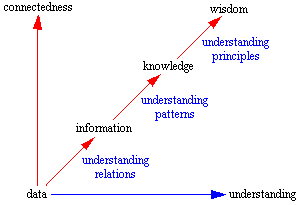
Other theories state that the sequence is less involved that the one described by Ackoff. One theory states that the transition moves from data, to information, to knowledge, and finally to wisdom, and understanding supports the transition from each stage to the next, and not a separate level of its own. The following diagram represents this less involved sequence:
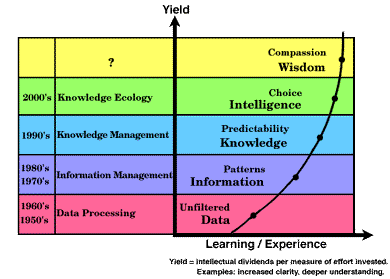
The following graph gives another interpretation on the transition from data to wisdom. Note that in this diagram, intelligence is on a separate level of its own.
Examples:
The following examples use the sequence Data, Information, Knowledge, Wisdom.
Example 1:
Data represents a fact or statement of event without relation to other
things.
E.g. It is raining.
Information embodies the understanding of a relationship of some sort,
possibly cause and effect.
E.g. The temperature dropped 15 degrees and then it started raining.
Knowledge represents a pattern that connects and generally provides
a high level of predictability such as what is described or what will happen
next.
E.g. If the humidity is very high and the temperature drops substantially
the atmosphere is often unlikely to be able to hold the moisture so it
rains.
Wisdom embodies more of an understanding of fundamental principles embodied
within the knowledge that are essentially the basis for the knowledge being
what it is.
E.g. It rains because it rains. And this encompasses an understanding
of all the interactions that happen between raining, evaporation, air currents,
temperature gradients, changes, raining.
Example 2:
1234567.89 is data.
"Your bank balance has jumped 8087% to $1234567.89." is information.
"Nobody owes me that much money." is knowledge.
"I'd better talk to the bank before I spend it, because of what has happened to other people." is wisdom.
Example 3: