The following is a brief overview of some important IT revolutions that have occurred throughout history. Note: much of the material in this document is taken from the book The Age of Information by Stephen Saxby. I hate to plagiarize material, but unfortunately this was the only way I could get the information out to everyone as quickly as possible. I'll try to fix it up when I get a chance. Other sources includes web pages from the Internet. The pictures are the same ones used in the PowerPoint presentation I showed in class.
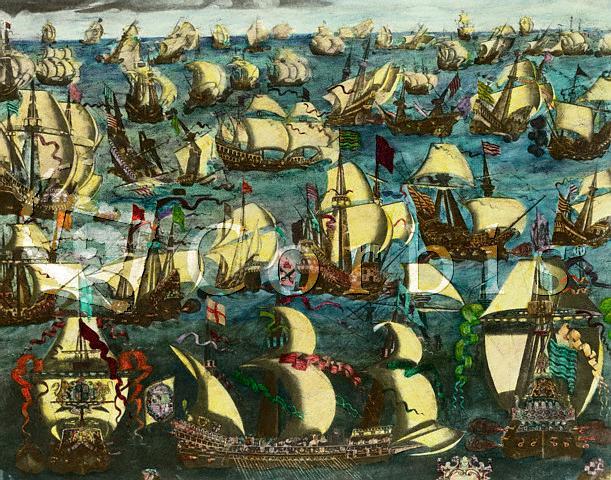
In the latter part of the 16th century, Spain was the major international power and either ruled, colonized, or exercised influence over much of the known world. Spanish power was at it's height and Spain's leader, King Phillip II, pledged to conquer the Protestant heretics in England and convert them to the Church of Rome. King Phillip had other reasons for conquering England. He held personal animosities towards England's Queen Elizabeth. To accomplish the conquest of England, Phillip planned a two pronged attack. He would send his "Invincible Armada" of 125 ships into the English Channel where it would link up with the Duke of Parma in the Spanish Netherlands at Calais. The Armada would ferry the Duke's soldiers across the straight of Dover and these troops would march on London, seize the Queen, and proceed to conquer the entire country.
The Spanish Armada, under the command of the Duke of Medina Sedonia, sailed from Portugal in late May of 1588 heading for the British Isles. It reached the South West coast of England on July 19 and was shortly thereafter challenged by the English fleet commanded by Lord Howard and Francis Drake. The English vessels, avoiding close-in combat as the Spanish desired, hung on to the flanks of the Spanish ships as they sailed up the English Channel. The English harassed the Spanish in every way possible, doing much damage, until the Armada anchored at Calais. Here the Duke of Parma failed to show up and as a result the English saw an opportunity to attack the Spanish fleet. On July 28, 1588 the English used fire-ships to scatter the Spanish ships. On July 29 at the pivotal Battle of Gravelines an 8 hour struggle ended with many Spanish ships lost or damaged.
The Spanish Commander, the Duke of Medina Sedonia, found himself in danger of total defeat and made a fateful decision to forego the invasion and return to Spain via the North of Scotland and Ireland. For three days the English fleet pursued the Spanish into the North Sea then returned to England when they ran out of ammunition. The Spanish fleet fared disastrously rounding the coast of Scotland. Many Armada ships were wrecked by storms off the coast of Scotland and Ireland and the surviving Spanish ships limped back to Spain totally defeated and demoralized.
The defeat of the Spanish Armada marked the turning point between the era of Spanish world domination and the rise of Britain to the position of international supremacy. Thus this battle began the decline of Spain and the ascent of Britain -- a sea change event. (Adapted from http://www.historybuff.com/library/refspain.html).
The Commander of the Spanish Armada must have known the value of accurate information and the consequences of the lack of it when required. It was a failure of communication between himself and his land forces, lack of local knowledge about tidal movements in the channel and the failure on the part of the designers of the Spanish artillery to obtain information about the time it took to reload and re-position heavy guns during battle, compared with the performance of the smaller and more responsive artillery of the British forces, that ultimately cost him the campaign. (Adapted from The Age of Information, by Stephen Saxby.)
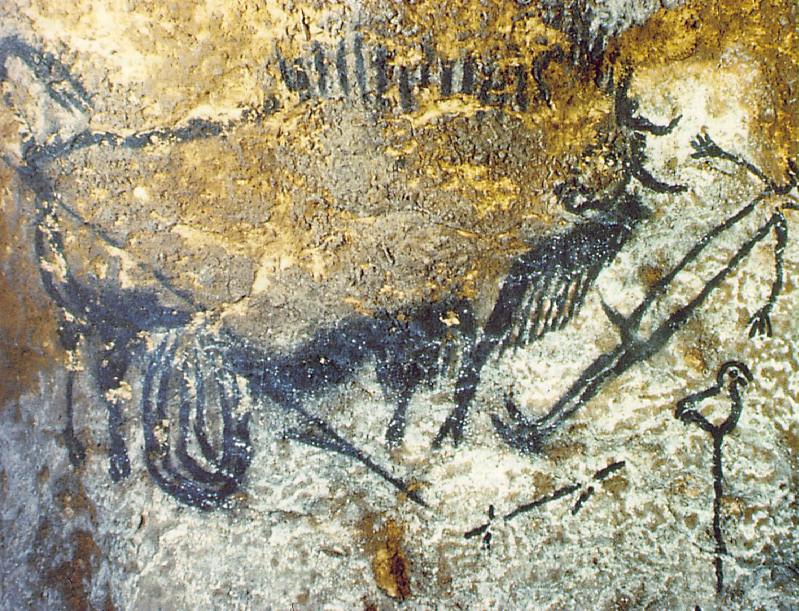
The technologies of communication and record have been developing since the very earliest of times. Man has always attempted to communicate his thoughts and ideas. Man discovered the techniques of storing information through painting. Some of the earliest paintings recorded are those of c.20,000 BC in the caves of Altamira in the Santander province of Spain. In Lascaux, in France, is a cave painting of a hunter gored by a wounded buffalo (above picture), the author no doubt intent upon recording the event.
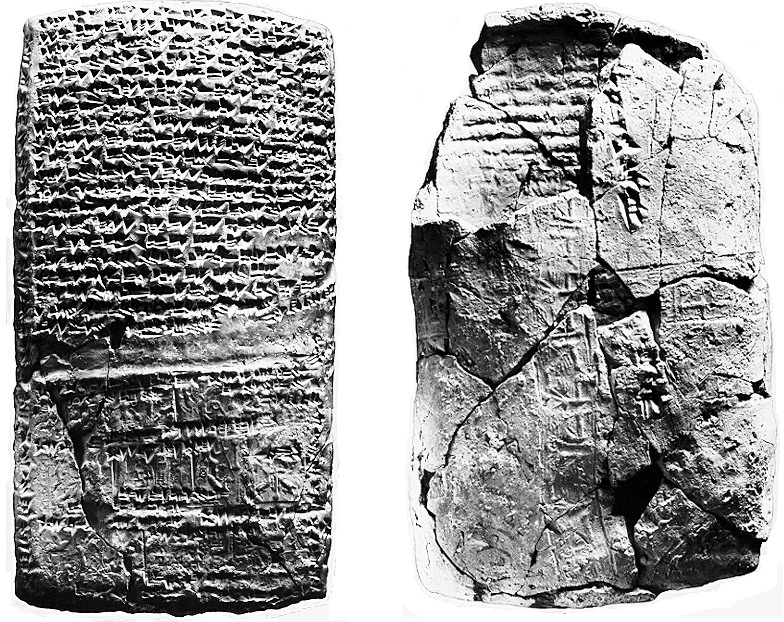
Although man took his inscriptions from the cave walls to other media such as wood and stone, cuneiform writing of wedge-shaped characters (above picture) did not appear until c.4000 BC. The first surviving example is that of the temple archives of Sumerian Erech, contained on a set of tables dating from c.3500 BC. Sumer was the southern part of ancient Mesopotamia and the Sumerians who lived there from c.5000 BC are regarded as one of the oldest known civilizations in the world. Later, in the same region, the Babylonians and subsequently the Hittites and the Egyptians developed the art upon clay. The Egyptians developed more rapid styles of writing just as computer design today looks for better and more efficient methods of data storage than before.
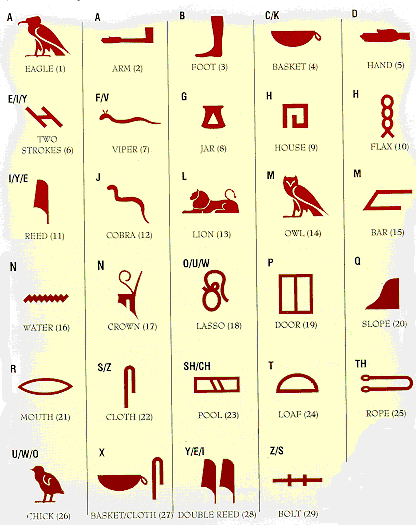
A primitive alphabet was in use possibly as early as c.2000 BC among a Semitic people in communication with Egypt. It is also known that an alphabet, similar in character to the Arabic was used in Ugarit on the north coast of Syria prior to c.1300 BC. The ancestor to the alphabet used today in most Indo-European and Semitic languages is the Phoenician alphabet. That alphabet spread with trade and colonization as the Phoenician people spread from land between the Lebanon and the Mediterranean and from the cities of Tyre and Sidon to places as far afield as Carthage, Cornwall and the Scilly Isles. The alphabet is to language as binary code is to computing. The construction of language and of words proliferated as a result of this powerful and flexible instrument of communication.
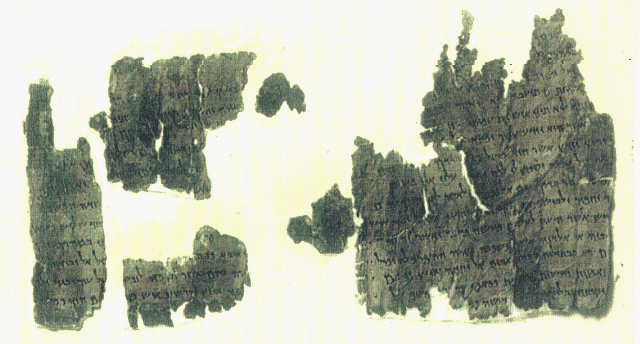
To spread writing required a more suitable media than the walls, tablets and clays of earlier times. The first step forward towards the recording of information on paper came with the use of parchment, first made in Pergamum in Asia Minor c.250 BC. The Dead Sea Scrolls (above picture), discovered by a Bedouin in 1947 in a hillside cave near the north end of the Dead Sea, have been dated c.200 BC-100 AD. Parchment was used in Europe first of all in the employ of the Church and later on for public legal documents. Just as the producers of today's information technology face pressures to reduce the cost of data storage in computers, similar concerns existed in relation to parchment. Two hundred pages of parchment - enough to compile a reasonably sized book, required the skins of 12 sheep; the cost of writing in terms of subsistence and rewards for the author was considerably less than the costs associated with the medium which carried the work.
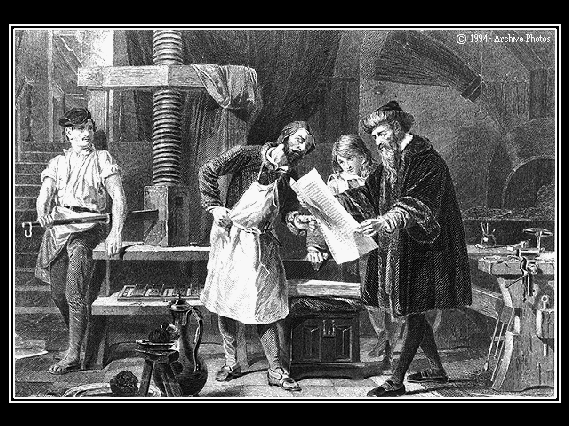
It was not until paper was discovered in the West that any tangible progress could be made in the dissemination of works that was to come eventually with printing. The introduction of mechanization into the process of recording the writings of authors was to come in c.1455 with the invention of the printing press. What had happened up to this point was the evolution, first, of a method by which one person could communicate to another through the techniques of language by means of speech and, second, of media that could hold and carry information in ever more detail to a wider and wider audience using pictures, then pictographic symbols and finally the linear signs which ultimately formed an alphabet. In contrast with the rudimentary forms of sharing and recording information that early man had mastered, a code and a method of communication of that code had emerged, transcending space and time as between the originator and recipient of the information fixed in the work. With the advent of printing, information was about to be made available in such amounts and to such numbers as to be orders of magnitude beyond what had gone before.
When Johannes Gutenberg began building his press in 1436, he was unlikely to have realized that he was giving birth to an art form which would take center stage in the social and industrial revolutions which followed. The most important aspect of his invention was that it was the first form of printing to use movable type. Although Laurence Koster of Haarlem also laid claim to the invention, scholars have generally accepted Gutenberg as the father of modern printing. A further claim that movable type was used in China as early as 1041 is undisputed. However, the Chinese type were made of clay (unlike Gutenberg's which were cast in metal), they comprised only oriental characters and their methods of application differed. Before Gutenberg's innovation, most books were produced by and for the Church using the process of wood engraving. This required the craftsman to cut away the background, leaving the area to be printed raised. This process applied to both text and illustrations and was extremely time-consuming. When a page was complete, often comprising a number of blocks joined together, it would be inked and a sheet of paper was then pressed over it for an imprint. The susceptibility of wood to the elements gave such blocks a limited life span. But metal type changed all this and in 1455 what is know as the 42 Line Bible (also known as the Gutenberg Bible) was published in Mainz. It is considered to have been the first substantial publication and took Gutenberg fully two years to complete. In the same year his financier Johann Fust, foreclosed on their agreements and Gutenberg lost his press and other equipment, although he is believed to have re-equipped himself soon afterwards. (Adapted from http://www.dotprint.com/fgen/history1.htm.)
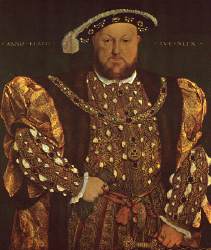
Henry VIII (1509-47) could see the benefits as well as the dangers of printing, and while using it to promote his own causes against the Roman Catholic Church, he found it necessary to protect his position through censorship. The issue of freedom of access to information, the regulation of international trade in books and the licensing and watchdog mechanisms subsequently imposed cause much controversy. Henry VIII and later Charles II introduced strict controls on the availability of books unless they had been officially sanctioned. The import of information into the country through books and pamphlets, etc., was also suppressed, unless it too met with official approval. Printers and printing presses were tightly regulated and a press censor with enforcement powers was appointed to monitor compliance with these conditions. Today, we can see the parallel of these measures in the controls imposed upon requests by individuals to have access to certain types of computer stored information, particularly that held on government computers. A further illustration of this comparison can be seen in the protectionist policies of some countries who seek to sustain their domestic data processing industry against foreign competition.
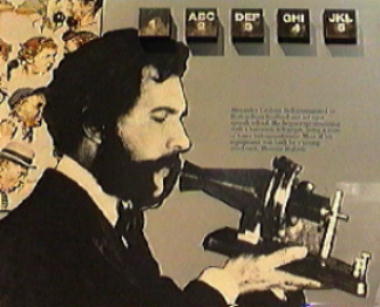
The possibility of being able to transmit speech, as opposed to printed messages by wire, had certainly been visualized by a few people by the time Alexander Graham Bell, a Scottish emigrant to Ontario, Canada, patented the invention on March 7, 1876. Three days later, the first coherent words: 'Mr. Watson, come here', were spoken down the 'telephone line'. Bell's invention made possible the long distance transmission of sound, as opposed to wired messages. A year after Bell's initial public demonstration of his invention, he placed the world's first phone call over telegraph wires between two towns in Ontario, Canada - a span of eight miles. Just two months later, the long-distance reach of telephone technology was expanded to 143 miles. Today, of course, telephone calls may be placed to virtually any location around the globe. (Adapted from http://web.mit.edu/invent/www/inventorsA-H/graham_bell.html.)
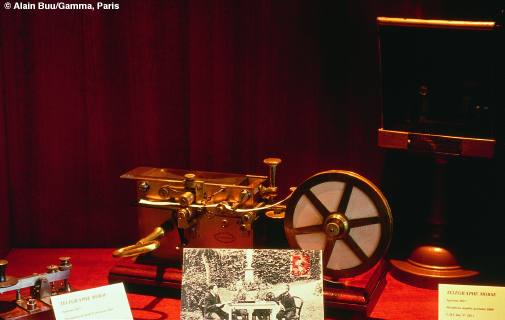
'Wireless telegraphy' was soon used to transmit information across air waves. Perhaps the most famous event prior to the outbreak of war, as far as radio is concerned, was its use in July 1910 to apprehend the murderer Dr. Crippen who had taken flight on board the liner 'Montrose', one of the the first ships to acquire a ship-to-shore radio. The Captain, having recognized Crippen, alerted Scotland Yard who sent an officer on a fast vessel, the 'Laurentic', to overtake 'Montrose' and arrest Crippen and his accomplice Ethel le Neve. This did much to publicize the new medium. Morse code was used as the language of radio communication. By the outbreak of World War I many very powerful stations had been set up around the world. During the War the Post Office created direction finding stations to locate enemy transmitter and aircraft. It was not until after the war that music and speech began to be heard regularly over the airwaves.
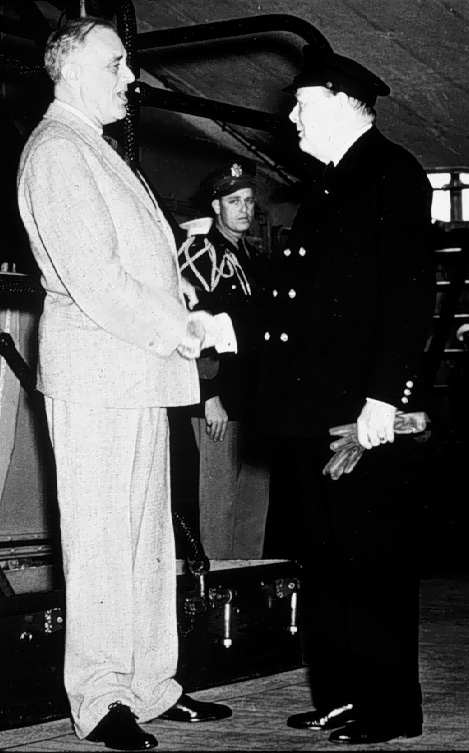
In 1944, President Franklin D. Roosevelt and Prime Minister Winston
Churchill were able to safely plan strategies across the Atlantic over
radiotelephone. Using digitally encoded speech, Churchill and Roosevelt
could talk without having to worry about Nazi listening posts eavesdropping
on their conversation and strategies. One can only imagine the outcome
in history if these two great leaders were unable to communicate as they
had, but instead had to rely on written letters.