Nepal is a
beautiful and small country existing in the big continent of Asia.
It is located in between the latitude of 260 22' north to 300 27
north and longitude 800 4' east to 880 12' east and elevations
ranges from 90 to 8848 meters. The average length being 885 km. east
to west and average breadth is about 193 km north to south. Nepal is
a land locked country encircled by two most popular countries of the
world, India in the east, west and south and China in north. It has
total area of 147,181 sqr. km. and occupies o.03% of the total land
of the world and o.3% of Asia subcontinent. It is inhabited by 22
million people of more than 60 caste and ethnic groups
Nepal has
been divided into there geographical regions from north to south.
The northern range is covered with stone over the year and is called
mountain region (Himalayas). Mount Everest, the highest peak of the
world stands in this region.
|
Mountains of Nepal 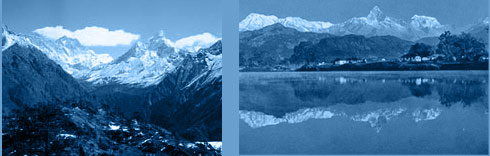
|
|
S.No. |
Name of the Peaks |
Height of the Peak in Meter |
|---|---|---|
|
1 |
Mount Everest
Sagarmatha (The head of the sea) |
8848 |
|
2 |
Mount
Kanchanjangha (The third highest peak of the world and the second highest in the country.) |
8586 |
|
3 |
Mount
Lhotse |
8516 |
|
4 |
Mount
Makalu |
8463 |
|
5 |
Mount Choyoyu
|
8201 |
|
6 |
Mount
Dhawalagiri |
8167 |
|
7 |
Mount Manaslu
|
8163 |
|
8 |
Mount
Annapurna |
8091 |
|
9 |
Mount
Gaurishankar |
7134 |
|
10 |
Mount
Machhapuchre (Fish tail) Virgin Mountain in term of
expedition) |
6996 |
The mountain region
occupies a total area of 15% of the land of the country. South of the
mountain region is called Hilly region. Its height varies from 600 to 5000
meter from the sea. Its breath is 75 to 125 km from north to south. It
occupies a total land of 68% of the country. This part of land captures
hill, valley and lakes. Kathmandu, the capital of the kingdom, lies in
this region. It is also one of the big valleys of Nepal. The southern part
of the hill region is called Terai or low land. The average height of this
region is 200 meter from sea level. Its breath is 25 to 30 km from north
to south. It occupies a total area of 17% of the country. This region is
the gangeitic plain of alluvial soil and consists of dense forest area,
national parks, wildlife reserves and conservation areas. King Janak, the
philosopher king and the father of Sita, the heroin of Ramayan, Sita the
ancient epic, and Buddha, the light of Asia, were born in this part of
Nepal. Terai is also called the granary of Nepal. This country has nearly
6,000 rivers and rivulets and prominent among them are Kosi, Gandaki,
Karnali, Mechi, Mahakali, Bagmati, Rapti etc. The major lakes of Nepal are
Mahendra Tal also called Rara Daha, Phewa Tal, Shey Phoksundo Tal, Roopa
Tal (at the highest altitude in the world). The main Glaciers of this
country are Mahalangur, Kumbhakarna, Kanchanjangha, Khumbu, Langtang and
Machcha puchchare.
The major export commodities are woollen carpet,
cotton readymade garments, pulses, hide and skins, niggerseeds, gold and
silver ware and ornament. twines, toothpaste, polyester yarn, Cardamom,
noodles, ginger, rice bran oil. Regarding the economic growth of the
country, Nepal in figures 1989 mentions. "Economic growth of the country
has not improved markedly over time to over take population growth. As the
current population growth is 2.3 per cent per annum, growing population
has concealed the gain achieved by developmental activities. Little over
half (57%) of the population of working age reported economically active
in 1991 and among them 81 per cent were engaged in agricultural
activities. In the development scale, Human development index (HDI)
computed for Nepal for year 1996 is 0.378(HDI lies between 0 and 1). This
value is only 45% of the World average. Among the districts, Kathmandu
possesses the highest (0.603) HDI and Mugu the least (0.147) in the same
year. Contributions of non-agricultural activities are gradually
increasing in the GDP.
Nepalese currency (Nepal's Rupee) is circulated
throughout the Kingdom.
Go
to Top
History of Nepal
The existence of Nepal
as an independent country is found in the ancient text Athrab Parisist
written in 800-600 B.C. Neep Tribe of Gopal (Cowherd) established the
monarchical system in their own way of governing the kingdom. The name of
this country as Nepal is derived from the word Nep. Actually, Nepal is the
combination of two words 'Ne' and 'Pal'. It means the place (pal) where Ne
(Nep tribe) lives. However, there are so many controversies regarding the
origin of the word Nepal. But no one can deny the fact that the origin of
word Nepal is as old as the history of human civilization. Daniel Wright,
a British Surgeon in British Residence, writes that eight Gopala rulers
ruled this kingdom for 521 years. Gopal were replaced by Kirata tribe.
Twentynine Kirate kings ruled Nepal for 1118 years, Gasti, the last king
of kirata, was overthrown by Lichhavi tribe. The first inscription with
the name of the king Mandeva and date 386 (464 c) was found in front of
the Temple of Changunarayan near Bhaktapur. The name of three kings as
Brishadeva, Shankaradeva, Dharmadeva and Mandeva are inscribed in the
pillar inscription of Changunarayan. Many famous kings ruled in this
period of history. That is why the period was called "Golden Age" in the
ancient history of Nepal. Amsuvarma was the most famous king of the
Lichchavi Period of Nepal. He constructed big palace called Kailashkut
Bhawan. He used to rule from that palace. He composed a book entitled
"Shawbda Vidhy". (Learning of word). He was also popular in India. Yuan
Chawang, the Chinese pilgrim, praised the work of Amsuvarma. Bhrikuti, the
Lichchavi Princess spread Buddhism in Tibet and China.
Lichhavis were
overthrown by Malla Kings. This period is called medieval period in
Nepalese history. This period starts with 880 CE and ended after the
unification of Nepal in 1768. Ari Malla is regarded as the first Malla
king of Nepal. Nepal was divided into a small principalities after the
death of Yakcha Malla. Malla period in Nepalese history is famous for the
preservation of art, architecture, culture and literature. Many wooden and
stone palaces can be seen in Kathmandu valley as a historical monuments of
Malla Kings. Pratap Malla used to compose poem, song and drama and played
for the entertainment of his subjects. He was a good dancer of his time.
He had constructed a big pond called Rani Pokhari in the heart of the city
in memory of his dead son and to console his wife.
|
| |
|
|
Hanuman
Dhoka:The gate of
monkey god called Hanuman Dhoka and other temples were the creation
of the King Pratap Malla. Jaya Prakash Malla in Kantipur,
Tejnarsingh Mall is Patan and Ranjeet Malla in Bhaktapur were the
last Malla kings of the three independent kingdoms of Kathmandu
valley. |
|
Prithivinarayan Shah, the founder of modern Nepal
unified small principalities into a big nation. His work was
completed by his sons Pratap Singh Shah and Bahadur Shah. Rajendra
Laxmi Devi, the queen mother, had also made great contribution in
the task of unification after the death of her husband Pratap Singh
Shah. She was also expert in horse riding. She used to ride horse
with a sword in her hand on the street of Kathmandu. Nepal had to
fight with big China and Tibet in 1792 and 1855, Bhimsen Thapa, the
prime Minister of Nepal tried to expand this country. The territory
of Nepal reached up to Tista river in the east and south in the
west. Autocratic family of Ranas rule was established by Jung
Bahadur Rana as a Prime Minister after Kot massacre of 1846 and Rana
rule continued up till 1950. Ten Rana Prime Ministers ruled for over
104 years. Mohan Shamsher was the last Rana prime minister of Nepal.
The Ranas were overthrown by the people movement under the guidance
of King Tribhuvan Bir Bikram Shah Dev, the father of the nation.
Many martyrs such as Ganga lal, Dharmabhakta, Dashrath Chand, Sukra
Raj Shastri Sacrificed their lives for the cause of
democracy. | |
|
Jung
Bahadur was the first Nepalese Prime Minister to visit England.
He introduced civil code after his return from
England. |
|
|
His Late Majesty King Birendra Bir Bikram Shah Dev and his family members were killed in Royal massacre in 2001 and his brother His Majesty the King Gyanendra Bir Bikram Shah Dev is ruling the kingdom of Nepal as the 12th King of Shah dynasty under constitutional monarchy. His Majesty has assured the people that His Majesty would follow the footprint of his elder brother His Majesty the King Birendra Bir Bikram Shah Deva and adhere all the norms and values of democratic exercises. The Nepalese People are enjoying Democratic Right under multiparty system. People exercise right of adult franchise. The Executive, Legislative and Judiciary function and exercise their right independently but there is also a check and balance in their functioning. There is two tier system of legislation one upper house called Rastria Sabha consists of 60 members and other is Lower House called Pratinidhi Sabha has 205 members elected from different constituency distributed in 75 district of the country. Majority party in Lower House forms the Government and Parliamentary party elects its leader as Prime Minister. Prime Minister heads the government. For administrative purpose the country has been divided into five development regions, fourteen zones, and seventy-five Districts. Districts are divided into smaller units called village Development committee and Municipality. There are 3913 village Development Committees (VDC) and 58 Municipalities in the country. Each VDC has nine wards and Municipalities ward varies from 9 to 35 on the basis of the size and population. | |
|
!Home!
|
|
!Feedback!
|
!Quiz!
|
!News!
|
!E-pal!
|
!Jokes!
|
!Photo!
|
