Filfla is a nature reserve and landing on it is not permitted. Permission to land is granted to bona-fide scientists only.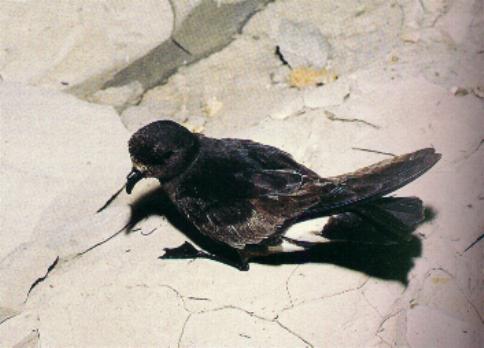
(Hydrobates pelagicus - photo. John J. Borg)
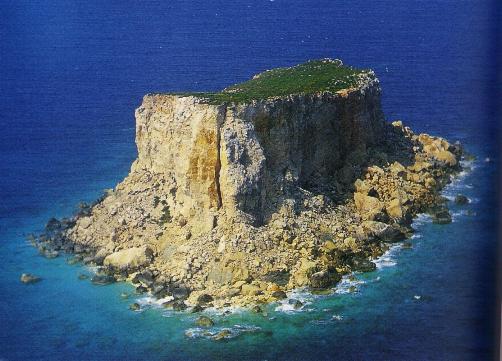
Floating lonely about 5km off the southern coast of Malta, lies Filfla. This island once formed part of the mainland, but a geological fault brought it to it's present island form. Filfla has a surface area of 2.5 hectares, nearly 800 metres in circumference. The 60m high cliffs end up at the top, forming a sort of plateau. The honey-combed rocks of its coastline blend with the startification of the grey cliffs. Over the past two hundred years, the island has undergone a lot of changes in its contours, mainly due to continuous bombing. For over two hundred years, the Turks, French, Dutch, British and American forces bombed the island. When seen from the air, the islet resembles an aircraft carrier, this made it ideal as an airborne bombing target. After several years of protests by Birdlife Malta, the Zurrieq Civic Council and other NGO's in the 1970's finally managed to stop the bombing.
A small chapel dedicated to the Assumption of Our Lady, was built inside a small cave in 1343. Every Sunday, mass was held for the fisherfolks, fishing around Filfla. The Chapel was destroyed in 1856 after an earthquake rocked the Maltese Islands.
The islet is quite and remote. Berthing a boat is extremely dangerous, mainly due to loose rocks and boulders, and the countless unexploded bombs that litter the island.
It has been established that the name Filfla is the noun of filfel, the Arabic name for pepper-seed. It is probable that the islet resembled a pepper-seed in shape or else, pepper used to grow on it in by-gone days.
Isolated from the mainland, Filfla holds a unique and very important eco-system. A number of endemics (Flora and Fauna)thrive there. Filfla is barren, there are no trees, but a variety of shrubs and plants managed to take root. Suaeda vera is the dominant plant, while an Allium species, not yet described by science, grows profusely on the top part. Capers and other salt resistant plants complete the flora of the island.
Insect life also abounds and one can find; ants, flies and moths. Spiders and scorpions are also present.
Due to isolation, Filfla produced an interesting variety of animal species. In the Maltese Islands we find one species of Wall Lizard (Podarcis filfolensis), Filfla hosts the nominate race which is larger than the others found on the other islands. It is black in colour with various blue and green spots. A top snail Helicella spratti var. despotti is endemic to Filfla. A cricket and a beetle found also on Filfla, both have a limited distribution on the Maltese Islands.
The most important animal group found on Filfla belong to the avian family, particularly the seabirds. No less than four species have been found breeding on Filfla. The largest is the Yellow-Legged Gull Larus cachinnans, nesting mainly on the top of the island. Some 150 pairs nest on Filfla. The birds start arriving in December and breeding starts in March, where two to three eggs are laid in a shallow nest on the ground. The members of the Procellariidae have been found breeding on Filfla; Cory's Shearwater Calonectris diomedea, Levantine Shearwater
Filfla is a nature reserve and landing on it is not permitted. Permission to land is granted to bona-fide scientists only.
(Hydrobates pelagicus - photo. John J. Borg)

