Metro, Sydney Morning Herald, 20 October 1995
return to article list
HERE
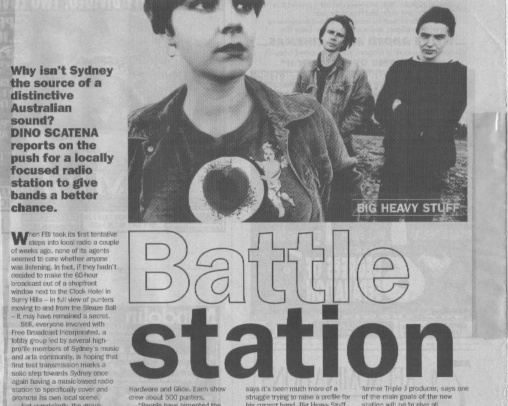
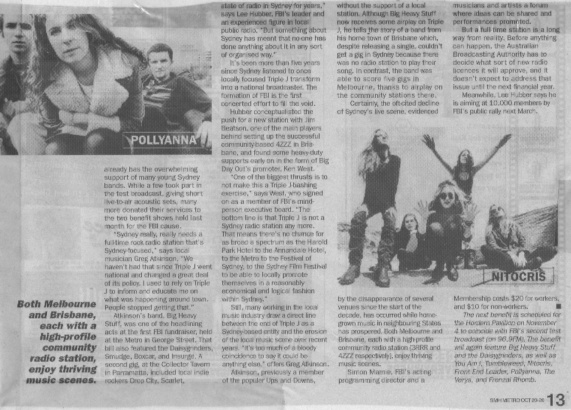
BATTLE STATION When FBI took its first tentative steps into local radio a couple of weeks ago, none of its agents seemed to care whether anyone was listening. In fact, if they hadn't decided to make the 60-hour broadcast out of a shop-front window next to the Clock Hotel in Surry Hills -- in full view of punters moving to and from the Sleaze Ball -- it may have remained a secret. Still, everyone involved with Free Broadcast Incorporated, a lobby group led by several high-profile members of Sydney's music and arts community, is hoping that first test transmission marks a solid step towards Sydney once again having a music-based radio station to specifically cover and promote its own local scene. Not surprisingly, the group already has the overwhelming support of many young Sydney bands. While a few took part in the test broadcast, giving short live-to-air acoustic sets, many more donated their services to the two benefit shows held last month for the FBI cause. "Sydney really, really needs a full-time rock radio station that's Sydney-focused," says local musician Greg Atkinson. "We haven't had that since Triple J went national and changed a great deal of its policy. I used to rely on Triple J to inform and educate me on what was happening around town. People stopped getting that." Atkinson's band, Big Heavy Stuff, was one of the headlining acts at the first FBI fundraiser, held at the Metro in George Street. That bill also featured the Daisygrinders, Smudge, Boxcar, and lnsurge. A second gig, at the Collector Tavern in Parramatta, included local indie rockers Drop City, Scarlet, Hardware and Glide. Each show drew about 500 punters. "People have lamented the state of radio in Sydney for years,' says Lee Hubber, FBI's leader and an experienced figure in local public radio. �But something about Sydney has meant that no-one has done anything about it in any sort of organised way." It's been more than five years since Sydney listened to the once locally-focused Triple J transform into a national broadcaster. The formation of FBI is the first concerted effort to fill the void. Hubber conceptualised the push for a new station with Jim Beatson, one of the main players behind setting up the successful community-based 4ZZZ in Brisbane, and found some heavy-duty supports early on in the form of Big Day Out's promoter, Ken West. "One of the biggest thrusts is to not make this a Triple J-bashing exercise," says West, who signed on as a member of FBI's executive board. "The bottom line is that Triple J is not a Sydney radio station any more. That means there's no chance for as broad a spectrum as the Harold Park Hotel to the Annandale Hotel, to the Metro to the Festival of Sydney, to the Sydney Film Festival to be able to locally promote themselves in a reasonably economical and logical fashion within Sydney." Still, many working in the local music industry draw a direct line between the end of Triple J as a Sydney-based entity and the erosion of the local music scene over recent years. "It's too much of a bloody coincidence to say it could be anything else," offers Greg Atkinson. Atkinson, previously a member of the popular Ups and Downs, says it's been much more of a struggle trying to raise a profile for his current band, Big Heavy Stuff, without the support of a local station. Although Big Heavy Stuff now receives some airplay on Triple J, he tells the story of a band from his home town of Brisbane which, despite releasing a single, couldn't get a gig in Sydney because there was no radio station to play their song. In contrast, the band was able to score five gigs in Melbourne, thanks to airplay on the community stations there. Certainly, the oft-cited decline of Sydney's live scene, evidenced by the disappearance of several venues since the start of the decade, had occurred while homegrown music in neighbouring states has prospered. Both Melbourne and Brisbane, each with its own high-profile community radio station (3RRR and 4ZZZ respectively) enjoy thriving music scenes. Simon Marnie, FBI�s acting program director and former Triple J producer, says one of the main goals of the new station will be to give all musicians and performers a forum where ideas can be shared and performances promoted. But a full-time station is a long way from reality. Before anything can happen, the Australian Broadcasting Authority has to decide what sort of new radio licenses it will approve, and it doesn't expect to address that issue until the next financial year. Meanwhile, Lee Hubber says he is aiming at 10,000 members by FBI's public rally next March. Membership costs $20 for workers, $10 for non-workers.