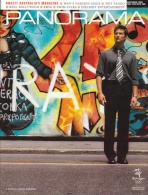
"Eau de Dino", published in Panorama (Sydney), September 1999.
RETURN TO ARTICLE LAYOUT HERE
THERE IS A BUNCH OF STRANGERS smelling me. Not polite, discreet little sniffs but huge, nostril-flared whiffs. And they're not stopping. You'd think this would feel a bit intimidating, but quite the opposite: it's exhilarating, intoxicating. "Smell me! Smell me!" I'm thinking, a dumb grin of near-ecstasy on my face. "Breathe me in, my friends!" Everyone else is smiling too. You see, it's not actually me they're smelling, it's the essence of me. An enhanced, chemical-based reconstruction. It's called, naturally enough, Eau de Dino. We're standing in the Sydney branch of Givaudan Roure, one of the world's top scent and flavour houses. We're here because, frankly, I was in need of a new scent. It's not that I stink, at least 1 hope not, it's just that I want a unique odour that shouts out "Me!" without saying a word, a waft that states, "I'm here!" even after I've left. After all, why should Joan Collins have all the fun? It was only a week ago that I first visited Givaudan Roure. A week isn't a long time to come up with a fragrance. For instance, when Michael Jordan went through this process, he had a panel select the five most significant moments in his life, they then went away and produced perfumes that would remind him of those memories, combining elements of each for the final product. That took months. I don't have that sort of time. And Mike's got a few more bucks than me too. THE NOSE THAT KNOWS It was here in the so-called Fragrance Room that I was introduced to Lewis Calwell, the company's recently retired Senior Perfumer. As I listened to Calwell explain why this is a house of art, a factory of invisible dreams, two casually dressed women and a young, lab-coated biochemist on the other side of the table were silently taking turns poking their noses into various long locks of hair stuck to pieces of cardboard. This scene didn't surprise me much. After all, before coming here, my entire knowledge of the perfume business was based on what I'd soaked in from Perfume, Patrick Sukind's contemporary classic about a freak "nose" named Grenouille living in 18th-century France. That nose killed virgins to extract their scent. So I was prepared for the worst. "What you are doing with fragrance is painting pictures with odour,� explained Calwell, waving his arms around like an orchestra conductor. His slicked back snow-white hair and matching goatee make him look part too. "Perfumery is an art form. Very much an art form, like music and sculpture and paintings." Calwell, now 63, began his life as a perfumer while working for Givaudan as a cosmetic chemist back in 1963. One of his bosses suggested he take the standard odour aptitude test. As it turned out, the boy could really smell. Calwell was soon assigned as an apprentice to one the company's esteemed head perfumers. "It is not a training I would recommend to everybody," says Calwell. "For the first six months, all you are allowed to do is smell bottles and remember what they smell like and what their names are. In the next six months, you may be allowed to mix two things together. You work up an odour memory of perhaps 500 to 1000 ingredients, where you can name something by someone sticking a bottle under your nose." These days, all the world's aspiring perfumers go to the School Of Perfumery in Europe. The institute receives about 1000 applications a year but takes on only 100 students. Of those, two or three usually survive past the first year of the three-year course. ROOMS OF DELIGHT As you approach the door to the Fragrance Room of Givaudan Roure, you're suddenly hit by a saccharine-sweet tidal wave of odours, a mixed-up rainbow dancing among your nasal hair. Inside, the place glows like a candy shop. The shelves all around it are stacked with hundreds of bottles and small boxes made from the brightest colours. There's a shelf of top women's perfumes, another is dedicated to men's colognes. The rest of the things are mostly every day household items: soap, dish-washing powder, toilet cleaners. Anything that contains a manufactured odour. Down the hall from The Fragrance Room are the Creative Development Laboratories. One looks like the nerve centre of a tiny cottage soap industry. The other is filled with hundreds and hundreds of identical-sized specimen bottles, each with a French label and its own scent in its purest form. Calwell gives me a quick guided tour of the bottles. At different points around the room, he stops and provides a sample of some basic tools of his craft, piercing the odd liquid with a piece of pencil-shaped paper and shoving it under my nostrils. This must be one of the only places in the world where two grown men can stand less than a metre apart, stare into space sniffing bits of paper and not draw as much as a glance from passersby. Calwell gives me a whiff of some acetates (the fruity smells), amyris oils (natural woody scent), iris absolute ($20,000 a kilo) and musks. Then the more common scents. There's a strawberry extract. Close your eyes and you're sitting in the world's biggest strawberry patch. Of course, there's a rose extract, close your eyes and it's a florist's on Valentine's. Calwell hands me another piece of paper-seaweed extract. Yuk! It's disgusting. Calwell is laughing. "Smells like an animal has left something behind, doesn't it?" Calwell, a lifetime member of the British Society Of Perfumers -- he's one of only about 100 -- once spent days sitting by a swamp in Western Australia, sniffing boronias. Two years of work on that project saw the development of a synthetic boronia extract as well as the basis of a perfume named, as it would happen, "Boronia". He goes for another bottle. "Have you read a book called Perfume by Patrick Suskind?" he casually asks. Here we go, I think to myself. It had to come up some point, didn't it? "Yeah," I reply even more casually, wondering why he is smiling as thoughts of murdered virgins are racing through my head. Calwell hands me another one of those pencil papers. "I think this is what Grenouille was after.� I take a sniff, my pulse racing a little. It smells like human sweat. But enough of this silliness. Where's my Eau de Dino? DINO IN A BOTTLE A week later, we find ourselves back in The Fragrance Room. Calwell reiterates that building up a scent usually takes a couple of months' work, but he's jotted down some ideas and has a rough formula in his head. "Eau de Dino: intense youthful approach to life, shown in the complex hesperidic, cologne top notes," reads Calwell's notepad. "The middle, with its mossy, herbal nuances, tempered with the sophistication of natural absolutes, leads to a back note of sophisticated woods in line with the full city life." Shucks, Calwell's kind words almost make me forgive him for that animal wee-wee incident last week. We move back into one of the Creative Development Laboratories. Calwell has already mixed up the three main notes. They're sitting there in front of us in separate bottles. Individually, they're all a little overwhelming. "Could all the subtle shades of Dino possibly exist somewhere in these stinky things?" I ask myself The resident young biochemist starts mixing them together, following Calwell's instructions to a T: Six grams here, three there. "This is one of the big things that a perfumer tries to do in his creation," says Calwell, eyes fixed on the young man in the lab coat. "That two and two make five. That putting this one with this one, the result is better than the individuals themselves. A good perfume is good synergy." There's no lightning, Calwell doesn't have his arms reaching for the heavens raving "Give it life! Give it life!" But suddenly there's a new crispness in the air. Calwell turns around holding a little glass beaker. "There it is," he smiles. "Something that's never been done before." He takes a couple of sniffs. "It's quite nice. I'm quite happy with that." Calwell hands it to me. Sniff-sniff. Nice? Lewis, it's the most wonderful thing I've ever smelled in my entire life! There's a hint of citrus when it first strikes you, but then it opens up to something much deeper, more earthy. That's the woody bit, right Lewis? Oh, it's just beautiful! The biochemist mixes a few drops from the test-tube in with alcohol, puts it into a lovely little atomiser. It's finally here: Dino The Cologne. I spray it all over. Calwell calls some of his colleagues in for a sniff. They all love it. They say things like, "It's great, it reminds me a little bit of such-and-such." Then the conversation takes an unexpectedly bizarre twist, and suddenly everyone is debating the unisex merits of Dino. "What the hell is going on?" I scream in silence. "It's all man! It's all man!" But since then, my girlfriend has taken to wearing Eau de Dino too. I was a bit taken aback by that at first, but now I like it, lots. I only wish I could share Dino with the whole world, but she wouldn't be too happy with that. Dino Scatena�s plans to market Eau de Dino have been stalled by PR�s insistence on a catchier label, and his refusal to change his name to Elle.