The Daily Telegraph, Sydney, 27 March 2002
return to news articles list
HERE
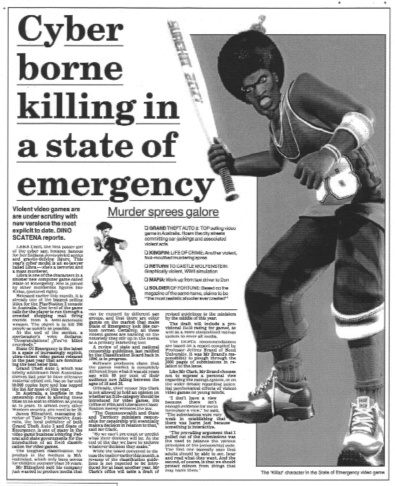
Cyber borne killing in a state of emergency LARA Croft, the first poster girl of the cyber age, became famous for her Indiana Jones-styled antics and gravity-defying figure. This year's cyber model is an ex-lawyer called Libra -- she's a terrorist and a mass murderer. Libra is one of the characters in a sinister new computer game called State of Emergency. She is joined by other murderous figures like Killaz. Released earlier this month, it is already one of the biggest selling titles for the PlayStation 2 console in Australia. One level of the game calls for the player to run through a crowded shopping mall firing rounds from a semi-automatic weapon. The object is to kill 200 people as quickly as possible. At the end of the section, a sportscaster's voice declares: ``Congratulations! You've killed everybody.'' State Of Emergency is the latest in a spate of increasingly explicit, ultra-violent video games released in the past year that are dominating the best seller lists. Grand Theft Auto 3, which was briefly withdrawn from Australian shelves last year to have offensive material edited out, has so far sold 55,000 copies here and has topped the list for most of this year. In Australia, a loophole in the censorship rules is allowing these titles to be sold to children as young as 15 years. In almost every other Western country, you need to be 18. James Ellingford, managing director of Take 2 Interactive Australia, the local publisher of both Grand Theft Auto 3 and State of Emergency, is one of many in the video game business lobbying Federal and state governments for the introduction of an R+18 classification for video games. The toughest classification for product in the medium is MA-restricted, which only bans access for children younger than 15 years. Mr Ellingford said his company just wanted to produce media that can be enjoyed by different age groups, and that there are other games on the market that make State of Emergency look like cartoon corner. Certainly, all these violent games are banking on the notoriety they stir up in the media as a primary marketing tool. A review of state and national censorship guidelines, last ratified by the Classification Board back in 1996, is in progress. Software producers claim that the games market is completely different from what it was six years ago with 85 per cent of their audience now falling between the ages of 18 and 35. Officially, chief censor Des Clark is not allowed to hold an opinion on whether an R18+ category should be introduced for video games. His Office of Film and Literature Classification merely enforces the law. ``The Commonwealth and State and Territory ministers responsible for censorship will eventually make a decision in relation to that,'' said Mr Clark. ``So we can't pre-empt or predict what their decision will be. At the end of the day we have to enforce whatever decision they make.'' While the board convened to discuss the matter earlier this month, a revamp of the classification guidelines is not expected to be introduced for at least another year. Mr Clark's office will table a draft of revised guidelines to the ministers by the middle of this year. The draft will include a provisional R+18 rating for games, as well as a more streamlined ratings system to cover all media. The OLFCs recommendations are based on a report compiled by Professor Jeffrey Brand of Bond University. It was Mr Brand's responsibility to plough through the 2000 pages of submissions in relation to the issue. Like Mr Clark, Mr Brand chooses not to express a personal view regarding the ratings system, or on the wider debate regarding potential psychological effects of violent video games on young minds. ``I don't have a view because there isn't enough evidence for me to formulate a view,'' he said. ``The submissions were very weak in establishing that there was harm just because something is interactive. ``The prevailing argument that I pulled out of the submissions was the need to balance the various principles of the [censorship] code. The first one basically says that adults should be able to see, hear and read what they want. And the second, of course, is that we should protect minors from things that may harm them.''