"We Should Be So Lucky", The Independent, Sydney, June 1995
return to background menu
HERE
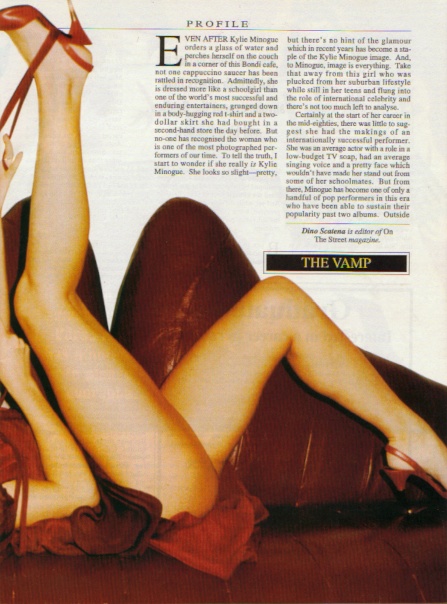
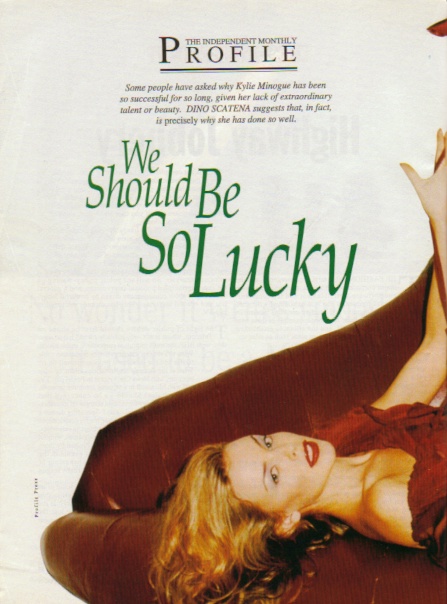
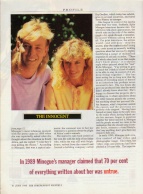
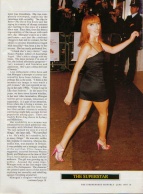
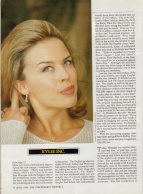
EVEN AFTER Kylie Minogue orders a glass of water and perches herself on the couch in a corner of this Bondi cafe, not one cappuccino saucer has been rattled in recognition. Admittedly, she is dressed more like a schoolgirl than one of the world's most successful and enduring entertainers, grunged down in a body-hugging red t-shirt and a two dollar skirt she had bought in a second-hand store the day before. But no-one has recognised the woman who is one of the most photographed performers of our time. To tell the truth, I start to wonder if she really is Kylie Minogue. She looks so slight � pretty, but there's no hint of the glamour which in recent years has become a staple of the Kylie Minogue image. And, to Minogue, image is everything. Take that away from this girl who was plucked from her suburban lifestyle while still in her teens and flung into the role of international celebrity and there's not too much left to analyse. Certainly at the start of her career in the mid-eighties, there was little to suggest she had the makings of an internationally successful performer. She was an average actor with a role in a low-budget TV soap, had an average singing voice and a pretty face which wouldn't have made her stand out from some of her schoolmates. But from there, Minogue has become one of only a handful of pop performers in this era who have been able to sustain their popularity past two albums. Outside America, the one territory she has yet to conquer despite a top three single in 1988, she is the most successful female recording artist after Madonna. Her single which followed a two-year break from recording, 1994's Confide in Me, was her 11th to reach number two or higher in the British charts. Only the Beatles and Elvis Presley have done better. She is one of the few entertainers on the planet whose popularity spans age groups, cultural groups (she has had top- 10 hits in 28 countries and is the only performer ever to have had three singles simultaneously in Israel's top 40) and changes in fashion. I have stood at one of her concerts surrounded by 14,000 screaming pre-pubescents and I have been at a chic lounge-room party where more than 30 sweating adults stripped off their tops while dancing to her greatest hits collection. She has the versatility to perform in front of royalty and before 15,000 Sydney Mardi Gras party-goers at three in the morning. She has been portrayed by the media as a defenceless young girl swamped by her fame and as a sophisticated sex kitten in control of her destiny. And yet, while the sum of her parts is impressive, when you try to analyse this, the individual parts remain persistently ordinary. Born in Melbourne in 1968 and raised in the middle-class suburb of Camberwell, Minogue started her career as a child actor with roles on television shows such as Skyways and The Henderson Kids. In 1986, she began to play Charlene Mitchell in Neighbours. Her on-screen marriage to the character played by Jason Donovan attracted record ratings. In 1987, her cover version of the song Locomotion launched her singing career. It was the top-selling Australian single of the eighties. Since then, she has sold more than 20 million albums and 25 million singles. Many of the early songs, such as I Should Be So Lucky and Got To Be Certain, were pop pap, produced by the British hit factory of Stock, Aitken and Waterman. The first thing that can be noted about her is a certain toughness. The life of a young soap star, with its 5.30am starts and constant promotional activities, requires enormous dedication. She did not come from a show business family. Her father, Ron, was an accountant with Camberwell council. She says she cannot remember much of Neighbours days, except being obsessed about "doing the right thing for everybody else, and trying to maintain my sanity at the same time. It's a bit of a blur, I worked incredibly-I was like anemic half the time, and ill. Working, working, working." She was cast as assertive characters in The Henderson Kids and Neighbours, where she played a motor mechanic. Perhaps the producers of these shows sensed character strengths which some of her later critics tried to deny her. She left Neighbours in mid-1988 to concentrate on singing, and began to realise that she had acquired a past from which it would be hard to break away. "In a way," she says now, "I wish I'd never done any interviews. Because those quotes and the misquotes, they're there in black and white. They stay, and that's too limiting. What I said six months ago and what I said eight years ago is probably not what I'm thinking today, yet things always get dragged up." In the early 1990s, she took Grundy's to court in an unsuccessful attempt to stop the release of a Neighbours video about the Scott and Charlene love story. In 1989, Minogue's manager claimed that 70 per cent of everything written about her was untrue. Perhaps Minogue's most infamous moment with the press came in 1989 when she was reportedly asked what she thought about the situation in South Africa, and she replied: "I wish they'd stop killing the rhinos." According to Minogue, that was a typical misquote: the comment was in fact her response to a question about the plight of Africa's native animals. She started to take back control of her own life with the help of her father who, while she was still with Neighbours, retired from the council and formed a holding company called KayDeeBee, which today has subsidiaries in several countries, and hired Terry Blarney as manager. She began to control the media rather than vice versa. Suddenly, Kylie Minogue interviews became rare. For television talk-show appearances, she would take on the role of the starlet, giggle a lot, speak through a transatlantic accent without saying much at all. For print interviews, the actress would-and still does-drop the accent, play the sophisticated young star, come across as earnestly tackling questions about her success by slightly modifying a range of memorised responses to suit any occasion. "There is a whole other level to me that people don't know about," is a typical reply when quizzed about the "real" Kylie Minogue. "I'm willing to give so much but I think it's kind of edited, to be able to stay in control of it all, keep things together." She has been acting for so long now that the notion of revealing much of herself in an interview has perhaps never occurred to her. The two hours she gave me produced little that the world didn't already know about her. She's happy to discuss the projects she's working on, to share anecdotes about the other famous people she crosses, but anything about her personal life , her finances, what's important outside the career, and the questions are politely side-stepped. Having been burned so many times in the early days by the media which, having helped create her success, began to question whether her talent merited it, Minogue and the people around her came to the realisation that she should keep it simple: Smile, maintain a clean lifestyle, don't say anything, don't give them any reason to hate you. In early 1990, Minogue took creative control of her video and photographic image. Until then, her video clips and persona had been pitched at 10-year-olds. The improvement was immediate. She was completely revamped, replacing the cutesiness with sexuality. The clip for Better The Devil You Know saw her raging in a variety of skimpy costumes and nestling in the arms of a naked black man. Since then, there has been a regeneration of the image with each new clip. Minogue's talent as a video performer -- not just the continual changes in hair and in costume, but her ability to project friendliness tinged with sexuality -- has been a key to her success. She has rarely performed live. �I think she's very clever," says Nancy Pilcher, editor of Australian Vogue. "She's able to change with the times. The latest pictures I've seen of her, she looked absolutely gorgeous -- very womanly and feminine and glamorous. She's got a china-doll sort of beauty." Less enthusiastic critics have said that Minogue's attempts to convey raw sexuality have been failures. But perhaps this is the point. "I think at the moment my image is very much a girl-woman," she was reported as saying in the early 1990s. "I hope I can be like that forever." In the past five years, we have never known whether, in her next video incarnation, Minogue will be girl or woman, innocence or experience. It is part of her attraction. Even when she is being a woman, we remember the girl, and vice versa. The fact that neither version is entirely convincing might help account for her popularity among gays. There are weekly Kylie drag shows in Sydney and Melbourne. Her credibility as a woman was enhanced by her much publicised relationship with Michael Hutchence. "He just opened my eyes to a lot of things," she later said. "We travelled a lot. He's wild, he's sensitive, he's so many things." He was also, unlike her, popular in America, whereas she, unlike him, was popular in Britain. It was probably not a strategic coupling of the sort that, Clive James has suggested, occurred between Warren Beatty and Madonna at the time of Dick Tracy, but it did her no harm with her audience. The girl was growing up, in public. Around the same time, Minogue took on her first major film role in The Delinquents. The character she played spent most of the movie exploring her sexuality and rebelling against everything around her. Minogue's singles -- which had taken on a more sophisticated edge to match the new image -- continued to chart strongly. There was another album, 1991's Let's Get To It, and then Minogue took the biggest risk of her professional career, leaving behind the men who had been responsible for producing almost all of her music to that point. The English production stable of Stock, Aitken and Waterman had spotted Minogue's potential early on, taking her under their wing after hearing Locomotion. Yet "Kylie" (as she was marketed early on) was simply one of a dozen single-name girlie popsters. If one of those early singles had failed, she undoubtedly would have been discarded like so many of the others. But none did. Some of them, such as Better the Devil You Know, What Do I Have To Do and Shocked, were among the decade's finest pure pop moments. Even so, once her five-album contract with Stock, Aitken and Waterman expired, she decided to break away. After being approached by virtually every major label in the world, she decided to sign to the small, hip English dance label, deconstruction, home of influential dance acts such as M-People and Black Box. "Kylie is regarded as a trashy disco singer," said the label's co-owner, Peter Hatfield, at the time. "We regard her as a potential radical dance diva." Although she still does not write any of her songs, at least now she chooses them and has a say in their recording and marketing. Late last year, the first product of the new relationship, the single Confide In Me, was released. It debuted on the Australian and UK charts at number two. The single, as well as the rest of the album from which it was lifted, Kylie Minogue (which sold more than 500,000 copies in the first couple of months after its release), was a musical reinvention. She was now more stylish than ever and, on some tracks, was actually stretching herself as a vocalist, her thin tone acrobatically twisting and floating above the grooves being provided by her new collaborators. As Mushroom Records' Michael Gudinski pointed out last year: "If you had said five years ago that Triple J would be flogging her record, they'd have said you were crazy. It's fantastic to see the way she's matured and that she's become quite a hip, state-of-the-art artist." With the increasing respect came interviews and profiles in Rolling Stone and other more serious, magazines. Like this one. Today, Minogue is a verified international star. A year ago, at the world music awards in Monte Carlo, she danced with Prince in front of some of the world's top singers and musicians. Her annual tax return in 1993 showed her net worth as $5.8 million, although a story in The Sydney Morning Herald the next year increased this to $12 million. She and her manager refuse to confirm or deny these details. Her management say they want her to be perceived as a performer, not a corporation. She has residences in Melbourne, London and recently sold an apartment she had in the south of France because her busy schedule over recent years hasn't given her the chance to spend time there. She is still trying to crack the US, this time through the movies. Her American film debut last year, starring alongside Jean Claude Van Damme in the $35 million Street Fighter, topped the American box office takings over the Christmas period. Now it is March 1995, and in a couple of days Minogue will be heading back to England. While here, she has been spending time with her new boyfriend Mark Gerber, who played the blind, naked stable hand in the film Sirens and who lives just down the road from this cafe. She has just completed work on a short film by director Kimble Rendall, the 12-minute Hayride To Hell. This has been another new role for Minogue, playing "a slightly deranged girl". "I did twitch a bit, I dribbled a bit and I heaved a bit," she says. "I found something inside me I felt I could expand on, some part of me. Some madness somewhere. Come the evenings, it was hard to switch off. My boyfriend started to wonder who I was. It was such a good experience. [She sighs.] Scared the life out of me." But it is her other recent work in Australia which will probably prove to have the greatest effect on her career since the signing to deconstruction. During an earlier trip this year, while she was spending Christmas with her family, she was approached by Nick Cave, Melbourne's only other international music star. Though he had often referred in interviews to his desire to collaborate with Minogue, many interpreted such sentiments as another example of his dry, dark sense of humour. But in January they came together to record a song written for the occasion, Wild Rose. Minogue describes it as "unlike anything I've ever done before. It's a murder ballad. My character gets killed with a rock: you know, all beauty must die. It's a beautiful song. It was an experience to work with him but, also, the way he made me perform was different to anything I've done. You probably wouldn't know it was me at all." Cave was similarly charmed, telling Minogue he has a whole batch of songs set aside especially for her. Last year, Prince told her the same thing. If Minogue ever needs to verify that her long search for musical credibility is complete, she need only mention those two names. At the end of the day, Minogue's hugely successful story is the public story of her personal growth, image control and of paparazzi-friendly relationships. Her acting and her music -- while improving --rate further down the list of priority concerns. She is not the next Madonna, just like she is not the next Michael Jackson or the next Prince. Her fate rests on a series of images and songs, a sort of singing, dancing blur. Unlike Madonna and so many other stars, she is not selling an attitude. Her story is that of a mechanic from Ramsey Street who became a star not because of talent but because of her ordinariness. She became a famous singer through an accident of fate, because she began her career with a ready-made public history (it did not matter that it was the history of Charlene Mitchell, not Kylie Minogue) which immediately linked her, emotionally and visually, with millions of people. Clive James has written that everyone needs to know about a range of famous people who represent things that are important -- Einstein as science, Hitler as evil, Mother Theresa as goodness: "The famous help us live. We turn them into characters and put them in a show, a modern version of the passion play." One can ask what Kylie Minogue represents, given that, unlike many actresses or singers, she is not extraordinarily beautiful or talented. Maybe the Kylie Minogue story lies in the fact that even those without great talent or beauty can become famous, a deeply appealing story for many of us. We love her because she is like ourselves.