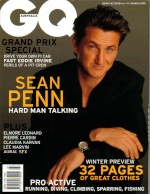
"Speed Freaks", published in GQ (Sydney), March 1999.
RETURN TO ARTICLE LAYOUT HERE
SPEED FREAKS BEFORE EDMUND IRVINE was invited to walk among the hallowed garage walls of La Scuderia's Italian headquarters, the place where he's lived happily as IL NUMERO DUE ("the number two") for more than three years now, the Irishman had earned himself a reputation of being a tad accident prone. Irv The Swerve, everyone used to call him. That's not the sort of tag you want when you're one of the chosen few allowed to play with the world's most expensive toys. But Eddie Irvine's time as the Number Two driver in Ferrari's globally revered Formula 1 team, especially his performance in last year's World Driver's Championship, has changed all that once and for all. After 16 races held everywhere from Brazil to Monaco to Canada to Australia and beyond, Irvine finished fourth, by definition making him the fourth best driver in the world in 1998. Think about that for a moment the next time you're stuck in traffic. Down pitlane these days, at least outside the Ferrari garage doors, Irvine's got himself a new nickname. It's The Playboy. A couple of reasons for the shift in Irvine's projected personality are, one, he doesn't crash as many cars anymore, and two, the boy's acquired a few expensive toys of his own. Last year he bought himself a luxury yacht, the year before that it was a Falcon 10 jet, a helicopter the year before that. The only thing left on his shopping list at the moment is a Ferrari Daytona. He'll probably be able to score one of those for cheap. Then there's the 33-year-old's nightlife. Following the last race in Japan in November, only hours after more than 100 million people watched him spray champagne from the second step of the podium, one level down from the newly-crowned world champion Mika Hakkinen, Irvine forsaked the official Formula 1 Association's end-of-season bash in favour of his favourite Tokyo nightclub. There, word had it, he partied the night away with fellow international jet-setters Liv Tyler, Ben Affleck and Bjorn Borg. Late last year, Irvine was back in Australia for some R&R. He'd stayed on in Japan for a few weeks after the final race and then came on to Bondi to recover at a friend's place. "Tokyo is, you know, a bit of a party town," The Playboy says with a smirk. "So I've just come down to Bondi, had a relax." Eddie Irvine loves this new life he's acquired. Calls it the "dog's bollocks". Bachelor, famous international man of action, Formula 1 driver for the sport's oldest and most glorified team. Not surprisingly, back in the scarlet paddock, Number One doesn't approve of his lieutenant 's extra-curricular activities. Number One, Germany's two-time world champion Michael Schumacher, is the fourth highest paid athlete in the world (1999 will see him earn a reported [AUS] $57 million compared to Number Two's measly [AUS] $13 million) and is universally recognised as the greatest driver of his era. However, his three years with Ferrari have failed to get his name engraved on the holy grail for a third time. No matter what Schumacher may think of how Irvine conducts his life in his free time, he can have no doubt that his Number Two is made of the right stuff when they're out there where it counts: On the track. Several times last year, Irvine deliberately slowed down during a race to let Schumacher pass. One time, in Austria, Irvine gave up his place on the podium. And, contracts or no contracts, that's the penultimate sacrifice in motor racing. To fans of Formula 1, the image of Irvine and Schumacher embracing after another successful dogfight against the enemy has become a common one. In such scenes of jubilation, one fact is guaranteed: Schumacher has finished ahead of his team-mate. That's because Irvine understands his job. It's a simple brief, and it's been the same for the last three years. Assist La Scuderia Ferrari and its Number One driver Michael Schumacher to regain the world championship. "It's not the job that I came into Formula 1 to do but it's the job I have at the minute," concedes Irvine without emotion. "I do it to the best of my ability but it's not what I want to do. "Ferrari has to win the championship and he (Number One) has the most points, so we have to concentrate on getting him the most points we can get him." So his loyalty to Michael Schumacher is without bounds? "The only person I have loyalty to is the team. They pay my wages so they're the ones I have loyalty to. They tell me what to do and I do it." In the last two championships, Schumacher has taken it to the line, both times finishing second on the points table. Close, but no tiara. Ferrari � the only manufacturer to have competed in every modern Grand Prix since the first official driver's world cup in 1950, the most popular motor racing outfit ever � hasn't won a World Driver's Championship since 1979. The closest it's come was in 1982 and 1983 when it managed to claim the team award, the Constructer's Championship. But, in 1982 at least, that only came at a sickening cost. That year Ferrari's number one driver (Gilles Villeneuve, father of 1997 world champion Jacques) was killed and its number two driver (Didier Pironi) was left in a wheelchair. The cars are much safer these days, but as the death of three-time world champion Ayrton Senna in 1994 starkly reminded everyone, danger will forever be a factor in the fastest sport on earth. Irvine says that sort of stuff never crosses his mind. "They're safer, but you can't be doing 200 miles an hour and be safe," he offers matter-of-factly. Still, in Belgium last year, he must have got a scare. In torrential conditions, only a few hundred metres on from the start of the race, a little bump between his Ferrari and the Mecedes Benz-powered McLaren of Scotsman David Coulthard led to the biggest Grand Prix pile-up ever. As Irvine and Coulthard's broken machines tried to hobble to a halt, car after car rammed them from behind, their drivers unable to control the hyper accelerators on the ice-like surface. It was unadulterated mayhem. Of the 22 cars that started the race, only nine survived intact. "It hurt my leg a lot, I'll tell you that," is the only thing Irvine's got to offer on the cockpit view of that billion-dollar spectacle. "Geez, it was killing me. It was okay a couple of days after but it just hit the bone on the metal, you see, so it hurt a lot more than the damage it did." Regardless, Irvine, like all the other drivers that had a spare car, was ready for a restart within an hour of the crash. Eddie Irvine was born in Newtownards, Northern Ireland, in November 1965. He began racing cars as a 17-year-old in a local Irish competition in 1983. By 1987, he'd won his first British championship. By the time he was asked by the Jordan team to race one of their cars in the final two Grand Prix on the 1993 calendar, he'd been in Japan for three years competing in the local F3000 championship. Irvine made quite an impression in his first Formula 1 race, the 1993 Japanese Grand Prix. Not only did he finish sixth to gain himself one world championship point � historically a rare feat on debut � he also landed on front pages everywhere after the race winner, Ayrton Senna, decked him in the pits. The veteran world champion didn't appreciate the precocious little debutant unlapping himself in the final stages of the race. "I just closed my eyes and thought, 'Here comes a few quid'," Irvine quipped at the time. "I don't remember that," is his version of the events nowadays. That's typical Grand Prix-speak. In the intensely political cess-pool that is Formula 1, Irvine knows when to keep his mouth shut. "There's reasons for everything," he explains. "There's good reasons why we can say certain things and there's good reasons why we can't say certain things. Some drivers are over the top and they say nothing and it's boring. I think I walk a tight-rope that I haven't fallen off yet. But there's a fine line." Nonetheless, the annual Japanese race has presented Irvine some slightly more memorable instances than that debut. Last year he was second. In 1997, he led a Grand Prix for the first time, eventually finishing third after letting Number One through again. Irvine's record on Melbourne's Albert Park track is a little more mixed. At the inaugural Grand Prix here in 1996, Irvine � in his debut race for Ferrari � out-qualified his more fancied team-mate, eventually claiming third. The following year, he didn't manage to get to the end of the first lap after a first corner incident which took out the new world champion Jacques Villeneuve. Last year, having watched the superior silver McLarens lap the whole field, Irvine settled for fourth. Although he's now fought in 81 Grand Prix, finishing in the top six on 29 occasions (he stood on the podium eight times in 1998 alone), Irvine flatly states he still hasn't had a career highlight in Formula 1. "I want to win races. That's the next step." A fastest race lap or pole position wouldn't go astray either. After his brief Australian sojourn last year, which included officially launching the 1999 Australian Grand Prix, The Playboy planned to head back to Tokyo for a few days and some more partying before he was required back at the office. Last year, outside the race weekends, Irvine estimates he did some 20,000 kilometres of test laps in his Ferrari, virtually the equivalent of driving from his home in Dublin to Melbourne and back again. So, Eddie, any plans for the off-season before arriving in Melbourne? Girls? Partying? Sailing? Flying? "Just testing, testing, testing." *Postscript: Eddie Irvine went on to win the 1999 Australian Grand Prix.
GOT ANY UNLEADED? Don't snicker at the guy with the lollipop. In the adrenalised fury of activity that is a modern Grand Prix pit-stop, he's the guy calling the shots. The modern Grand Prix pit-stop happens in a suspended blink of an eye, but often the race hangs on it. If it takes you any longer than eight seconds to change all the tyres on your car and load up on a 100-plus litres of fuel, something's gone terribly wrong and you may as well start packing up the garage for the day. But when it works right, it's something like the perfect golf swing, only there's 19 people out there swinging. These days, most teams opt for at least two pit-stops per race. As soon as the race car comes to a stop, two guys stab it with a fuel pump, while another two, armed with jacks, lift machine and driver off the ground in an instant. A bit to the side of them, there's the fireman guy aiming an extinguisher. Then there's three guys on each side of the car changing rubber. One guy takes a tire off as another guy puts a tire on while the other bloke does the bolting. This bit of the procedure takes 1 ... 2 ... 3 ... 4 seconds and suddenly the car has four new tyres. The petrol takes a bit longer ... 6 ... 7 ... Go, go, go! Over at Stewart Grand Prix, the man left holding the lollipop is the team's chief mechanic David Redding. His driver doesn't move from his pit until Redding has lifted that brake board and told him he's allowed to do so. Everyone else around the car does exactly what Redding tells them to do as well. On the garage floor, he's team captain. And when they're not in their balaclavas, nine of the guys from the pit-crew are back at their regular gigs as mechanics, constructing and deconstructing the most high-tech cars in the world. Another man if the gear-box specialist, one's an electronics' freak and another knows his hydraulics. There's also a couple of the team's roadies involved. "So everybody who's got a normal job gets involved in the pit-stops as well," says Redding. The Stewart team had a pretty good season of it last year in the pit-stakes. All the practice they put into their routine all year - they run through it ten times on the Thursday before a race, another ten in the morning of the big day itself - all that practice paid off. There was only one minor snag at the Austrian Grand Prix when one of the cars stopped in its box with a jammed fuel flap. "So the car came in and obviously we had to prise the flap open and that took about five or six seconds longer that it should have," recalls Redding. "From Stewart's point of view, that was our only nightmare last year." One nightmare that went for five seconds in some 40 real-life Grand Prix pit-stops. That's a good season. You can call it a lucky season too. Because when you practice in a science as precise as the perfect pit-stop, one in which humans must work in absolute synchronicity with their machines again and again and again, something is bound to eventually go wrong. Sometimes really, really badly. Which brings us back to the pit person count. The nineteenth member of the multi-coloured balaclava clad crew simply stands there with his hand on the dead man's handle. Dead man's handle? "If something goes wrong with the refuelling, they can shut off the fuel supply to the nozzle," explains Redding. "That's just a mechanical lever on the rig. "After all," he adds a couple moments later, "well, I think everybody saw the Benetton thing in '94. That probably highlights the worst thing that can go wrong. "It is safer now but there's still an element of risk and if someone's not paying attention, you can get hurt quite easily and quickly." The "Benetton thing in '94" was one of the scariest moments in recent Grand Prix history. The infamous instance took place during the German Grand Prix back in 1994 . Dutch driver Jos Verstappen, Michael Schumacher's team-mate at the time, pulled into the pits during the race for a regulation tire-and-fuel thing. But a splash of petrol squirted out of the fuel pump and over the side of the car, a couple of drops landing on the sizzling engine. The next second, whoosh!, 19 men and a driver disappeared in the biggest fire ball ever to flash live-via-satellite into millions of homes around the globe. Incredibly, no one was hurt thanks to the protection provided by all the sponsors logos on the team's fireproof uniforms. "Since the refuelling came back in (1994), I suppose it has added to the show but I don't think anyone down pit-lane is particularly happy with it," adds Redding. "From a mechanic's point of view, it's another risk really. "But, then again, we can have quite a big effect to what happens in the race. And that's nice" The art of the Grand Prix pit-stop only resurfaced as recently as 1982. For decades before that, drivers would race a whole Grand Prix without stopping. The concept of modern pit-stop, as devised and re-introduced by the now-defunct Brabham team, was that if you only put half the usual amount of fuel in these 500 kg machines, they'd be a hell of a lot lighter and therefore they'd go much faster. Stopping in the middle of the race to refuel would also let you put new tyres on the car. That would provide a lot more grip on the track and make it go faster still. The catch was that you had to make up the time you lost coming in and out of the pits _ about 30 seconds all up _ back out on the track. But by 1983, every team was doing it. In 1984, organisers banned refuelling, fearing a "Benetton '94"-esque incident. In 1994, they reintroduced refuelling and got one. David Redding, who was Mika Hakkinen number one mechanic over at McLaren before joining the all-new Stewart team at the end of 1996, believes the pit-stop has changed the very nature of Grand Prix racing. "People design the cars now to take less fuel. The cars used to take 200-220 litres. Now most cars take about 140, because you're never going to fill the car up, you're always going to change tyres and you can refuel. "It's had quite a big effect on the design of the cars. They've got narrower because they don't have to carry as much fuel. And it's also made the drivers drive differently. They drive two or three sprints now so that people like Schumacher, who are hyper fit, can go as fast at the end as they did at the beginning. "Whereas a few years ago, during the last laps, a driver would be hanging on for grim death rather than pushing."
B.A.R. FILES It might be called British American Racing but, aside from engine whiz, the most prevalent sound to be heard in the team�s paddock when it makes its Grand Prix debut in Melbourne in March will be sweet Aussie strine. "I reckon there are more Australians in this team than any other Formula One team I've ever seen,� says Willem Toet. He's one of them himself. The Melboume-bred aerodynamics expert left his prime position in the all-powerful Ferrari camp at the end of last season to be part of the new and untested BAR campaign. So why would the chief aerodynamicist leave the sport's top-ranking team for a pack of nobodies? Scotsman Craig Pollock, BAR's founder and boss, has a theory. "Australians tend to stick to themselves," he suggests. �A good Australian will attract other good Australians." And in Pollock's BAR, one of the prizes already on the mantle is a man named Malcolm Oastler. Oastler, the team's chief car designer -- a graduate of the mechanical engineering course at the Sydney Institute of Technology in the early '80s -- has an unrivalled reputation in global motor racing circles: every new machine to come off his drawing board has won its first race out. It's a formidable record that Oastler isn�t too concerned about living up to. "People's tendency to set out their goals at the beginning of the year and make them less than being successful mystifies me, really,� he says. "It's just like saying, 'I think we can come sixth in a race some time this year.' It's a strange approach." Toet, who worked with Michael Schumacher in the German's three most recent and thrilling attempts to regain the world crown, is more direct about his new team's aims and potential: �My gut feeling is that we'll be up there fighting for third place in the Constructors' Championship. If we get higher, we will have done really well." As for Pollock, he's already on the record as saying he believes Oastler will keep his record intact. For a newcomer, BAR has an unprecedented wealth of Grand Prix experience among its ranks. Many of the folk now behind the scenes at BAR were involved in the Reynard company's aborted first attempt to crack F1 in the early �90s. Back then Dr Adrian Reynard assembled a design team, again led by his chief designer Malcolm Oastler, to devise and build a competitive car for the 1992 World Championship. Two years of work went into the project, which was eventually abandoned at the 11th hour when the team failed to secure an exclusive deal with a top engine maker. Toet, also a part of that project, had left his prime position at the Benetton team for the privilege. �We as a group decided, 'No, this is not going to be a top team -- we're not going to go in as a lowend team'," recalled Toet. "So we pulled the plug. Virtually the whole group of engineers bar one went from the Reynard group back to Benetton.� Not surprisingly, the car they designed for Reynard went on to form the basis of the 1992 Benetton machines. Now, all these years on, most of that same crew has reconvened at BAR. Another Australian, Sydney-born Steve Farrell, is the team�s chief engineer. Farrell also happens to be the man responsible for luring Oastler to Europe and international motor racing in the first place, initially as a driver, back in the mid-'80s. Oastler had fared quite well as a race driver in Australia, finishing second in the national Formula Ford competition in his rookie year. But Europe was a different game altogether. "It was quite dear to me that it (racing) wasn�t my future," says Oastler. �So I stopped doing it." Oastler soon scored a job with Reynard's crew. His first car design for Reynard, a Formula Ford, revolutionised that form of racing. His first Indy Car a few years later did the same for that league. Oastler's new boss is confident his boy will have a similar impact on Formula One. �I think Malcolm is a huge key to our success," says Pollock. "He's a genius." Pollock is full of praise and pride for all of his Australian contingent. "They're very much laid back, light-hearted, good fun to work with. They don't take themselves too seriously but they know exactly what they want. And they're ugly," he laughs.