return to article list
"bruce as god", first published in the daily telegraph, sydney, 8 february 1997.
also publsihed in mucchio salvaggio (rome), issue 248, in March 1997
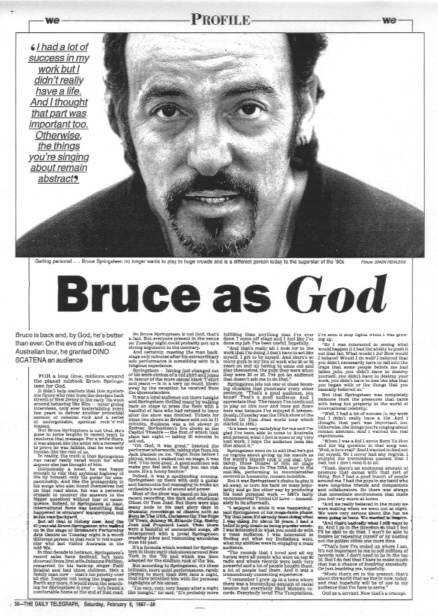
FOR a long time, millions around the planet mistook Bruce Springsteen for God. It didn't help matters that this mysterious figure who rose from the desolate back streets of New Jersey in the early '70s went around behaving like Him - never giving interviews, only ever materialising every few years to deliver another proverbial sermon of celestial rock and a series of unforgettable, spiritual rock 'n' roll masses. But Bruce Springsteen is not God. He's gone to some lengths in recent years to reinforce that message. For a while there, it was almost like the artist felt a necessity to prove he was fallible, that he was only human like the rest of us. In reality, the truth is that Springsteen has never really cared much for what anyone else has thought of him. Intrinsically a loner, he was happy enough to ride that mythical highway of life by himself, only his guitar for companionship. And like the protagonists in his songs who also found themselves lost on that road alone, his was a personal crusade to uncover the answers to the bigger questions without fear of consequence. Indeed, to Springsteen at least, international fame was something that happened in strangers' loungerooms, not in his own backyard. But all that is history now. And the 47-year-old Bruce Springsteen who walked on to the stage of Brisbane's Performing Arts Centre on Tuesday night is a much different person to that rock 'n' roll superstar who last visited Australia in the mid-'80s. In that decade in between, Springsteen's record sales have declined, he's been divorced (from first wife Julianne Phillips), remarried (to his back-up singer Patti Scialfa) and had three children. He's a family man now - that's his priority over all else. Despite not being the biggest on Earth any more, it would seem the searching for Springsteen is over - he's found a comfortable home at the end of that road. So Bruce Springsteen is not God, that's a fact. But everyone present in the venue on Tuesday night could probably put up a strong argument to the contrary. And certainly, meeting the man backstage only minutes after his extraordinary solo performance is something akin to a religious experience. Springsteen - having just changed out of his work clothes of a red shirt and jeans in favour of the more casual black T-shirt and jeans - is in a very up mood, blown away by the reception he received from the Queenslanders. It was a loyal audience out there tonight and Springsteen thrilled many by walking back on stage to press the flesh with a handful of fans who had refused to leave after the show was finished. Tickets for these two shows in Brisbane sold out in 11 minutes. Business was a bit slower in Sydney, Springsteen's five shows at the Capitol Theatre -the first of which took place last night -taking 30 minutes to sell out. "Oh God, it was great," beamed the performer afterwards, taking sips from his Jack Daniels on ice. "Right from before I played, when I walked out on stage, it was like, `This feels good'. A good audience will make you feel safe so that you can risk more. It's a funny bounce." Indeed, it was a spellbinding evening. Springsteen up there with only a guitar and harmonica but managing to evoke an orchestra's worth of sound and power. Most of the show was based on his most recent recording, the dark and emotional Ghost Of Tom Joad. But there were also many nods to his past glory days in dramatic reworkings of classics such as Born In The USA, Darkness On The Edge Of Town, Johnny 99, Atlantic City, Bobby Jean and Promised Land. Then there were a handful of unrecorded songs, all interspersed with a jovial Springsteen cracking jokes and recounting anecdotes from his past. It's a formula which worked for Springsteen in those early club shows around New York in the '70s and which was then adapted for the stadium rock of the '80s. But according to Springsteen, it's these intimate, more quiet performances, rarely playing to more than 2000 fans a night, that have provided him with the personal highlights of his career. "I'm very, very, very happy after a night like tonight," he said. "It's probably more fulfilling than anything that I've ever done. I come off stage and I feel like I've done my job. I've been useful, hopefully. "And that's really all I look for in the work that I'm doing. I don't have to act like myself, I get to be myself. And there's so many guys in my line of work who 20 or 30 years on end up having to come out and play themselves, the guys they were when they were 20 or 25. I've got an audience that doesn't ask me to do that." Springsteen lets out one of those booming chuckles that punctuate every other sentence. "That's a good audience, you know? That's a good audience. And I appreciate that. The reason I've continued to play on this tour and have got down here was because I've enjoyed it tremendously. (Tuesday was the 110th show of the Ghost Of Tom Joad world tour which started in 1995.) "It's been very satisfying for me and I'm glad I've been able to come to Australia and present what I feel is some of my very best work. I hope the audience feels like that about it." Springsteen went on to add that he's got no regrets about giving up his mantle as the world's biggest rock 'n' roll star. Certainly, those images of him on stage during his Born In The USA tour in the mid-'80s, performing to mountainsides covered in humanity, remain indelible. But it was Springsteen's choice to give it all away, to turn his back on mass popularity and go the other way by producing his most personal work - 1987's fairly uncommercial Tunnel Of Love - immediately in its aftermath. "I enjoyed it while it was happening," said Springsteen of his mega-fame phase. "By that time, I'd already been doing what I was doing for about 20 years. I had a belief in pop music as being popular music. I was interested in what you could do with a mass audience, I was interested in finding out what my limitations were, what my abilities were in engaging a mass audience. "The records that I loved and all my heroes were all people who were on top 40 radio and whose records were both very powerful and a lot of people bought them, a lot of people had them. And it was a tremendously connecting experience. "I remember I grew up in a town where there was a tremendous amount of racial tension but everybody liked Motown records. Everybody loved The Temptations. I've seen it stop fights when I was growing up. "So I was interested in seeing what would happen if I had the ability to push it out that far. What would I do? How would I behave? Would I do well? I believed that you didn't necessarily have to fall into the traps that some people before me had fallen into, you didn't have to destroy yourself, you didn't have to destroy your work, you didn't have to lose the idea that you began with or the things that you basically believed in." Not that Springsteen was completely immune from the pressures that came with being hot property in the world of international celebrity. "Well, I had a lot of success in my work but I didn't really have a life. And I thought that part was important too. Otherwise, the things you're singing about remain abstract. And I wanted the real experiences. "When I was a kid I wrote Born To Run and the big question in that song was, `Well, is love real?' And I wanted to find out for myself. So I never had any regrets, I enjoyed the tremendous success that I had, but I don't miss it at all. "Yeah, there's an enormous amount of pressure that comes with that sort of thing. But I had a good bunch of people around me. I had the guys in my band who were long-time friends and companions and collaborators. So there was always that immediate environment that made you feel very much at home. "And we really believed in the music we were making when we went out at night. We were very serious about the fun we were going to have. We wanted to inspire. "And that's basically what I still want to do. And I go in the direction in that I feel I'll be able to do that. I won't be able to inspire by repeating myself or by busting out the golden oldies one more time. "That's how I've ended up where I am. It's not important to me to sell millions of records now, I don't need to be in the top 10. But I do feel that I have to make music that has a chance of inspiring somebody. Or just inspiring me, hopefully. "Music that's set in the present, that's about the world that we live in now, today, and that hopefully will be of use to my audience that I'm here to serve." God as a servant. Now that's a concept.