RETURN TO ARTICLE LAYOUT HERE
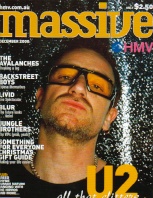
Bono interview and profile, published in The Sunday Times (Perth), 5 November 2000, and rewritten for Massive (Sydney), December 2000
THE UNFORGETTABLE FIRE Bono and the rest of U2 are in Los Angeles for the launch of their tenth studio album, All That You Can�t Leave Behind. In about a week�s time, the record will commandeer pop charts the world over. If there were any lingering doubts that, after 21 years together, this Irish quartet might have slipped from its mantle as the biggest rock band in the world, that should have blown such thoughts out of the stadium once and for all. But that�s next week. For the moment, Bono __ one of the most famous human beings in the world __ is reflecting how LA, this City Of Angels, has always acted as a microcosm of U2�s world domination. �From the very first time we came to Los Angeles,� he explains, with the same hyper-active energy he puts into everything he says, �things went off for us very quickly. Our first ever concert here, when we were 17 or 18, they put us on the cover of the calendar section (of the LA Times), an unknown band. And it just said: This is it! �And from playing to 200 people that first time, the next time it was like 2,000, the next time there were 20,000, next time there were 100,000, and the next time there were literally 200,000 people. Every single time we've played here, things have been really, really good. Except for the last time. I remember things not going well.� Indeed, LA also provided the first hint to Bono and U2 that perhaps they had faltered in the direction they chose for their last studio album, Pop (released March 1997) and its accompanying over-the-top world tour, PopMart. �I�m really proud of the material on Pop,� the singer offers earnestly. �I just don�t think we finished it. �It was supposed to be a party album because it came out of a time in ours lives when we were listening to a lot of music, and club culture in Dublin and London was very, very strong. We wanted to capture that feeling, that house party and feeling we were having. There were kids around and we just had this amazing time. �But what came out was more of a hang-over than a party album. It�s a party album for about five minutes. The hang-over is all these questions, everything, heavy stuff. There�s a lot of very primal questions on that album. But, you know what, it�s about tunes and I don�t think the tunes connected with people the way they could have if we had time to finish them.� An early show of the PopMart tour, again in LA, indicted that some die-hard fans at least __ perhaps for the first time ever __ weren�t buying this latest repackaging of the U2 sound and vision. �I think it's the only bad gig we've had in LA,� says Bono. �I think, in a weird way, the places where PopMart didn't work were places that are inclined to think of music as entertainment. Whereas in Ireland, music isn't entertainment __ it's a life or death situation. It's everything to us. And lots of places where you go__ Italy and Australia. You don't feel like the popcorn.� So what was the problem, Bono? Didn�t your fans in LA find PopMart entertaining enough? �No,� jumps up Bono. �They found it to be just entertainment. I think that was the problem. In fact, we opened that tour in Las Vegas. And we thought the surrealism of it and the Dada, we thought, �This will blow America's mind�. And we just by accident chose Las Vegas to open the tour. �And, of course, we were in a city that looks like it's been designed by children. And all of a sudden PopMart looked completely normal. It just looked like one of the rides. You could see the Great Pyramid (casino) from the back of the stage, you could see King Arthur's castle. �Then four rock stars get out of ... as Woody Allen described U2: �Isn't that the band that gets out of a giant citrus fruit during their show?� In places like that, and Los Angeles, where they always come to U2 for soul and for blood and tears, I think they were completely confused and bought popcorn.� But Bono has a plan to rectify that misjudgment when the band plays LA again early next year at the start of their All That You Can�t Leave Behind world tour. �I'm ready to bleed all over them,� he laughs. �I'm going to bleed all over Los Angeles,� Bono adds screaming. �There's going to be blood all over downtown!� This reminds Bono of another funny LA experience, the time U2 wanted Public Enemy to be their opening act on their Zoo TV tour in 1992. �We had taken Public Enemy to play the Coliseum (stadium) in Los Angeles and they were banned from playing Los Angeles. They hadn't played there for five years and there were all kinds of rows to get them on the bill. And finally, there were some Irish owners of the stadium and there had to be calls in the dead of the night, orchestral maneuvers, and eventually they agreed to put Public Enemy on. �And Chuck D said, �This is really great, Bono, I think I've got something really special for the people of Los Angeles, a special show.� And they went on and, this is right in East LA where the stadium is, the heart of (street gangs) the Bloods and the Crips and stuff like that. And people were really worried about a war breaking out in the streets outside and stuff like that. So what did Public Enemy do? They went on stage, erected a scaffold and hung a white Klu Klux Klan man from it.� Bono bursts out laughing uncontrollably. �It was really one of the great moments.'' Although All That You Can�t Leave Behind comes more than three years since Pop, U2 have never strayed too far from our ears in the interim. Or from our best seller lists either. The first volume of their greatest hits set, Best Of 1980-1990, remains in the Australian top 50 two years on from its release (November 1998). That compilation of old stuff even gave U2 another worldwide number one single thanks to the re-release of a decade-old B-side called The Sweetest Thing. And in many ways, the retro-U2 sounds of All That You Can�t Leave Behind are more a direct follow-up to that best-of rather than the techno-rock of Pop. Gone, for the most part, are all the electronic gizmos which dominated the final of U2�s futurama trilogy which had started with Achtung Baby in 1991, and then followed up by Zooropa in 1993. �We spent a lot of time in the �90s really trying to avoid sounding like ourselves,� says The Edge on the decision to abandon the electronica sheen. �In fact, it was kind of against the law for me to sound like The Edge for most of that last 15 years, on the basis that, really, with rock & roll, there�s a need for it to move forward, to find new ground, embrace new technologies and movements within music. �And we�ve always known this, used that sense of discovery as a way of being inspired. So there was no instinct ever to repeat ourselves. Quite the opposite. We�d be much more interetsted in something that we'd never done before than something that we had done before. �But on this record, I suppose because it was really a record about us playing together in a really small place, just the four people knocking out the tunes, it did seem that it was valid. In a sense, this record is every other record we've made. All those lessons we've learned distilled into one record. �We just wanted it to be a very joyful record, something that had a vitality to it and something that was really band-centred. And the thing we discovered along the way is that certain kinds of sounds, certain kinds of treatments were sounding really tired. The thing that was sounding the most fresh and the most interesting to us was a really stripped-down sound. Really back to what the core of the band was about, which is guitar, bass, drums, voice. �So the emphasis was placed back on me, I guess, to be in the musical foreground. And I was very happy to take that challenge and come up with music and guitar parts that spoke about the band and were really simple. Because, in the end, one of the things that we're good at is making quite simple music mean a lot. �Our thing, when it's working at its best, is pretty stripped down, pretty minimal. In the end, I suppose that's what we ended up with: 11 songs and the sound of the four individuals coming through very strongly on the album.� (The Australian edition of the album also contains a bonus track in The Ground Beneath Her Feet, which originally appeared on U2�s most recent side-project, the soundtrack to a film co-penned by Bono and entitled The Million Dollar Hotel.) The Edge makes no secret of the fact that the work he personally put into compiling the greatest hits collection made him keen to push the idea of a back-to-basics album to Bono, Adam Clayton and Larry Mullens. What impressed the Edge most while he had his head stuck in the audio archives was just how spirited and captivating those initial records __ Boy (1980), October (1981) and War (1983) __ still sounded all these years on. �I had to do a lot of listening when we were putting the best of together,� says Edge. �I guess there are a part of all those records that have really survived well. Then there are songs that haven't. And I'm not particularly surprised. We made those records in a real hurry. They really are like a Polaroid of where we were musically at the time. �But what was surprising was the inventiveness. From a pure musical arrangement point-of-view, those first few records were so full of ideas, very unconventional in a great way. I was really quite taken by that. I could see the spirit of what we were doing. I could see now why people got so excited by those albums. �And it probably wasn�t for the reasons I thought at the time. It wasn't that it was such clever work, it was just that it had great spirit and a great inventiveness. But it didn't have great poise.'' It was that lack of perceived poise that made it difficult for Bono, at least, to revisit and re-examine that earliest phase of U2 with any sense of fondness. �I never listen to U2 from the �80s because I think I sounded like a girl,� Bono says bluntly. �Even though I'm macho enough to accept that now, back then I could never listen to those records. �We reached the Best Of and Edge did all the work putting it together. And he actually made me sit down and listen to it. He said: �You have to listen to this now __ we're putting the fucking thing out.� I was like, �I can't Edge, I really can�t.� �And I was surprised when I did. It was ecstatic music and I could see through the naivete and the gouache moments and the songs that weren't finished because we ran out of time in the studio. Potentially extraordinary songs, lyrically. But they were written in the first sketch and you think, �Why didn't I finish that thing?� �But I just thought there's pure joy in these songs. And that is the hardest thing to find. If you're a painter, it's easy to achieve drama with black. And anger is an emotion that�s very easy to get across. And melancholy, because we're Irish __ it�s the fucking rain. It's always raining so there's always melancholy in our music. �But the joy, the pure joy of four jerks from the north side of Dublin going out against the world, I heard it in the music. And I thought __ for this time out, for this new century __ that would feel like daylight to people. So we went at it. �And it's hard to contrive it. You have to get into that place. And luckily enough in our lives, we�re hitting that place where people know who they are, the kind of wounds you get through living your life like we have, they�re not half as open as our faces at the moment, you know? �There�s a real honesty in the band at the moment. Having tried our hand at a few things, I think that we�re really clear that this is what we want to do with our lives. We want to be in the best rock and roll band in the world. And I know that even that term rock and roll doesn�t apply to us. We�re more like the loudest folk band in the world.� It�s now the stuff of rock legend that the world as one quickly accepted that there was something quite magical about U2 virtually the moment they popped out of the box in 1979. Within a couple of years, these �four jerks from the north side of Dublin� were already scaling charts the planet over with their first hit single, Gloria. But it wasn�t until 1983 that U2 staked its claim at the forefront of global pop culture. The War album featured new wave anthems such as New Year�s Day and Sunday Bloody Sunday, as well as another hit single in Two Hearts Beat As One. A little later in 1983, U2 released a video and a mini-album of their recent extraordinary concert at the Red Rocks ampitheatre in Denver and it was this amazing footage that most transparently hinted at the band�s true potential for greatness. To a backdrop rain, fire and a mountainside of fans, Bono waving his white flag high above his head, the concert looked a lot like the greatest rock and roll show of all time. �We came out of the anti-music punk thing,� Edge says of those hurly-burly early days. �Literally the idea was that anyone could be in a band if you had a real passion for music. You didn't have to be a great musician and certainly none of us were at the beginning. It was the spirit of the music that was important, the fact that we wanted to make what we played really count. I suppose that's what made me want to be in a band in the first place, that sort of music. �We quickly moved from clubs into theatres, then from theatres to arenas. And every step we took into the larger venues seemed to be real progress and it seemed to suit our music. So it wasn't a case of missing the clubs or even the theatres __ we were happy to be in arenas. I'd say even up to the stadiums. It just became another challenge to us to stare down the monster of the stadium tour, try to make sense of it. Or at least to do something that made sense of the scale of the event.� Meanwhile, the band started getting more experimental with its music. The Unforgettable Fire (1984) was the first fruit of collaboration with the band�s new production team of Brian Eno and Daniel Lanois, a partnership which was has survived intact through to All That You Can�t Leave Behind. While half of Fire poked about for a sonically mystical way forward, the other half had U2 sounding as big and glorious as rock ever got. Songs such as A Sort Of Homecoming, Pride (In The Name Of Love) and the album�s title track showed that U2 had further refined its by now trademark aural euphoria. But U2�s biggest moment of the 1980�s was yet to come. The Joshua Tree (1987), spilling over with anthemic classics such as Where the Street have No Name, Desire and With Or Without You, went on to become one of the most popular albums of its era. U2 were certified superstars. There was a full-length feature film made of the following world tour, as well as a mostly-live soundtrack to accompany it (Rattle And Hum, 1988). However, as another great rock band once pointed out, it�s a long way to the top if you want to rock and roll. And certainly, by the end of the 1980s, with a decade of solid touring and music making behind it, U2 felt spent, decided it should take some time out to reinvent itself. It wasn�t until late in 1991 that the outfit re-emerged with it metallic-edged Achtung Baby. And it wasn�t just the music that was different. Indeed, if U2 had been the social and moral conscious of rock through the 1980s, it now looked like The Fly (sorry, Bono), The Edge, Adam and Larry had morphed into bizarre cartoon caricatures of their previous selves. So while anti-stars such as Kurt Cobain and Eddie Vedder rose to prominence elsewhere in the global pop landscape, screeching, whining and mopping about in their cardigans and sneakers, Bono took to behaving exactly like what he was: The biggest rock star in the world. The working-class singlets and silly cowboy hats of the Rattle And Hum phase were now replaced by black vinyl suits and even sillier over-sized sunglasses. And, for their next world tour, the multi-media onslaught they called Zoo TV, the band that had always relied strictly on its raw passion in concert was now lugging around the biggest stage gimmicks rock had seen since Pink Floyd�s Wall. Another even more experimental album followed in Zooropa. Then came Pop. And its accompanying PopMart tour, featuring literally the biggest television set the world has ever seen, was even more ostentatious than its predecessor. �Whereas in maybe the last decade we�ve allowed for the ride and for the materials,� says Bono, �we�ve kind of pretended to be rock stars and actually got quite good at it. But in truth, it�s not who we are and I think that everybody knows that. And, more importantly, I think we know it. So that�s why there�s no attitude. There�s a different kind of attitude. We�re proud of who we are and what we�re doing. It�s not self-effacing. It�s not that �70s, progressive rock star carry-on.� All gimmicks and gizmos aside, Acthung Baby and its on-the-run sequel Zooropa saw U2 hit a creative peak. The band�s sound was at the cutting-edge, assured, euphoric as ever and __ in contrast to its packaging __ just as spiritual as anything the band had ever done, arguably even moreso. �Everything fed into everything else,� Edge says of the period. �I really enjoyed the whole thing, beginning to end. It was a huge challenge and a lot of fun. We had some great people working with us, the work really stands up. �That's the nice thing. Looking back, it really doesn't seem to have dated. In fact, it seems even more on the money now than it did back then, which is really something. But I do remember a certain point about halfway through Zoo TV looking at Bono and saying: �Bono, do you know if there�s anyway back from this place? Can anyone ever listen to a U2 song and take it at face value after this?� �I think it was a very necessary move for us, to reclaim our public personas. Particularly for Bono. We felt so reduced by the way people perceived us. It had no humour, this idea that we were incredibly earnest. The truth was there were always a lot of laughs on the road and we didn't have an interest in putting that into the work because that's not what was turning us on. �But it was nice when we got into the Achtung Baby sessions to discover that, for Bono as a lyricist, he could adopt a different approach to the lyrics without having to compromise the things he wanted to say, but just a way of avoiding hitting everything so head-on. He certainly got into the new approach of lyric writing and took it as far as he could. �But at this point, this record (All That You Can�t Leave Behind) is the first album where we're actually okay to be earnest again, it's okay to be brutally frank. I think there's a strength to the fact that we're making this music now, having gone through all the Achtung Baby- Zoo TV, Zooropa, Pop-PopMart trilogy. I don't think we could have made this record if we hadn't made those three records.� It speaks volumes for Bono�s stature in the entertainment world that he became close friends with the most popular entertainer of them all, Frank Sinatra, in the years leading up to Ol� Blue Eyes� death Oddly, before he�d even struck up a companionship with the legendary performer, Bono used to cite an incident at a Sinatra concert in the mid-�80s as the turning point on his attitude towards his own celebrity. That night. from the concert hall stage inside a Las Vegas casino complex, Sinatra pointed out the young Irish band to the rest of his audience and asked the boys to stand up and take a bow. Noting their cowboy hats and faded denim, Sinatra __ dressed in a tuxedo __ quipped that obviously the rock business wasn�t all it was cracked up to be. From those inauspicious beginnings, Bono and Sinatra went on to become the best of pals. The two shared a hit record when they dueted on a remake of the crooner�s old standard, I�ve Got You Under My Skin. When it came time for The Grammys to present Sinatra with a lifetime achievement award, they asked Bono to do the honours. �It wasn�t the usual introduction that you read off the cue cards,� says Bono. �It was a long, rhapsing, fucking no full-stops or commas sort of prose poem to him. And when the curtain came up, he was in tears. And he walked down and said I�ve never had an introduction like that. Totally freaked him. And then he started riffing and going off. He started just talking off the top of his head, like I had been. �Then a weird thing happened. The Grammys � someone opened the box and panicked that Frank was going to say some scary shit, and they pulled a commercial on him, in the middle of Frank Sinatra�s speech. The curtains came down. What an insult!� But Bono has paid his own lasting tribute to his friend and idol in a song called New York which appears on All That You Can�t Leave Behind. In many ways, the composition __ simple, clever, euphoric __ encapsulates everything about the new album. New York is thematically linked __ both lyrically and musically __ to Sinatra�s signature tune, New York, New York. �I�ll tell you how the song used to end,� offers Bono. �Where you hear it end now, my voice used to come over and, just in space, came the lines: �When I�m down on my luck, I often think of Frank Sinatra.� �We kind of just stayed in touch. It was an odd thing. And he just used to send me stuff. I�ve got this gold and saphhire Cartier watch he sent me, he sent me one of his paintings. He was always sending gifts. He liked to drink and I used to like to try to keep up with him. And failed more than a few times.� Committed for a while longer to his work with Jubilee 2000, an organisation which is trying to convince world powers to forgo debts owed to them by third-world nations (and with considerable success too), Bono hopes he and the rest of U2 will be ready to take All That You Can�t Leave Behind on the road early into 2001. The tour should start in the US in the Northern Hemisphere spring and hopefully arrive here in Australia late in the year. But, warns The Edge, don�t expect another PopMart extravaganza. �I think the music is the clue to how we're going to put the show together,� he says. �I imagine we're going to do something a bit more stripped down, more music-orientated than visually-orientated. �I don't quite know what that means yet. We're not going to turn up with a couple of coloured lights. There's going to be a production but I don't think it's going to be a big as last time.�