|
 Land
Land
|
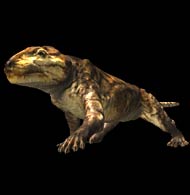 The term "cynodont" refers to a broad group of extinct mammal-like reptiles, the Cynodontia. These include the direct ancestors of mammals. This animal has been modelled on fossils of another cynodont found in South Africa called Thrinaxodon (thrin-AX-oh-don). Thrinaxodon lived a little earlier and was about the size of a cat. Thrinaxodon's teeth were varied with canines, incisors and molars which are mammalian features. Small holes in the bone of the snout suggest whiskers. The presence of whiskers implies body hair and suggests that the cynodont was warm blooded.
Being half reptile and half mammal the cynodonts represent the missing evolutionary link between these two groups. The cynodont and Placerias were distant relatives but the cynodont was more mammal-like. In the Petrified Forest, Arizona area in the USA only two molar teeth of a large cynodont have ever been found. These were similar to Thrinaxodon's but suggested a much larger animal.
|
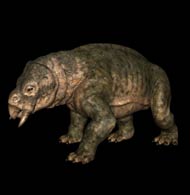 Placerias was a sturdy animal with tusks for rooting through the soil in search of a range of vegetation, and a beak for uprooting plants. A low-slung, powerful animal resembling a hippopotamus, Placerias was not a dinosaur, but a dicynodont or "two-tooth dog". It was so called because it had toothless jaw margins with only the two canine teeth, near the front. Dicynodonts are therapsids, or mammal-like reptiles, a group that includes the ancestors of modern mammals.
The best fossil find was at the Petrified Forest at St Johns, Arizona in the USA, where forty individuals were identified.
Some palaeotologists believe there is evidence that Placerias lived in a seasonal environment. Wear patterns on the tusks of other dicynodonts show alternate deep grooves and a smoother polishing effect. In the dry season they would have dug hard earth, which scarred the tusks. In the wet season, the ground would be wet and silty, helping to polish them.
|
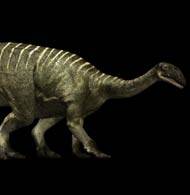 Plateosaurus evolved in the Late Triassic period and lived through to the Early Jurassic period. It was the first of the giant dinosaur herbivores, growing to around 9 metres long and 3-4 metres high. It had a long tail, long hind limbs, and a small head at the end of a fairly long neck. It had leaf-shaped teeth, and a beak-like jaw.
Plateosaurus belonged to a group known as the prosauropods and was a relative - though not an ancestor - of the gigantic sauropods of the Jurassic and Cretaceous. Until their appearance all herbivores had been squat, short-necked animals incapable of reaching high foliage.
Plateosaurus and the other prosauropods were the first dinosaur group to feed exclusively on plant-matter. Although Plateosaurus walked on four legs, palaeontologists believe that it could rear up on its hind legs and use its powerful clawed hands to pull in succulent branches. It was the first animal to evolve the ability to feed on relatively high vegetation.
Many fossils of these dinosaurs have been found throughout Europe and several species have been identified. The abundance of Plateosaurus fossils at some localities has prompted the suggestion that they lived in herds and even that they migrated to avoid seasonal droughts.
|
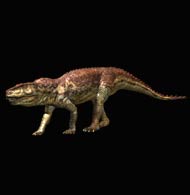 Postosuchus evolved in the Late Triassic period. Its skull was short and broad, and it had a narrow snout and deep powerful jaws. It had heavy-duty armour consisting of rows of plates covered its long back. It was the top carnivore of the age. It had a unique upright stance with straight legs directly beneath its body suggesting a quick and efficient runner. It is sometimes called a "running crocodile". It had longer back legs than front legs. Some palaeontologists believe it ran on two legs, but the majority think that it did so on four.
Postosuchus was an archosaur ("ruling reptile"), a major group of living and extinct reptiles that includes crocodiles, dinosaurs, pterosaurs and birds. It was on the line to crocodiles, but it was not a crocodile itself. There have been several Postosuchus fossil finds in the Petrified Forest in Arizona, and Post Quarry in Texas, both in the USA.
|
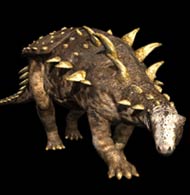 Polacanthus was a nodosaur, a type of 'bird-hipped' dinosaur. It sported a thick coat of bony armour plates that covered its rump. Evenly spaced rows of fierce spikes ran along its sides and shoulders. It was closely related to both the stegosaurs and ankylosaurs. All of these relied on armour or spines rather than fleetness of foot as defence against predators. Fossil remains show that it was a squat, four-legged herbivore that ate ground vegetation. It is only known about from three fragmentary skeletons and many armoured plates. These have been found in southern England, particularly on the Isle of Wight.
|
|
