|
THE GREAT |
EXTICTION |
|
 For about 160 million years, dinosaurs were the largest and most successful animals on land. Then about 65 million years ago, these huge archosaurs died out along with pterosaurs, mosasaurs, and many other reptiles. Mammals then became the dominant animals on the earth. Scientists have developed many theories to explain dinosaur extinction. The two major theories involve (1) gradual climate changes and (2) the collision of an asteroid with the earth. The first theory argues that, toward the end of the Cretaceous Period, the shallow seas dried up and the climate became more varied everywhere around the globe. Winters became too cold and summers too hot for dinosaurs to survive. Dinosaurs were too large to hibernate in dens, and they had no fur or feathers for protection against the cold. They also probably had difficulty cooling off in hot weather. Thus, death and extinction came as a result of gradually colder winters and hotter summers.
The other major extinction theory claims that a large asteroid hit the earth at the end of the Cretaceous. This asteroid impact would have thrown billions of tons of dust and debris into the atmosphere. Heat from the impact may have caused huge fires worldwide. Together the clouds of smoke and debris would have blocked sunlight from reaching the surface of the earth for many months. Although the seeds and roots of plants had a good chance of surviving this lightless period, the plants themselves stopped growing and died. If the catastrophe was severe and widespread enough, plant-eating dinosaurs would have starved to death. As the plant-eaters died, so did the meat-eating dinosaurs that fed on them. In addition, the darkened skies caused land temperatures to drop below freezing for 6 to 12 months in many parts of the world. Such low temperatures further damaged the dinosaur populations. According to the asteroid theory, small mammals and birds survived because they were protected from the cold by fur or feathers. Mammals and birds also could feed entirely on seeds, nuts, and rotting vegetation. Other survivors may have escaped extinction because they could live at the bottom of lakes or burrow underground. Most scientists, however, feel that no single theory completely explains why dinosaurs suffered extinction. They argue that a combination of causes contributed to the dinosaurs' disappearance. In fact, experts now believe that not all dinosaurs became extinct at the end of the Cretaceous. Many scientists regard birds as living dinosaurs that survived extinction. |
||
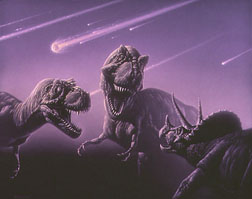 Asteroid theory
