BACK TO LATEST DINO NEWS
2 T-rex's and a Triceratops Uncovered
August 21, 2002- Two Tyrannosaurus rex fossils and a Triceratops specimen are about to be recovered from their excavation sites near the Hell Creek rock formation (near Miles City, Mont). They will be airlifted from the area Saturday. One T. rex will go to the Smithsonian's National Museum of Natural History, the other to the Museum of the Rockies in Bozeman, Mont., officials said. The fossils were uncovered by an expedition led by Jack Horner, curator of paleontology at the Museum of the Rockies, senior scholar at the Smithsonian museum and the palenotoligical consultant for all 3 Jurassic Park films.
(More at Yahoo! News ). |
New Pterosaur Discovered

July 18, 2002- Scientists have discovered a new species of Pterosaur named Thalassodromeus sethi (The first word is Greek for "sea runner" and the second honors the ancient Egyptian god Seth). The fossilized skull was dug up near the town of Santan do Cariri in northeastern Brazil. The scientists said the animal lived about 110 million years ago,spending its life soaring on 15-foot wings over a land dominated by lumbering dinosaurs. The pterosaur's
four-foot-long skull was topped with a hollow bony crest that rose 31 inches from the top of its head and may have acted like a rudder as the large animal flew. The crest fossil is marked with grooves from blood vessels, suggesting that the top knot also helped keep the animal cool.
(More at Yahoo! News ). |
More Evidence To Support Asteroid Extinction

June 11, 2002- Researchers say analysis of fossil leaves from 65 million years ago shows that there was a sudden and dramatic rise in carbon dioxide in the Earth's atmosphere. This could only have resulted from the impact of a large asteroid, vaporising billions of tonnes of limestone rocks, that could have quickly released massive amounts of gas into the environment. This would have resulted in catastrophic global warming, making it impossible for the dinosaurs and countless other lifeforms to survive.
(More at BBC News ). |
New Family Tree of Dinosaur Evolution Created
April 30, 2002-The most comprehensive picture yet of how dinosaurs evolved has been produced by a team at Bristol University. Since 1980, over 150 evolutionary trees of dinosaurs have been published, most of them looking at small groups of species. Now, Bristol researchers have put all of these smaller trees together to produce a "supertree" of 277 species of dinosaur(More at unisci.com ). |
New Ceratopsian Discovered in China
 April 6, 2002-Named Liaoceratops yanzigouensis, the newest find hails from the fossil-rich Yixian Formation in northeast China. Its discoverers say the dog-size creature is the oldest, smallest and most primitive of the neoceratopsians, one of the two main lineages of horned dinosaurs. The discovery shows evidince that Triceratops and its relatives evolved from very small Asian ceratopsians.(source from nationalgeographic.com ). April 6, 2002-Named Liaoceratops yanzigouensis, the newest find hails from the fossil-rich Yixian Formation in northeast China. Its discoverers say the dog-size creature is the oldest, smallest and most primitive of the neoceratopsians, one of the two main lineages of horned dinosaurs. The discovery shows evidince that Triceratops and its relatives evolved from very small Asian ceratopsians.(source from nationalgeographic.com ). |
| T-rex may not have been able to run at all?Feb 19, 2002-Using biomechanics, scientists created a computer model to analyze how much leg muscle mass is necessary for running. Computer models showed that in order for T-Rex to run 45 miles per hour (like shown in JP), as much as 86 percent of its weight might have had to be leg muscle mass! The ability of muscles to exert force at very large sizes is outstripped by the actual weight of the body that those muscles need to support. "As animals get bigger, their muscles have to be bigger and bigger to support their own weight. But adding muscle adds weight, and eventually something has to give.(source from cnn.com ). |
| New Sauropod discovered had a head like a Hammerhead Shark?Feb 19, 2002-
The new sauropod,Nigersaurus, had a mouth like a hammerhead shark and up to 1,000 teeth in its intricate jaws, "it would have swung its long neck to crop low-lying meadows of ferns like a mesozoic lawnmower", says Paul Sereno (paleontologist). Nigersaurus, named after the location discovered in Niger, Africa, may have grown to 14 metres (45ft) long and three metres (10ft) high at the hip. The teeth were narrow, needle shaped and no bigger than just a few millimetres in width, packed into an open groove in the jaw (the jaw extended to each side of the skull). Nigersaurus could have been the prey of a 12 metre (40ft) long crocodile called Sarcosuchus, or now famous "supercroc", discovered and named by Dr Sereno. (source from board membertherinzinosaurus and www.guardian.co.uk ). |
| Final Name for BataarFeb 15, 2002- The dinosaur formerly known as Tyrannosaurus bataar(which was known as Tarbosaurus bataar before that) has
had it's name changed again to "Jenghizkhan Bataar"(named after Gengis Khan)
and has been put into genus of it's own. The name "Tarbosaurus" is now resricted to smaller species(and their new genus). An 8 meter long Asian tyrannosaurid has been given the name tarbosaurus efremovi.
(source from board membertherinzinosaurus and his copy of "Dinosaurs:the ultimate guide to prehistoric life"). |
| New Troodontid DiscoveredFeb 14, 2002- The new species called Sinovenator changii (closely related to Archaeopteryx). The fossil was relatively complete and found in the rich Yixian Formation of western Liaoning in China. The specimen demonstrates that major structural modifications toward birds occurred much earlier in the evolutionary process than previously thought. Also the findings help counter, once and for all, the position of paleontologists who argue that birds did not evolve from dinosaurs.(source from board memberSegnosaurus and Fieldmuseum.org). |
| Ichthyosaur Vomit DiscoveredFeb 2, 2002-The worlds oldest fossilized vomit (from ichthyosaurs) has been found near the english town of Peterborough. The vomit shows that Ichthyosaurs regurgitated belemnites (a squid-like shellfish) like modern sperm whales do today with squid beaks. When examined under a microscope the shells show signs of being etched by acid digestive juices proving they were "puked" and that they would not have been excreted in the usual way because the shells would have caused massive damage to the animals intestines.(source from board member Segnosaurus and New Scientist.com). |
| Feathered Pterosaur DiscoveredJan 29, 2002-
The fossil discovered in inner Mongolia turned out to be the most complete pterosaur skeleton with "feather" and patagium found in the world at this time, and is named "Ningcheng Rehe Pterosaur". But feathered pterosaurs,have been found more than a decade ago, but have so far not been confirmed due to lack of discovery of intact skeletons, until now.(source from Peoples Daily). |
| How Did Theropods Learn to Fly?Dec. 20, 2001- Scientists have stated a new theory as to how the relatives of birds learned to fly. Taping the wings to a bird's sides (partridge chick), so it could not use them for flight, it was allowed to attempt to climb a tree, observers had discovered that the bird used it's wings to help climb the tree, flapping them as it climbed, even though they were taped down. The new arborial theory is that the relatives of birds developed the gift of flight after using there small arms, for means of balance while running, and while climbing trees to evad predators. (source from sciam.com). |
Largest Dinosaur of Australia DiscoveredOct. 10, 2001- The biggest dinosaur ever found in Australia has been unearthed on a sheep property and may prove to be a unique Australian Sauropod, paleontologists said on Wednesday. I've already noticed a few differences and it could be that we are looking at a new type of Sauropod," scientist Steve Salisbury told a news conference in announcing the find. Sauropods, which lived 95 million years ago, were gigantic, four-legged herbivores and are characterized by extremely long necks and tails, and disproportionately small heads. It was previously believed that the Australian Sauropod belonged to a group spread through the ancient super continent of Gondwana which incorporated South America, Africa, India,Australia and Antarctica. Salisbury said the dinosaur, nicknamed Elliot, may prove to be part of a unique Australian group of Sauropods. Elliot was discovered by a sheep farmer in 1999. He found a part of the dinosaur's thigh bone on his property near Winton in western Queensland state after heavy rain washed away top-soil.
Scientists visited the farm in 2001 to inspect the piece of thigh bone displayed in the farmer's house and have since found bones spread over a 2.4 mile radius.
Elliot is the largest dinosaur ever discovered in Australia and is believed to have measured between 52 and 69 feet in length, stood 29 feet tall and weighed between 22 and 30 tonnes. But scientists have unearthed only about five percent of "Elliot," including part of the thighbone, ribs and portions of the backbone. They believe some of the smaller, fragile parts of the skeleton such as the skull could be buried deep underground. "It could turn out to be the most complete Sauropod every found in Australia, apart from the largest dinosaur we've ever found," Salisbury said. Queensland Museum director Ian Galloway said it would take up to five years to extract another 500 bones which make up "Elliot." The exact location of the fossil find has been kept secret to avoid vandalism.(source from Discovery.com). |
| Embryonic Skin Discovered 
Oct .1, 2001- "If the discovery of these eggs is a rarity, then finding skin is a bombshell because it's the first time that embryonic skin has been preserved in a fossil," paleontologist Rodolfo Coria said. The fossilized eggs discovered in Neuquen, an oil-rich province in Argentina's southern Patagonian desert some 700 miles south of Buenos Aires, and were laid by a plant-eating titanosaur. Titanosaurs had small heads, long necks and heavy, bulky bodies. With their long tails and thick, pillarlike limbs, they may have reared up on their hind legs to crop leaves and browse tall trees when they roamed what is now modern-day Patagonia some 80 million years ago. Coria, paleontologist Luis Chiappe of Los Angeles' Museum of Natural History and Leonardo Salgado of Neuquen's Museum of Comahue University discovered the fossilized eggs in 1997 and are preparing an article on the discovery for a scientific journal. These are the first fossilized eggs of a sauropod � a broader category of dinosaurs that includes titanosaurs � to be discovered, Coria said. "This discovery and identifying these eggs as those of sauropods demonstrates that sauropods were egg layers, as are all reptiles," he said. The find also shed light on titanosaurs' gestation habits. "Various members of a herd would gather and deposit their eggs in a specific location of their choice. The area extends over 20 kilometers (12 1/2 miles), and it is impossible to think these eggs belonged to a single mother," Coria said. "This implies that many mothers gathered in the same place at the same time. It indicates a certain level of sophistication in their reproductive habits. We knew nothing of this about sauropods before this discovery," he added. Since the site of the discovery is not named on any maps, the scientists used the name of the nearby volcano of Auca Mahuida, a native word, to name the area Auca Mahuevo. "Huevo" means "egg" in Spanish. (source from Discovery.com)
|
| First Dinosaur Babies Identified
Sept.27, 2001- In a nesting area once used by hundreds of generation of dinosaurs, researchers have found a clutch of unhatched babies that come from the last and most massive family of long-necked,plant-eating sauropods. Luis Chiappe, first author of a study appearing Friday in the journal Science, said the baby dinosaurs drowned in there eggs just before hatching when a river flooded some 80 million years ago in what is now the Patagonia region of Argentina. Chiappe, chair of the department of vertebrate paleontology at the Natural History Museum of Los Angeles County, said the dinosaur nesting area was discovered in 1997, but researchers only now have identified the types of animals that used it as a nursery. He said the embryos are from a sauropod type of dinosaur in a family
group known as titanosaurs. A member of this family group, argentinosaurs, lived 90 million years ago and is thought to be the largest animal ever to walk the Earth-some 36.6 metres long and weighing more than 81 tonnes. Chiappe said the drowned embryos found in the eggs are from a previously unknown species that is a later and smaller member of the same titanosaur family. "We have found hundreds of nests� in an area known as Auca Mahuida, said Chiapllpe. �Sauropods gathered in great numbers-by the hundreds of thousands-to nest at this site. They returned to this site time after time.� Sauropods had small heads atop long necks. The massive body ended with a muscular tail. Chiappe said the dinosaurs apparently dug holes, laid their eggs in irregular clusters, often two or three layers on top of each other. They then mounded the nests with vegetation, he said, and abandoned the young to there fate. �They preferred to lay their eggs on the flood plain, but not close to river channels,"he said. The fossilized eggs prove the animals could misjudge the river. At least four times, he said, the nests wereflooded, drowning the young in their shells and burying them in mud. The mudpreserved and fossilized the eggs and the embryos. Chiappe said the eggs were about the size of softballs, and the six baby dinos analysed were about 30.5 centimetres long. Fossil fragments of adults from the same species, found nearby, suggest that when fully grown the babies would have been about 15.2 metres long. �They grew about 50 feet in 15 to 20 years, which means they grew very fast,�said Chiappe. The six baby dinos have the most complete skulls of any titanosaur yet discovered, a fact that Chiappe called ironic. �The best preserved skulls of this large group of long-necked dinosaurs come from embryonic remains, which are among the rarest of all dinosaur fossils,�he said. Lawrence Witmer, a dinosaur researcher at Ohio University, said the Chiappe discovery "is truly remarkable" and will contribute important new understanding about dinosaurs. "this is important," said Witmer. "It tells us about the growth and development of dinosaurs,...a key element of biology and one that is sorely missing from dinosaur studies." (Source: The Associated Press, Washington) |
| Fight for Utah Allosaurus 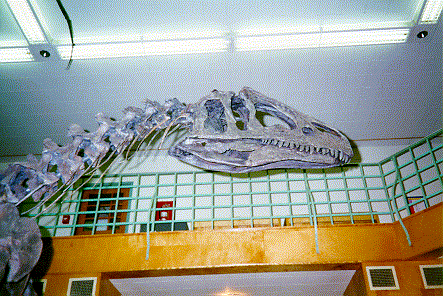 Sept.10, 2001- Mark Goodwin of the University of California Museum of Paleontology in Berkeley is criticizing the federal government for failing to demand that Japan return a rare, nearly complete 12 metre-long Allosaurus specimen ( one of only 10 or 12 well-preserved specimens that exist today). Emery County prosecutors charged a Pennsylvania couple with theft last week and federal prosecutors filed a civil suit against them seeking $2.1 million US in damages. They were accused of hiring someone to dig up the fosslil in 1991 on federal land about 320 kilometres south of Salt Lake City, and then selling it for $400,000 to an unidentified Japanese collector. Federal Officials are reluctant to pressure the collector, a key but volunteer witness in the case."We would end up with no dinosaur and no case if we don't play this out correctly," said a spokeswoman for U.S Attorney Paul Warner. (source from my local newspaper...)
|
BACK TO LATEST DINO NEWS