Dinoflagellate
have a simple structure consisting of a cyst which is covered by a complex
covering called an amphiesma. The
amphiesma consists of two membranes containing flattened vesicles. The thecal
plates which are composed of cellulose and act as the protist’s “armor”
are contained within these vesicles
(MacRae
1994). There are two
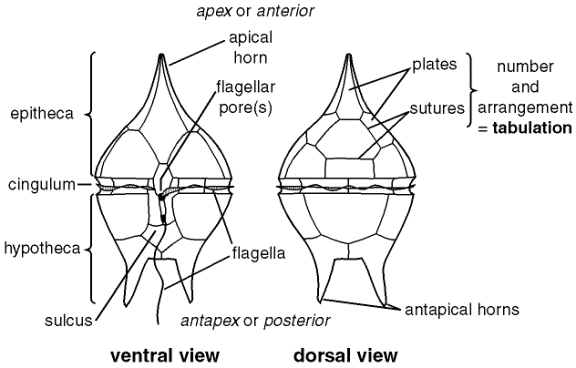
primary regions within the cyst: the
epicone and the hypocone. The
epicone is the top part of the organism and the hypocone is the lower part.
There are two grooves called the cingulum and the sulcus.
The cingulum is the central groove around the cell between the two cones
and runs horizontally. The sulcus
is the vertical groove that runs through the hypocone at a 90° angle to the cingulum (MacRae 1994).
Figure 1. Basic dinoflagellate structure (MacRae 1994)
The dinoflagellate has two dissimiliar flagella in which it uses for locomotion. One of the flagellum lies in the sulcus which beats back and forth for anterior propulsion. The other lies in the cingulum allowing for turning and maneuvering. The two together cause the organism to spin on its axis when moving creating a circular motion (MacRae 1994).
Some of the organelles of the dinoflagellate are special to the group.
The nucleus contains more DNA than any other eukaryotes and may sometimes
fill half the volume of the cell. Eyespots
are found in photosynthetic dinoflagellates only.
They are composed of lipid droplets and are capable of detecting the
direction of a light source. Trichocysts
are rod shaped protein filaments used for defense, which are discharged upon
rapid hydration. The plastid of the
organism has a triple membrane. This
plastid carries out photosynthesis and may even contain its own nucleus (MacRae
1994).
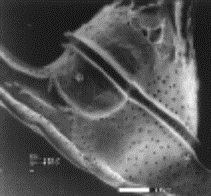
Figure 2. SEM of a horned dinoflagellate (MacRae 1994)
Page created by: Erin Grenert