Dinu-Stefan Teodorescu
Norway, Tromsø University
Psychological Institute
1-6-2000
Twenty three participants were tested for the modification of PPI as
influenced
by different sensory modalities prepulses: acoustic and tactile. Six
SOA 30,60,
90,120,150,420 msec, were used to further test their influence
on PPI. It was
found that the tactile sense inhibits more than the auditory sense
PPI .
Key words: prepulse inhibition (PPI), startle reflex, startle eye-blink
modification(SEM), stimulus
Onset asynchrony(SOA).
Introduction
Attention research have come to the interest of psychophysiology
for its importance in understanding the human normal and pathological mind;
using psycho physiological methods researchers have identified clear differences
between normal and schizophrenic subjects(Braff et.al., 1978), giving extra
credit to the deficit attention hypothesis in schizophrenics.
The most robust finding in psychophysiology is prepulse inhibition
phenomenon (PPI), that is assumed to be an index for automatic attention(Graham,
1975). The direction and amount of reflex modification can serve as involuntary,
nonverbal indices of the psychological processes elicited by the prepulse
(attention/inattention). Theoretical models of information processing proposed
by Shiffrin in 1988 distinguish between early automatic/preattentive processing
of information and later controlled/attentional processes. Automatic processing
is seen as occurring quickly independent of attention, without requiring
intention and without conscious awareness.
Modification of the startle reflex can be useful in identifying the
neural mechanisms at several levels of the central nervous system, special
in the automatic attention process.
In order to understand the logic of the experiment, we shall define
first some key concepts of the PPI phenomenon.
The startle reflex
The startle response is a brainstem reflex elicited by the sudden presentation
of a sufficiently intense stimulus (Koch & Schnitzler). Startle reflex
is proposed to have evolved as a defensive response (Davis, 1984) because
of the protective nature of the behaviour patterns consisting of eyelid
closure, limb flexion and a transient increase in sympathetic output (e.g.
increased heart rate).
Prepulse modification of startle have been shown to be determined by
activity in the pedunculo-pontine tegmental area (PPTg) of the midbrain
(Swerdlow & Geyer, 1993). This area projects to the nucleus reticularis
pontis caudalis (nRPC), which is considered to be the area in pons where
the startle response is initiated (Davis, 1984). Activation of the nRPC
produces startle responses, and activation of the PPTg inhibits these startle
responses.
It was a Russian researcher Gersuni who in 1971 identified two kind
of neurons, transient neurons and sustained neurons thought to function
in the service of stimulus detection and stimulus identification respectively.
Short time constant neurons are sensitive to changes in stimulus energy
that occur within a window of up to 20 msec (Gersuni, 1971).
The modification of the startle reflex decreases as a testing session
progresses, and this is due to either habituation of the inhibitory mechanism
or to a decrease in control startle reactivity.
Prepulse inhibition phenomenon(PPI)
The modification of the startle reflex in people have been first been
discovered by Graham in 1974 who gained the insight from her work with
rabbits in which she could easily modify the reflex.
The reflex modification phenomenon (PPI) can be described as follows:
a “non-reflex eliciting” stimulus called prepulse (S1) presented before
a reflex eliciting stimulus called startle stimulus (S2), can modify (facilitate
or inhibit) the amplitude and the power of the reflex.
The intensity of S1 must be not so strong as it can elicit the startle
reflex, but it must be strong enough to capture the person’s attention
or orientation reaction (OR) (Svartdal & Flaten, 1998). The lead stimulus
(S1) can be near threshold and in a different modality from the startle
stimulus and the inhibition can be produced not just by stimulus onset
alone, but by offset and stimulus change as well.
The inhibitory effect of the prepulse (S1) is profound and it does
not depend on learning, sensory masking or middle ear protective reflexes
(Graham, 1975).
PPI is not due to an activation of the middle ear reflex, because PPI
is present when the startle-eliciting stimulus is in another sense modality.
Also PPI is not due to forward masking of the startle stimulus by the prepulse
since the intensity of the prepulse is much lower than that of the startle
stimulus. PPI is not due to learning or conditioning since the effect of
the prepulse can be seen on the first prepulse- startle stimulus pairing
(Graham, 1975).
The modification of startle can be affected by a variety of parameters
of the lead stimulus (S1), such as duration, intensity and lead interval.
When the lead interval is short , 30-500 msec. For auditory prepulses and
slightly longer for visual and tactile prepulses, there is a reduction
of the startle response amplitude, compared to when the reflex is elicited
in the absence of prepulse.
Stimulus onset asynchronies (SOA)
The interval between the presentation of the prepulse (S1) and the startle
stimulus (S2) is called SOA. Short SOAs(15-500msec) are assumed to inhibit
the reflex (Dawson et al.,1997) while longer SOA ( bigger than 500msec)
potentate the reflex. Short SOAs up to 50 msec are proposed to facilitate
the reflex but only when the lead stimulus is presented in a different
sensory system then the startle stimuli. Short-interval inhibition effect
reflects a wired-in negative feedback which reduces the distraction produced
by reflexes such as startle, and thus protects what has been called preattentive
stimulus processing (Neiser, 1967, in Graham, 1975). Short lead interval
facilitation of startle may be useful in determining not just the convergence
of sensory pathways, but the conduction velocities within those pathways.
Short lead interval modifications of startle is considered to be automatic,
not under attentional control, and as a response measure has several advantages:
-availability of animal models, leading to an understanding of the
neurological mechanisms underlying the effect
- availability of developmental models
- minimal compliance and motivation required of the subject
- sensitivity to manipulations of the sensory, cognitive, social and
pharmacological environment
- functional significance in the life of the organism.
Short interval inhibition of startle is due to activation of neurons
in the auditory pathway that re preferentially sensitive to transient stimulus
aspects, such as stimulus onset (Gersuni, 1971).
At long intervals with neutral prepulses, startle amplitude is facilitated
if attention is directed toward the modality of the startle-eliciting stimulus,
but is inhibited if attention is directed away from the modality of the
startle-eliciting stimulus. Startle eye-blink modification at long lead
intervals may be either facilitatory or inhibitory depending on the direction
of attention, and therefore may be a sensitive index of sustained modality-selective
attention.
The fact that a lead stimulus can modify the response to a startle
stimulus proves that the neural signals activated by the two stimuli converge
at some point. The dependence of startle modification on lead interval
has helped to identify the neural mechanisms underlying startle elicitation
and modification.
The range of lead intervals at which startle inhibition is found for
acoustic lead stimuli and acoustic startle stimuli has traditionally been
considered to be 15-400msec, with maximal inhibition at aprox. 100-150
msec (Graham, 1975).
Protection of preattentive processing hypothesis
Protection of preattentive processing theory was proposed by Graham to explain the PPI phenomenon. At the onset of a lead stimulus two automatic processes are initiated: one necessary to identify the lead stimulus and the other to protect the processing of the lead stimulus from interruption by the startle stimulus .The degree to which this protective mechanism is activated determines the extent to startle inhibition. Lead stimuli that are more intense or longer in duration activate the protective mechanism more strongly, reflecting greater neural activation. Masaro has found in 1970 that the time window for PPI (30-500msec) is similar to the time required for stimulus recognition. The PPI phenomenon prevents the interruption of the processing of the prepulse; the process of preattention processing is vulnerable to interruption by extraneous stimuli and in order to prevent the interruption of preattention, a “preattentive defence mechanism” acts to suppress responding to extraneous stimuli during this processing stage. If the startle stimulus is presented after prepulse recognition has occurred (after about 500msec) the preattentive defence mechanism is no longer needed and either does not become active or “shuts off”. PPI is an indication that the protection of preattentive processing mechanism has been activated.
Attentional and automatic processing hypothesis
Dawson , Schell, Swerdlow and Filion (1997) have shown that short lead
interval startle inhibition can be more pronounced if the subject is told
to attend to the lead stimulus. Although startle modification at short
lead intervals is an automatic process, it can also be affected by controlled
attentional processing. Filion et al.(1993) proposed: ”short lead interval
SEM ( human startle eye-blink modification) may reflect not only the nonselective
protection of preattentive processing, but also the outcome of preattentive
processing in terms of an early evaluation of the significance of the lead
stimulus” (p.197).
The attentional hypothesis makes use of startle inhibition to
distinguish between automatic and controlled processing: directed attention
is proposed to enhance lead stimulus processing.
Dawson et al. (1993) has shown also that using directed attention this
has affected startle inhibition in normal subjects, but not in schizophrenics.
The schizophrenics show normal automatic processing, but were deficient
in the degree to which controlled attentional mechanisms could contribute
to startle inhibition.
Hypothesis
Prepulse inhibition (PPI) is assumed to be an index for automatic attention
and never before this have been tested, so in this experiment we have try
to test this by using a variation of type, number and complexity of stimuli
to see how these influence the PPI.
Other goals of the experiment were to see which of the two types of
prepulse, air or tone inhibits more and how the accuracy in the different
sense modalities influence the PPI. There have been identified two hypothesis
for this experiment, and these were:
Hypothesis 1
If a person is engaged in active attention toward the tactile sense,
than an auditive startle-eliciting stimulus after a short lead- interval,
shall produce a greater eye-blink inhibition.
Hypothesis 2
-If a person is engaged in active attention toward the auditory sense,
than an auditive startle-eliciting stimulus after a short lead-interval
shall produce a inhibition of blink.
The predictions of the experiment were: 1) Startle response magnitude
shall be influenced by SOA
2) Prepulse identification accuracy shall be inverse proportional with
the magnitude of the startle response.
In order to test the hypothesis , an experiment was designed in the
psycho physiological laboratory, using one group of subjects.
Methods
Participants
Nineteen University of Tromsø students, twelve men and seven females, with an media age of m = 24,82 years, volunteered to participate as paid participants to this experiment which was conducted in the psychophysiological laboratory at the Psychology Institute of Tromsø . All the participants had normal hearing as resulted after the perambulatory testing in the laboratory. None of the subjects were reported as having drunk alcohol or used caffeine before coming to the testing.
Apparatus and materials and stimuli
The experiment have been taken place in an acoustic isolated room (Tegner)
with the background noise level less than 25dB. The control of the experiment
together with the registration of the subject’s data was done by the data
program ASYST 3,1. The acoustic stimuli were produced by a Coulbourn sound
and sign generator , while the tactile stimuli were air-puffs with 21kPa
pressure (Flaten et al., 1989) presented between the fingers, which
could be registered but were not uncomfortable. The prepulse was 60-dB
a rise/fall time of 5 msec and the frequency of 1000 Hz .The startle-eliciting
stimulus was 5/100 msec. duration, 95-dB burst of broadband noise (20 Hz
to 20 kHz) with a rise/fall time of less than 1 msec. The prepulse preceded
startle stimulus by either 30, 60, 90, 120, 150 or 420 msec. The tone 1
and tone 2 were presented at an interval of 4000 msec. The startle
stimulus and the prepulse was produced by a Coulbourn S 81-02 noise
generator delivered to the subjects over Telephonics TDH-39 stereo headphones.
Beckman 3mm miniature Ag/AgCl electrodes were used to measure electromyographic(EMG)
activity from the periorbital region of the subject’s left orbicularis
oculi muscle (just below the left eye) using SIGNA electrode cream. EMG
activity was amplified by a Coulbourn S75-01 high-gain bio amplifier with
filters passing 9o to 250 Hz and amplified by a factor of 6000, kept constant
for all the subjects. The EMG signals were registered via a Coulbourn S
76-01 machine. The amplified signal was afterwards sent to the data machine
via Keithley interface. The collection of data was started 200 msec. Before
the stimulus presentation with a samplings rate of 10Hz. After the presentation
of the stimulus, the samplings rate was increased to 1000Hz.
Procedures
Before the experiment each subject filled out an informed consent
form and then the experimental preparations were executed in the following
order. First, a control test for hearing was undertaking, by presenting
the subject a 20-dB sound on the headphones which was the screeaning condition
for participation in the experiment. Second, the skin just beneath the
subject’s left eye was cleaned with an alcohol- saturated cotton
swab. Two electrodes were placed on the subject’s left orbicularis oculi
muscle (just below the left eye) at a distance of 15 mm on the side
of each other and a third electrode was placed in the middle of the front
head. Third, an air- gum was taped between subjects first two fingers,
at a distance of 3mm distance from the skin wall between the fingers. Fourth,
the instructions for the experiment were read and checked with the subject
if he have understood them. For the first protocol, the experimenter was
informing the subject that he/she was going to feel a puff of air, and
after some time, another puff of air together with a distracting tone,
followed by a scratch sound. For the second protocol, the experimenter
was informing the subject that he/she was going to hear 2 tones of 60-dB,
followed by a scratch sound of 95-dB. If the instructions were not
understood , the explanations were repeated again. The instructions for
the protocol 1 were:
“You shall feel a puff of air (1), then a new puff of air (2) and in
the same time a tone with a following noise stimuli. You shall judge if
the first puff of air is longer , or shorter than the second puff of air.
Ignor all other stimuli”
Fifth, a scoring sheet and a pen was given to the subject, to mark
the longer puffs of air in the first protocol, and to mark the longer tone
in the second protocol.
Sixth, the headphones were placed on the subject head while asking
him/she to keep the eyes open and to be concentrate.
In order to be accepted the experimental results of a subject, he/she
was supposed to be correct on minimum 50% of the trials.
The experiment was consisted of 84 trials, in each protocols, lasting
totally about 67 minutes.
During the experiment the experimentator was asking the subject through
the intercall the number of the trial, in order to check if the subject
was on the right trial.
Design
A 2(prepulse type: auditory, tactile) X 6 (lead intervals: 30, 60, 90, 120, 150, 420) X 2 (trial blocs: 1, 2) within subject factorial design was used.
Data analysis
Simple regressions Anova were performed for each dependent measure.
A probability level of .05 was used for all statistical tests; tests with
a probability level greater than .10 are not reported.
Results
Of a total of 23 subjects, four were excluded from the experiment because
of too little response on the startle (S2). The data is thus based only
on N=19 subjects. There have been found no sex differences
in the performance of the experiment.
Startle response magnitude
Startle response magnitude was positive correlated with the SOA , reaching
the highest amplitude at SOA = 120 msec. The amplitude is increasing up
to SOA = 120 msec. and after that the amplitude is decreasing, in the both
sensory systems . A rigid order of SOAs was found to be significant
for the magnitude of the startle, SOA[ F (5,90) = 11,59, p= .0001].
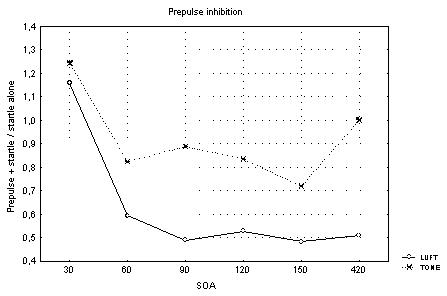
We have found a marked difference on PPI produced by using different
modalities prepulses, so that the air is inhibiting more than tone [F(1,18)=
6.09 p = .23].
A posthoc Newman-Keuls test was conducted showing that air inhibits
more than tone at all the earlier SOA, up to and included 150 msec, but
a prepulse at 420 msec gave a facilitation effect for air.
In earlier studies there have been found just the opposite effect,
that the sounds inhibits more than the air, and the air facilitates the
startle response.
In order to see more closely which of the two modalities inhibits most
the startle response we have constructed a graph.
Figure1.The startle is inhibited more by Tactile prepulse than an
acoustic prepulse
Prepulse identification accuracy
Interesting for the experiment was to see if the accuracy for the identification
of air puffs and sounds can have an influence on the startle inhibition.
It was found a significant difference between the subjects who were accurate
more sounds and puffs of air , compared with the subjects who were not
so accurate SOA[ F(5,75)=6.70, p=.00001]. For air puffs the accuracy mean
was m = 47,89[range( 39-62) max 72] , and the sound accuracy mean was m=
55,73[range(48-66), max 72].
Discussion
The startle reflex modification is one of the most robust findings in
psychophysiology, enabling more precise quantifications of psychological
processes , such as automatic attention, found for interest both in normal
and pathological subjects. The experiment hypothesis were answered,
so that we found a significant result for the first hypothesis, in that
the puffs of air inhibit more than sounds the Startle reflex. Also we answered
the first prediction, that the SOA influenced the startle response magnitude.
The third prediction proposing that prepulse identification accuracy
shall be inverse proportional with the magnitude of the startle response,
was not calculated .
Future experiments may share more light on attention in
different sensory modalities, which is better for different manipulations
of the PPI, and criss-cross between different modalities may help to measure
with more precision, the time used in the processing of information in
these sensory modalities.
References:
Blumenthal, T.D. (1999). Short lead interval startle modification. In M.E.
Dawson, A.M. Schell & A.H. Bøhmelt(Eds.), Startle modification:
implications for neuroscience, cognitive science and clinical science(3,
51-71). Cambridge University Press.
Braff,D., Stone,C., Callaway,E., Geyer, M., Glick, I. & Bali, L. (1978).
Prestimulus effects on human startle reflex in normal and schizophrenics.
Psychophysiology,15(4), 339-343.
Dawson,M.E., Schell A. M., Swedlow, N.R. & Filion, D.L. (1997).
Cognitive, clinical and neurophysiological implications of startle modifications.
In P.J.Lang, R.F. Simons & M. Balatan
(Eds.), Attention and orienting(11, 257- 279). London: LEA.
Filion, D.L., Dawson,M.E. & Schell A.M. (1993), Modification
of the acoustic startle-reflexeyeblink: a tool for investigating early
and late attentional processes.Biological Psychology, 35 185-200.
Graham,F.K.(1975). The more or less startling effects of weak
prestimulation.Psychophysiology, 12(3), 238-248.
Norris, C.M. & Blumenthal, T.D.(1996). A relationship between
inhibition of the acoustic startle response and the protection of prepulse
processing.Psychobiology, 24, 160-168.