Voice over IP: Products, Services and Issues
Mohamed Dinbil Aden, [email protected]
Abstract:
Once you are aware of the benefits and applications of
Voice over IP, it is too good to resist. Perhaps that is why vendors are
flooding the market with VOIP products and services. The following
paper analyzes the various issues in the evolving VOIP technology and the
challenges in the development of VOIP products. It then presents the features
of few VOIP Products offered by the leaders in this field, how well they
handle the issues and some services currently available.
See also:
Back to Mohamed Dinbi Aden's Home
page
TABLE OF CONTENTS
1. Introduction
1.1 Benefits of the Technology
1.2 New applications
2. Identification of Major System Components
2.1 Gateways
2.2 Gatekeepers
2.3 IP Telephones
2.4 PC based Software Phones
3. VOIP Product Development Issues
3.1 Voice Quality
3.2 Bandwidth Constraint
3.3 Transparency to the user
3.4 TCP/UDP Issue
3.5 Deployment of Gateway: Trunk Contention
Ratio
3.6 Security
3.7 Accounting/Billing
4. Market Products
4.1 Gateways
4.2 Gatekeepers
4.3 IP Telephones
4.4 PC based Software Phones
4.5 Motorola vanguard 6560 access
Device
4.6 Lucent Technologies Softswitch
5.VOIP Services
5.1 PC to phone Services
5.2 PC to PC Services
5.3 Phone to Phone Services
5.4 Network Services
5.5 Service for the Service providers
6.Summary
Appendix A - List of Gateway vendors
Appendix B - List of Group Conference Software Vendors
References
Acronyms
1. INTRODUCTION
"Migrate to IP or risk being left behind." This seems to be the idea
in the minds of vendors who have been using circuit switching infrastructures
for the transportation of voice. As you are reading this article, the Internet
is being modified to support voice traffic and products are being made
to link the data and voice networks. Eventually the Internet and the telephone
network will be one and the same.
Internet Telephony is an emerging technology and has a number of technological
and evolutionary issues. The technological issues are mainly because the
Internet was not designed for real time traffic such as voice and video.
The evolutionary issues stem from the fact that a variety of vendors develop
their products according to market demands and supplies. It will take time
for all these products to converge and inter work with the same reliability
as the circuit switched networks. However the benefits of using IP as a
generic platform for both data and real time applications are compelling
enough to encourage resolution of these issues.
The following sections describe the benefits of this technology, the
issues related to the technology, the challenges ahead and also present
a survey of the current VOIP products in the market, the services provided
and how well they handle the issues.
1.1 Benefits of the technology
-
Integration of Voice and Data
The integration of voice and data traffic will be demanded by multi
application software. The inevitable evolution will be web servers capable
of interacting with voice, data and images.
-
Simplification
An integrated infra structure that supports all forms of communication
allows more standardization and lesser equipment management. The result
is a fault tolerant design.
The integration of voice and data effectively fills up the data communication
channels efficiently, thus providing bandwidth consolidation. The idea
is to move away from the TDM scheme wherein the user is given bandwidth
when he is not talking. Data networks do not do this. It is a big saving
when one considers the statistics that 50% of a conversation is silence.
The network efficiency can be further boosted, by removing the redundancy
in certain speech patterns.
The Public Switched Telephone Networks' toll services can be bypassed
using the Internet backbone, which means slash in prices of the long distance
calls. However these reductions may slightly decrease when the Federal
communications Commission (FCC) removes the Enhanced Service Provider (ESP)
status granted to Internet service providers (ISPs) by which they do not
have to pay the local access fees to use the telephone company (TELCO)
local access facilities. Access fees form a significant part of all long
distance calls. But in spite of this, the circuit switched telephony would
be expensive because of lack of bandwidth consolidation and speech compression
techniques.
1.2 New Applications
-
Directory Services over Telephones
Ordinary telephones can be enhanced to act as an Internet access device.
Directory services could be implemented by submitting a name and receiving
a reply.
-
Inter Office trunking over the corporate intranet
The tie trunks between company owned PBXs could be replaced by an
Intranet link and would provide large savings at a good quality of service.
-
Remote access to the office from your home
One's home could be converted to a home office and gain access to
the company's voice, data and fax services using the company's Intranet.
With the advent of the Internet, companies have experienced large
increase in their web site inquiries. These may not result in immediate
financial transaction but atleast people get to know about their products.
This is the beginning of E-commerce. With VOIP there can be interaction
with the customers.
Real time facsimile transmission is an immediate application of Voice
over IP. Facsimile services which use dial-up PSTN services are affected
by high cost for long distance, analog signal quality and machine compatibility.
Instead a fax interface unit can convert the data to packet form, handle
the conversion of signaling and controlling protocols and ensure complete
delivery of the data in correct order.
Back to Table of Contents
P>2. IDENTIFICATION OF MAJOR
SYSTEM COMPONENTS
2.1 Gateways
The gateways are the devices that communicate between the telephone
signals and the IP endpoint. The IP endpoint usually speaks H.323 for media
stream and more recently Session Initiation protocol (SIP). The gateways
usually perform the following 6 functions
When an IP gateway is used to place a call across an IP network, it
receives a called party phone number. It converts it into the IP address
of the far end gateway, possibly through a table lookup in the originating
gateway or in a centralized directory server.
The originating gateway establishes a connection to the destination
gateway, exchanges call setup, compatibility information and performs any
option negotiation and security handshake.
Analog telephone signals coming into a trunk on the gateway are digitized
by the gateway into a format useful to the gateway, usually 64 kbps PCM.
This requires the gateway to interface to a variety of Telephone-signaling
conventions.
With some gateways the gateway trunk can accept only a voice signal
or a fax signal but not both. But sophisticated gateways handle both. When
the signal is a fax, it is demodulated by the DSP back into the original
2.4-14.4 kbps digital format. This is then put into the IP packets for
transmission. The demodulated information is remodulated back to the original
analog fax signal by the remote gateway, for delivery to the remote fax
machine.
-
Compression functions
When the signal is determined to be voice, it is usually compressed
by a DSP from 64K PCM to a 5.3 Kbps signal, which is the G.723.1 standard.
-
Decompression and Remodulation functions
At the same time that the gateway performs steps 1-5, it is also receiving
packets. Hence this function is required
2.2 Gatekeepers
Terminals are the L AN client endpoints that provide real time two way
communications. When an endpoint is switched on, it performs a multicast
discovery for a gatekeeper and registers with it. Thus the gatekeeper knows
how many users are connected and where they are located. The collection
of a gatekeeper and its registered endpoints is called as a zone.
A gatekeeper is required to perform the following functions:
Translation of an alias address to a Transport Address using a table
updated via Registration messages.
Authorization of LAN access, using Admissions Requests or Confirm
and Reject (ARQ/ARC/ARJ) messages. Access is based on call authorization,
bandwidth or some other criteria.
Support for Bandwidth Request, Confirm and Reject messages, or a null
function that accepts all requests for bandwidth changes.
The Gatekeeper provides the above functions for terminals, MCUs, and
Gateways, which are registered in its Zone of control.
2.3 IP Telephones
These are devices, which replace the existing telephones by providing
enhanced services suited to VOIP. At the same time they should retain the
capabilities of the original phones to keep the user comfortable.
2.4 PC Software phones
This arrangement consists of a microphone connected to a PC interfaced
by a card and running a software which permits voice and multimedia transfer
over the Internet. Microsoft NetMeeting is an example.
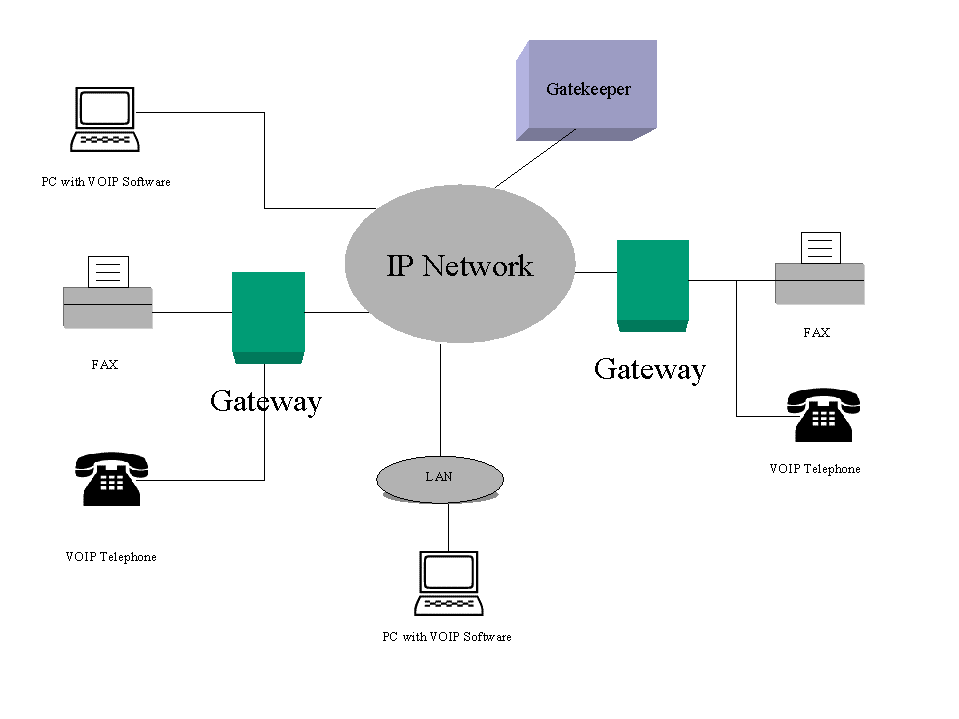
Fig.1 Components of a VOIP system
A range of the above products launched by different vendors is discussed
later. But before that, the major development issues regarding these products
are discussed.
Back to Table of Contents
3.VOIP PRODUCT DEVELOPMENT ISSUES
In this section we discuss the points that manufacturers have to take
note of while developing their products.
3.1 Voice Quality
The voice quality should be comparable to what is available using the
PSTN, even over networks of varying levels of QoS. If a company thinks
that reducing the bills is the criteria and adopts a poor quality VOIP
service, then the only people using that service would be the Managing
Director and the Accounting Officer. The employees will not compromise
quality to reduce the company's bills.
The following factors decide the VOIP quality:
-
Use of a Quality CODEC
Codec stands for Coder Decoder. It should give good voice quality and
low delay. The International Telecommunication Union's (ITU's) officially
recommended CODEC for all wide area networking applications is G.729
-
Echo cancellation
When a two-wire telephone cable connects to a four-wire PBX interface
or a telco central office interface, a special electric circuit called
a hybrid is used to do the conversion. But in them a small percentage of
telephone energy is not converted but instead reflected back to the caller
creating an echo. If the delay is more than 10mS the caller hears the echo
and this has to be avoided.
-
Delay
-
VOIP Forward Error Correction (FEC)
The public Internet has substantial packet corruption and loss. Packet
replay may not suffice. For this FEC can compensate for the corrupted or
missing packet.
-
Intra Packet FEC
Here extra bits are added, thus allowing the receiving end to determine
which of the bits were corrupted, yielding a packet ready for play out.
-
Extra packet FEC
Here extra information is added to each packet that allows the receiving
gateway to extrapolate from the previously received good packet and reconstruct
the missing or severely corrupted packet
3.2 High Bandwidth consumption
A telephone quality call or a toll quality call requires atleast 64
kbps/call. This bandwidth is impossible to dedicate on a data network for
voice.
Speech compression techniques as the G.729 reduce this to around 8kbps.
The IP router overhead is around 7 kbps. Thus it is 15 kbps. But modern
compressors make use of an important technique called as silence suppression.
In a typical full duplex phone conversation, only 35-40% is active. There
are significant pauses between words, phrases etc. The bandwidth consumption
is thus reduced by silence suppression. Ultimately voice requires only
5-6 kbps.
Silence suppression renders the line absolutely silent to the listener
so much so that it sounds absolutely dead. But by inserting Comfort
Noise or even better, by periodically sampling the background noise
and regenerating it for the listener, the line sounds active.
3.3 Transparency to the user
The user need not know what technology is being used for the call. He
should be able to use the telephone as he does right now.
An easy to use management interface is needed to configure the equipment.
A variety of parameters and options such as telephony protocols, compressing
algorithm selections, dialing plans, access controls, PSTN fall back features,
port arrangement etc. are to be taken care of.
Telephone numbers and IP addresses need to be managed in a way that
it is transparent to the user. PCs that are used for voice calls, may need
telephone numbers. IP enabled telephones IP addresses or an access to one
via DHCP protocols and Internet directory services will need to be extended
to include mappings between the two types of addresses.
3.4 The TCP/UDP issue
The voice packet is constructed as a UDP/IP packet, to avoid TCP/IP's
attempt to retransmit the corrupted packet. However TCP could be a better
alternative for Fax transmission simply because if lost packets occur during
the negotiation of a page, the fax could be terminated. When TCP/IP is
used and the host software hides the retransmission from the fax machine,
there will be no impact.
3.5 Deployment of the Gateway: Trunk Contentions
At a remote site there are normally 2 to 4 VOIP connections (or trunks)
from the VOIP gateway to the PBX allowing 2 - 4 simultaneous phone/fax
connections between the remote site and other corporate locations. The
actual number of trunks, depend upon the number of calls made per day and
the total amount they consume. The number of the head quarters trunks is
decided by the total number of phone calls between head quarters and the
remote sites and the total number of simultaneously active calls. Usually,
head quarters have a fraction of the total trunk count. The trunk contention
ratio is the ratio of total remote site trunks to head quarter trunks.
3.6 Security
-
Authentication/ Encryption
VOIP offers the potential for secure telephony by making use of the
services available in TCP/IP environments. Access controls can be implemented
using authentication and calls can be made private using encryption of
the links.
Security features are usually implemented using four primary components:
Packet Filtering Router, Connection gateway, Address Translating firewall
and Application proxy. [Mercer '99]
Achieving security is a complex issue. An H.323 call is made up of many
different connections. In addition addresses and port numbers are exchanged
within the data stream of the next higher connection. this makes it particularly
difficult for address translating fire walls which must modify the addresses
inside those data streams.
The firewall must be able to stand under a large number of simultaneous
connections also. Detection of intruders should be possible on the inside
and the outside of the firewall.
3.7 Accounting / Billing
VOIP gateways must keep track of successful and unsuccessful calls.
Call detail records should be produced. But the major issue is the suitable
billing model selection. A number of billing models have been suggested
-
Time-based - Metered by flow duration, time-of-day, time-of week
-
Destination, distance, carrier-based IP - Rated by called and calling station
IDs associated with the sequence of stages used to support the call
-
QoS-based Voice over IP - reflecting established service parameters such
as priority, selected QoS, and latency.
3.7.1 Future Billing Models [Mercer '99]
Directory-based billing applications will streamline the process of
customer registration, authorization, and service provisioning without
human intervention. Directory-based billing applications store user profiles,
service profiles, and service policy information in the directory instead
of a private datastore. That way, the directory service can maintain the
security and integrity of the data in a physically distributed environment.
Other billing models currently being developed include:
-
Secure Active Directory services for storage and replication of static
and dynamic data
-
Integrated Domain Name System (DNS) and Dynamic Host Configuration Protocol
(DHCP) services for associating IP address pools with user and application
profiles
-
Directory-based event services for propagation of application and network
events
-
Cross-platform application programming interfaces for enabling disparate
billing, provisioning, and management applications to securely produce
and consume directory-based data
In addition to all the above points, in a public networking environment
different products will need to inter work if any to any communications
is to be possible. The gateway between the telephone and the VOIP needs
to be highly reliable and fault tolerant. Sufficient capacity must be available
in the VOIP systems to minimize the likelihood of a call blocking and mid
call disconnects. The gateways must allow every device to be accessible,
especially when there is mapping across different protocols and signaling
systems. VOIP is likely to get very popular. In that case, the components
should be flexible enough to grow to very large user populations, to allow
a mix of public and private services and to adapt to legal regulations.
Back to Table of Contents
4. MARKET PRODUCTS
In this section some important market products categorized as gateways,
gatekeepers, IP phones and PC based software phones are discussed. Two
important VOIP support products, which do not fall into these categories,
are discussed in the end of the section. These are the Motorola Vanguard
6560 and Lucent Softswitch.
4.1 Gateways
4.1.1 MICOM V/IP
Gateway
Features
-
Uses the company's current LANs, routers and WANs
-
Easily integrates into any server or desktop PC running DOS, Windows 95,
Windows NT or Netware
-
Flexible analog/digital connections and operating platforms
-
V/IP interfaces with all the current communications equipment, from telephones
and PCs to servers and routers. The benefits of Voice/ data integration
are obtained at no risk of losing data or the expense of re provisioning
of the network.
Operation
-
The V/IP access number, destination office number and remote extension
number triggers a "calling out" signal which travels from the telephone
through the PBX system.
-
The "calling out " signal goes into either an analog or digital V/IP voice
interface card in the gateway PC.
-
The V/IP does call setup based on the digits entered. The V/IP's phone
data base maps the destination office number to the remote V/IP gateway's
remote address.
-
V/IP establishes availability of an open channel on the remote gateway.
If a priority protocol such as RSVP is available, it is requested for allocation
of bandwidth.
-
The call is connected within 1 or 2 seconds.
-
In the course of the conversation, the voice signal is digitized and compressed
into IP Packets. The voice packets are sent over a router. The router treats
the packets as priority IP traffic over the WAN.
-
When the call is terminated, V/IP automatically deallocates bandwidth,
logs call accounting records and recycles for the next call.
4.1.2 Nortel Networks
CVX SS7 Gateway
Features
The CVX SS7 Gateway supports up to 100,000 circuits, 2,048 route/trunk
groups, and 32 SS7 links (16 link sets). Because of this, service providers
can grow without bothering about Signaling System 7 (SS7) hardware changes,
if any.
Makes it easier to leverage existing SS7 trunks, which are typically
less expensive and readily available.
Bellcore certified to Network Equipment Building Standard (NEBS) Level
3, Earthquake Zone 4, and is Year 2000 compliant.
Provides a highly available, Bellcore- and industry-proven platform.
It includes fully redundant hardware components. Hence they are resistant
to single failures.
Web-based network management interface (SS7View) is provided to enable
fast and easy provisioning, supervising and troubleshooting.
4.1.3 Lucent Technologies
Pathstar Access server
This integrates the following components into a single system.
-
Digital loop carrier
-
Telephony system
-
Voice over IP gateway
-
Remote access server
-
Digital Subscriber Line (DSL) Access multiplexer
-
Edge router
It is an open platform with support for industry standard protocols such
as H.323, Q.931, Signaling System 7 (SS7), Open Shortest Path First (OSPF),
Border Gateway Protocol (BGP) and IP multicast.
4.1.4 CISCO
systems DE-30+ Gateway
The Cisco DE-30+ digital gateway provides a connection path between
the Cisco AVVID (Architecture for Voice, Video and Integrated Data) packet
telephony network and the Public Switched Telephone Network (PSTN) or a
PBX, which uses digital Primary rate Integrated Services Digital Network
(PRI ISDN) trunks. The DE-30+ supports 30 voice channels on an E1 interface.
Gateways are administered through the required
Cisco
CallManager. The DE-30+ gateway consists of a single PCI bus-based
card and mounts in any PCI bus-PC (where it only draws power).
The DE-30+ gateway supports up to 30 simultaneous channels of voice
over IP (VoIP) packet to circuit switched adaptation, G.711 encoding (A-law
or m-law), dual tone multifrequency (DTMF) detection/generation, signaling,
and line echo cancellation. 30 simultaneous channels of G.723.1 encode/decode
are also supported.
4.1.5 3Com Gateway
Features
-
3Com's total control IP telephony gateway promises to deliver a high density,
scalable platform that performs all H.323v/2 compliant functionality including
real time voice and call processing.
-
Its modular design allows interface and application cards to be inserted
and removed while the chassis remains on line, minimizing downtime.
-
3Com gateway is designed to inter operate with H.323 compliant gateways,
gatekeepers and legacy or third party back end services.
-
Each gateway can support up to 312 concurrent DS0 channels via T1 infrastructures
or 390 calls via E1.
4.1.6 VocalTec
Series 2000 Gateway
Features
-
Advanced Audio Capabilities
Advanced voice packet handling strategies such as reconstruction redundancy
provide enhanced sound quality. It also includes a jitter buffer (0-300
msec with controlled automatic tuning mechanism), interpolation of bad
frames, Voice Activity Detector (VAD), Comfort Noise Generator (CNG) and
16/32 ms G.165 adaptive echo canceler. The G.168 adaptive echo canceler
is up coming. Additional audio features include input/output gain control
and selectable G.711 u-law/A-law interface.
A standalone application, which runs on Microsoft WindowsNT, provides
network management. It offers an advanced Graphical User Interface (GUI).
Management can be launched from VocalTec Network Manager on a single console.
-
Failure Handling and Redundancy
Failure handling, based on VocalTec Gatekeeper (VGK), ensures that
Call Detail Record (CDR) information will be saved locally until the VocalTec
Gatekeeper connection can be renewed. A dynamic gatekeeper search algorithm
(DNS or IP-based) allows quick relocation of an available gatekeeper.
-
System maintenance and monitoring
The system topology, various statistics, current equipment status
are displayed. An event history browser with event log is also provided.
Output relay stops traffic in case of an alarm. Terminal tumble switches
allow the administrator to monitor time slots.
The open architecture of VocalTec Telephony Gateway Series 2000 offers
the option of interfacing to third party systems. Billing, Quality of Service
(QoS), and Authorization, Authentication, and Accounting (AAA) Software
Development Kit (SDKs) are available for third-party developers. AAA is
also supported via VocalTec Gatekeeper in VocalTec Telephony Gateway Series
2000.
VocalTec Telephony Gateway Series 2000 supports up to 16 E1/T1 trunks,
with up to 480/384 ports per shelf and 3 terminals per cabinet.
VocalTec Telephony Gateway Series 2000 uses industry standard codecs
(G.729A, G723.1, G.711, G.726, G.727, VHQC at 6.4, 7.2, 8, 8.8, 9.6 Kbps).
It is compliant with the International Telecommunication Union H.323v2
standard, helping to achieve interoperability in a multi-vendor environment.
H.323 (specifically H.235) token based authentication and authorization
procedures maintain network security.
4.1.7 Nuera
Solutions Access plus F200 IP
Features
-
Advanced voice compression
-
High bandwidth efficiency
-
Call routing
-
Flexible voice interfaces
-
SNMP network management.
-
High density, scalable architecture.
-
MGCP (Media gateway Control protocol) protocol used.
4.2 Gatekeepers
4.2.1 Ericsson
H.323 gatekeeper
Features
-
Provides Least Cost Routing
-
Provides Admission Control using Access Control lists and User profiles.
-
Tracks bandwidth usage
-
Provides Billing and Customer Care using a god database management system
-
Service Management is web based. It is done through extensive monitoring
and logging. It includes alarm and debug facilities.
-
Registration Admission Support (RAS), Q.931 and H.245 signaling support
-
Non RAS client support (e.g. Microsoft NetMeeting)
-
Scalability through architectural design
4.2.2 VocalTec
Gatekeeper
Features
It provides flexible, rule based dialing plan management to ensure
full control over call routing to all VocalTec Telephone Gateways. Routing
can be configured using permissions, restrictions or hours of service.
Least Cost Routing is supported, by assigning priorities to termination
gateways. Load Balancing ensures even distribution of call load between
available gateways.
It authenticates user ID/passwords and authenticates users who want
to access the IP telephony system. Cryptographic access tokens allow secured
control to network elements in compliance with the International Telecommunication
Union (ITU) H.235 standard.
-
Centralized Accounting and Billing is maintained.
-
Database Management and Backup is done through an Oracle Database.
-
It promises to accommodate networks with thousands of lines and millions
of subscribers.
-
Network manager can establish a gatekeeper hierarchy for networks managed
by separate organizations (domains). Each gatekeeper defines its own view
of the network and communicates with other gatekeepers when necessary to
contact a destination outside its span.
4.2.3 Nortel
networks' IPConnect
IPConnect is an Internet Telephony solution from Nortel Networks for
full featured telephone services and advanced data/multimedia services.
IPConnect promises a full featured, PSTN-grade telephony over multi-service
IP networks. IPConnect allows customers to take advantage of the cost efficiency,
open standards, and time to market for new services promised by IP networks
without sacrificing the values of traditional telephony: service richness,
quality, reliability, scalability and manageability. The idea is, providing
PSTN equivalency is the first step in moving to a highly advanced, integrated
voice/data communications based on an IP network.
4.2.4 Elemedia H.323 gatekeeper
GK2000S
The Elemedia® H.323 Gatekeeper Platform is a software package that
enables rapid development of high-performance H.323 Gatekeeper applications.
This modular software provides the components necessary to build H.323
version 2 compliant gatekeeper applications. It is designed to interface
easily to existing systems. It also provides stand-alone services for the
H.323 environment.
4.3 IP telephones
4.3.1 CISCO's
IP Phones
The Cisco 30 VIP voice instrument is marketed as a full featured IP
telephone for executives and managers. It provides 30 programmable line
and feature buttons, an internal, high-quality, two-way speakerphone with
microphone mute, and a transfer feature button. The 30 VIP also provides
a large 40-character LCD display consisting of two lines of 20 characters
each. The display provides features such as date and time, calling party
name, calling party number, and digits dialed. An LED associated with each
of the 30 feature and line buttons provides feature and line status.
4.3.2 Selsius IP phones
The Selsius IP Ethernet telephone is a device, which connects to the
standard ethernet LAN jack. It gives audio quality comparable to that of
a PBX telephone and id easy to use with single button access to line appearances
and features. The IP telephone has many characteristics of a PC in that
it can operate as a standard IP device and has its own IP address. Because
the IP phone is compatible with H.323, it can talk to other H.323 devices
like Microsoft NetMeeting.
4.3.3 Nokia
Systems' IPCourier
IPCourier is an ethernet business telephone that delivers PBX functionality
to the desktop without the PBX. Its features are multiple line appearances,
speakerphone capability, programmable buttons for memory dialing and LCD
display.
IPCourier also supports advanced call features such as call waiting,
caller ID, forward, transfer, mute and do not disturb.
4.4 PC based software Phones
4.4.1 VocalTec
IPhone v.5.01
-
PC-to-Phone Communication: requires signing up with an Internet Telephone
Service Provider (ITSP) and then regular telephones around the world can
be called. Community Browser serves as a virtual neighborhood in Cyberspace.
Direct Calling makes calling as simple as entering an e-mail address.
Caller ID, Call Waiting, Muting, Blocking and Directory Assistance offer
the amenities of a full featured phone.
-
Live Motion Video: One can actually see the person with whom he is speaking.
(No additional hardware is required to receive video).
-
Audio Conferencing Support: Can talk with up to 100 people using the VocalTec
Conferencing Server.
-
White boarding lets one share and edit documents, photos, and drawings
with other users. Text Chat lets fingers do the talking.
-
Multitasking and Auto Accept Calls let Internet Phone run in the background
while working.
4.4.2 Netscape's
CoolTalk
CoolTalk is a real time desktop audio conferencing and data collaboration
tool specifically designed for the Internet. Not only does CoolTalk provide
real-time audio conferencing at either 9600 baud, 14.4k or 28.8k modem
speeds, but also includes a full function White board, text based chat
tool, and answering machine.
4.4.3 White
Pine's CU-SeeMe Pro
-
Directory Service lets one see a list of all of the users published on
a particular ILS server, whether they are usingCU-SeeMe Pro, CU-SeeMe Version
3.1.2, or Microsoft® NetMeeting.
-
Conference Companion lets the user locate associates, friends or family
online and call them without needing to know their IP addresses
-
One can view up to 12 video images simultaneously
-
Integrated T.120 data collaboration for sharing applications, white board,
and file transfer for multi-user collaboration during conferences
-
A choice of video and audio codecs for best performance over a variety
of network speeds
-
It is H.323 compatible So one can make point-to-point calls to users of
Microsoft NetMeeting, Intel ProShare and other H.323 clients
-
It is available for Windows® 95/98, Windows NT®
4.4.4 Microsoft
Net Meeting
Overview
NetMeeting for Windows 95 and Windows NT is an award winning product
that provides the most complete conferencing solution for the Internet
and corporate Intranet. Its features let one communicate with both audio
and video, collaborate on virtually any Windows based application, exchange
graphics on an electronic white board, transfer files or use the text based
chat program. Using the PC and the Internet, one can now hold face-to-face
conversations with friends and family around the world. NetMeeting works
with any video capture card or camera that supports Video for Windows.
Benefits
-
Multipoint Data Conferencing.
Allows sharing of any Windows based application or folder with several
other participants using standards based T.120 data conferencing. There
is also an electronic white board, text based chat as well as file transfer
capabilities.
-
Internet Audio/Video Conferencing.
With a sound card, microphone, and speakers, NetMeeting lets one place
standards based H.323 audio calls over the Internet or a corporate Intranet.
Addition of a video camera permits face-to-face communication.
4.5 Motorola Vanguard Series
Motorola Vanguard 6560
This is an award winning expandable network access and concentration
platform that integrates LAN, analog/digital voice and future multimedia
traffic. The Vanguard 6560 Multimedia Access Device features Dual Core
routing and Bridging, which results in low response times, bandwidth efficiency,
quality voice transmission, and Multimedia transport capability.
It has following Voice Support features:
-
8/16 Kbps compression minimizes network bandwidth requirement
-
Support for analog and digital voice port connections
Other benefits include low response times and high bandwidth efficiency
4.6 Lucent
Softswitch
Overview
The Lucent technologies Softswitch is a programmable, multi-protocol
software system that allows communication between different signaling systems
such as SS7, SIP, H.323 and Q.931. It thus serves as a mediator between
telephony and IP connectivity. The system promises to be a scalable one.
It restores the simplicity for the user who is used to the current style
of placing telephone calls, fax and other voice services. It also solves
inter operability problems between gateways from different vendors caused
by signaling and protocol incompatibilities. Thus it permits an incremental
evolution of services. New protocols can be supported, by defining new
device servers.
Working
It sets up a point-to-point connection across IP and PSTN networks by
providing interoperability between SS7 and IP protocols. It is written
in Java and works on several platforms available. Internet Service Providers
can use it to offer multi-protocol telephony or telephony enabled services
and both.
Back to Table of Contents
5. VOIP SERVICES
With a whole range of products being launched in this field, there are
a variety of services being provided to the end user. The service basically
involves transferring voice from one end to the other. There are different
ways though.
5.1 PC to Phone Services
These Services require a gateway on the receiving side to convert the
IP packets back to Telephone signals.
A good example would be the VocalTec Surf&Call. It enables Web
to Phone Call center applications, promoting e-commerce. The web user sees
an icon of Surf&Call and when he clicks on that he is connected to
the phone on the other side through the internet via VocalTec gateway bypassing
the PSTN.
Dialpad.com has started an online VOIP service at www.dialpad.com.
This offers free of cost long distance calling service without any installation
of software through the Internet. Its revenue comes from online advertising.
5.2 PC to PC services
These can be provided without a gateway on either side.
This service is obtained by a variety of software products such as
It promotes video conferencing applications, Application share, White board
etc.
5.3 Phone to Phone Services
A large number of Companies are providing long distance phone call services
by means of VOIP at reduced rates. Examples are:
-
AT&T's 7cents
per minute any day any time offer for long distance calls in the United
States. It also offers discounted international calls on purchase of the
above offer.
-
America On-line offers 9cents/minute service.
-
IDT Corporation introduced
a service, which costs 8cents/minute in US. UK-18cents, Australia 20cents,
Japan 29cents/minute. These rates are 95% less than before.
A variety of calling card services to talk over long distances from anywhere,
including different countries. However in many of these services which
offer low rates, the quality is poor. But there are some, which use good
gateways and reliable billing mechanisms.
Examples:
-
AcculinQ :
This offers local Access in 5 Major US Cities including: Austin, Dallas,
Fort Worth, Houston Texas & Denver Colorado at an extraordinarily low
long distance rate of 5.9 cent per minute.
Calls to France and Germany are 11.9 cents per minute.
-
USATEL
VIA ONE Prepaid Calling card:
This card does not charge the FCC pay phone access fee. It charges
14 cents per minute in Continental USA.
Qwest, AT&T,
Deutsche
Telecom in Germany, France
Telecom, MCI,
Sprint,
Cyberlink,
VoiceNet
Global card are some other examples.
5.4 Network Services
Here we talk about services being offered to improve the quality of
transfer of IP packets. VOIP in a company Intranet is currently much better
than that over the public Internet. While talkng about issues, we talked
about the Managed IP Network. It is believed that fiber networks will improve
the quality of transfer.
5.4.1 Level
3's IP Crossroad Service
It is a nation wide IP network. This service is intended to give better
multimedia transfer across the network at reduced rates. The customer is
charged depending on the origination and the destination of traffic.
5.4.2 QWest
QWest Virtual Network Service enables building a virtual private network
system for call networks to meet individual business needs. It is built
with Qwest Macro Capacity Fiber network as a backbone and advanced architecture
and includes features desired by most private users.
QWest Dedicated Internet Access provides reliable Internet connection
by means of OC-48 packet over SONET IP backbone
5.5 Services for the Service Providers
5.5.1 ITXC
The company's customers and affiliates are traditional telephone companies,
new competitive carriers, ISPs, prepaid calling card companies, call back
companies, and newly formed Internet telephony service providers.
ITXC's WWeXchange Service networks different carriers and links every
telephone in the world by using a combination IP and PSTN.
5.5.2 IP Telephony for carriers by Delta Three and Ericsson
This service, combines Delta three's IP network with Ericsson's networking
hardware and software. The service will be marketed to fixed line carriers
and Internet Service Providers.
5.5.3 Cisco and VocalTec to jointly provide hybrid end-to-end services
to carriers and service providers
This agreement is claimed to put both companies in a unique position
for offering scalable, manageable, and flexible end-to-end solutions for
customers seeking innovative new services over cost-effective networks.
It is supposed to combine the best of both worlds by bringing together
Cisco's experience as a leading manufacturer of data networking and voice
gateway equipment and VocalTec's strong reputation as a software provider
and focused research and development in the area of voice services.
5.5.4 Cisco AVVID
Cisco Architecture for Video, Voice and Integrated Data is an Open systems
architecture proposed by Cisco to bring about converged networking. It
proposes 3 building blocks for this
-
Infrastructure such as Switches and Routers
-
Applications such as call control.
-
Clients such as IP telephones, H.323 Video conferencing equipment and PCs
It has applications in unified messaging, Desktop IP Telephony and CISCO
IP Contact centers.
Back to Table of Contents
6. CONCLUSION
VOIP is growing fast. The very knowledge of the applications of this
technology is enough for users and manufacturers to flock towards it. It
is ideal for computer based communications and at the same time bringing
down the cost of multimedia transfer. Hence VOIP products and services
have flooded the market. The above paper presented the features of the
products of a few major game players in the field of VOIP and how well
they handle the issues.
A list of gateway vendors and links to their web sites can be found
in Appendix A. A list of Group Conference Software Vendors is provided
in Appendix B.
Back to Table of Contents
APPENDIX A: LIST OF GATEWAY VENDORS
Back to Table of Contents
APPENDIX B: GROUP CONFERENCE SOFTWARE VENDORS
Back to Table of Contents
REFERENCES
The following references are organized approximately in the order of
their usefulness and relevance.
Technical Papers
[Mercer 98] Tom Mercer , "An Overview of the Internet Telephony Market",
Compaq White papers '98, 9 pages, http://www.digital.com/info/LIW06W
Discusses Current VOIP market
[Mercer 99] Richard jones, Jesus Cruz, Sridhar Solur, "Carrier Class
Voice over IP", Compaq White Papers '99 ,9 pages,
http://www.digital.com/info/LIW0PF
Discusses blling and other issues related to VOIP
[Ryan] Jerry Ryan, "Voice Over IP", Techguide, 24 pages, .http://www.techguide.com
Article on fundamentals of Voice over IP and issues related to quality
of transfer
[Micom] "Voice/Fax over IP: Internet, Intranet and Extranet", MICOM
White Paper,50 pages, http://www.micom.com
Discusses Qulity of service in VOIP and economics of investment
[SR99] Henning Schulzrine, Jonathan Rsenburg, " The IETF Internet Telephony
Architecture and Protocols ", IEEE Networks (June 99), pp 18-23
[HCM99] Christian Huitema, Jane Cameron, Petros Mouchtaris, Darek Smyk,
" An Architecture for Residential Telephony Service ", IEEE Networks (June
99),pp 50-55
[CISCO] "AVVID", Cisco White Paper ,30 pages, http://www.cisco.com/warp/public/cc/cisco/mkt/iptel/prodlit/avvid_wp.htm
Discusses CISCO's Architecture for Video, Voice and Integrated Data
[RC99] Daniele Rizetto, Claudio Catania, " A Voice over IP Service Architecture
for Integrated Communications ", IEEE Networks (June 99), pp 34-39
[Munch] Bjarne Munch, "IP Telephony - Today/Tomorrow Ever? ", Ericsson
White Paper ,13 pages http://www.ericsson.com
Discusses Fundamentals of VOIP and Market situation of VOIP
Books
[Marcus 98] Marcus Gonclaves, "Voice over IP Networks", 1998
[Black 99] Uyless Black, "Voice over IP", 1999
[DP 99] Jonathan Davidson, Jim Peters, "Voice Over IP Fundamentals,"
Macmillan, November 1999
[KG 99] Matthew Kolon, Walter J. Goralski, "IP Telephony," McGraw Hill,
September 1999
[Minoli 98] D. Minoli and E. Minoli, "Delivering Voice over IP Networks,"
John Wiley, 1998
[Douskalis 99] Bill Douskalis, , "IP Telephony: The Integration of Robust
VolP Services," Prentice Hall, 1999
Web Pages (For Product Information)
1. CISCO, http://www.cisco.com
2. MICOM, http://www.micom.com
3. Lucent Technolgies, http://www.lucent.com
4. Nortel Networks, http://www.nortel.com
5. VocalTec,http://www.vocaltec.com
6. Nuera, http://www.nuera.com
7. Ericsson, http://www.ericsson.com
8. Qwest, http://www.qwest.com
9. ITXC, http://www.itxc.com
10. Motorola, http://www.motorola.com
11. Delta Three, http://www.telephonyworld.com/service/delta3/
Back to Table of Contents
ACRONYMS
BGP - Border Gateway Protocol
NEBS - Network Equipment Building Standard
OSPF - Open Shortest Path First
PSTN - Public Switched Telephone Network
SIP - Session Initiation Protocol
SS7 - Signaling System 7
Back to Table of contents
Last Modified: November 23,1999.