
Gemstones Advices

| Gemstones Advices |
|


We can break down the price ranges of the different gem varieties into five basic categories: Traditional Gemstones, New Classics, Connoisseur Gems, Collector Gemstones and Affordable Gems.
These categories have basic price ranges. Lower quality stones, or stones with less popular colors, may cost less. Meanwhile, stones with particularly fine quality or color may cost more. These price ranges are meant to give you a general idea of the price relationship between the different varieties of gemstones.
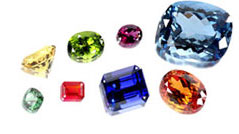
As with diamonds, gemstone value and quality are evaluated according to the "Four Cs": color, clarity, cut, and carat weight.
There's a fifth, much less scientific factor--perception.
Not surprisingly, color is the key factor with colored gemstones.
A common misperception in judging gems is that people assume the darker the color, the better the stone. This isn't true: color can be too dark, as with some sapphires that look more black than blue. If a gem's color is overly dark, it tends to be subdued and lifeless.
A much better rule of thumb is the brighter, richer and more vivid the color, the better. Within each gemstone variety it is the clear, medium-tone, very intense and saturated basic color that is most preferred. Muted colors or colors between hues, which some might find very attractive, are usually less expensive.
Always remember to look at the color in different kinds of light, since the light spectrum can affect gem color greatly.

A good cut, while it may not cost more, can add or subtract quite a lot of beauty to a stone.
A well-cut, faceted gemstone reflects light evenly across its surface area when held face up.
If the stone is too deep and narrow, areas will be dark. If it is too shallow and wide, parts of the stone will be washed out and lifeless.

Gemstones are generally sold by weight rather than size.
Some gems are denser than others, so the same weight stone may be a different size!
The carat weight will also affect the price. Large gemstones are usually rare, marking up the price per carat of the stone.

For every gemstone, pricing follows common sense: the better the final visual effect of all the quality factors of the stone, the more valuable that stone is. But different varieties of gemstones have different price ranges. This is where the perception factor comes in.
Some varieties are lower in price because they are readily available; some, because the color isn't very popular (brown and yellow stones, for example); some, because the material is relatively soft; and some, because they have all the right stuff but no one knows it.
There are plenty of examples of beautiful, rare gemstones costing less than gems that are not so rare -- merely because they possess a funny name, or people confuse them with an inexpensive variety, or they are of a gem variety few of us are acquainted with.
In the past, the gemstone business was dominated by the big three: ruby, emerald and sapphire. These often are called precious stones, a term probably derived from the French label, "pierres precieuse."
When other gemstone varieties began to gain popularity, the jewelry industry got tired of calling them "colored gemstones other than ruby, emerald and sapphire." Unfortunately, the term they made up for these other stones was "semi-precious." Too bad the French terminology was not followed in this instance, or these other stones would have been known as "fine gemstones," which is a much better and more accurate term.
The problem with "semi-precious," and the reason the jewelry industry essentially banned its use, is that it's a misnomer. Rubies, emeralds, and sapphires can sell for less than $100 per carat, while a fine Paraiba tourmaline, for example, can sell for $20,000 per carat!

These are the ruby, the emerald and the blue sapphire. Because of their lasting appeal and distinguished history, they are usually more valuable than other colored gemstones.
Generally, rubies and emeralds are priced higher than a sapphire of comparable quality, due to rarity. For a one-carat stone of average-to-good quality you can expect to pay between $250 and $10,000 per carat. Of course, truly fine gems will cost more.

Then there are the gemstones that are the rising stars of the jewelry industry: tanzanite, tourmaline, aquamarine, imperial topaz, and tsavorite garnet. These gemstones are usually available in standardized sizes, but you really should look at some of the fine, larger single stones to see why they have so many fans.
Gems in this category range from $50 to $1,000 per carat, for an average-to-good-quality one-carat stone. As a perfect example, tsavorite easily can reach $3,000 per carat.

These are gemstones that have a more specialized market because they are more of a rarity. They include black opal, jadeite, pink topaz, chrysoberyl cat's-eye, fancy colored sapphires, and rare stones like demantoid garnet and alexandrite, which are practically "extinct" in rough form.
These gemstones are highly prized, with prices that range from $250 to $5,000 per carat. For instance, an alexandrite with a good color change will command at least $10,000, even in a one-carat size.

These are not available in quantity to be marketed effectively, so you get a lot of beauty for the money. This category includes spinels, zircons, moonstones, morganites and other beryls, along with many other rare gemstones.
Red and hot pink spinels can command a few thousand dollars per carat, but most of the gems in this category will sell for hundreds, not thousands, even those specimens with excellent color.

The more affordable gems combine great color with surprisingly reasonable prices and good availability.
These stones include some old favorites, as well as some new ones: amethyst, white opal, citrine, ametrine, peridot, rhodolite garnet, blue topaz, iolite, chrome diopside, kunzite, andalusite, and many ornamental gemstones such as lapis lazuli, turquoise, onyx, chrysoprase, nephrite jade, and amber.
Prices for these gemstone range between $5 and $100 per carat for a one-carat stone.

In every gem variety, especially the more expensive ones, you should expect to pay more for matched pairs, sets, and special shapes and cuts.
When you shop for gemstones in jewelry stores you will see a range in qualities. Generally, you will find low-to-medium quality gemstones set in jewelry, and a wider range of qualities in unset gemstones.
Often, the jeweler will have to call in top-quality gemstones from a supplier: most jewelers do not stock a wide selection of fine gems even in ruby, sapphire and emerald.
How can you comparison-shop on the web? Very carefully. Some sites make extravagant claims about the "investment quality" of their stock.
With gemstones, color is the most important value factor; but it's difficult to compare color online, because the differences between monitors make the color comparison of even the best photographs difficult.
To counter this effect, the better gem retailers such as Mondera will stock and sell only top-quality gems, because it's very difficult to show subtle differences in quality on the screen. Also, a liberal return policy can assure you of the opportunity to independently appraise your gem in order to verify its quality.
Certainly, lesser-quality and less expensive gems can be sourced out by retailers who offer finding services. However, before you decide to trade down in quality, think instead about choosing a top-quality gemstone in a more unusual gemstone variety.
� 2001-2004 - Cambodian All rights reserved.
Mr.Keut Dina
Phone : (855) 12 764555
Phone : (855) 12 771169
Fax : (855) 23 880965


