
SUMMARY
AND RECOMMENDATIONS:
Contrary to
general belief, publishing sector in Turkey is a grand one, which is in
cooperation with many other domains. The sector has 4 main problems: Pirate
edition of books, distribution, lack of qualified employees and lack of official
and efficient associations of publishers. Due to the lack of standardization in
the market, sufficient data cannot be reached.
As for the
position of the translators in the sector, translators are not accepted as
personnel. Instead, they work by contract per book and are paid on the profit of
the book they translate. In the sector due to the lack of a legal association
and insufficiency of laws, translators are usually faced with injustices and
problems. Consequently, the sector requires hard work and satisfies spiritual
needs, yet it does not offer satisfactory earnings for translators. Thus,
1)
Establishing
publishing houses and declaration of these institutions to official bodies
should be determined by legislations to be introduced. So, standardization of
founding a publishing house should be scrutinized.
2)
In order
to combat pirate editions of books, publishing houses should form organizational
structures among themselves. Efficient and deterring laws should also be
introduced.
3)
Much more
importance should be given to advertisements and promotions and the
book-purchasing habit should well spread to a far wider population so as to
promote book sales and help the sector to flourish.
4)
Translators
working by contract should solve their social security problems. The contracts
should also be founded on a legal basis.
5)
On-the-job
training opportunities should be offered to translators within an organizational
structure among translators.
BACKGROUND OF THE STUDY:
AUTHORIZATION OF
THE STUDY: This report on the profile of translators in publishing sector is
submitted on July 17, 2000 to Mrs. Leyla Güder, Assistant Director in the
department of translation and interpretation at the University of Bilkent. Mrs.
Güder orally authorized Neslihan Demirkol, Onur Şen, Esra Ortakan to conduct
the study on June 26, 2000.
STATEMENT OF THE
PURPOSE: We are aiming at analyzing job opportunities available for translators
and interpreters in the publishing sector.
METHOD OF
ANALYSIS: In seeking job opportunities for graduates of translation, we firstly,
determined the sector on which we would study. In determining, our interests and
accessibility of the sector were the criteria. In the first step, we searched
for general information in libraries on the Internet and we contacted with two
associations: YAY-BIR (Association of publishers in Turkey) and the agency of
ISBN (International Standard of Book Number) in Turkey. In the second step, we
chose 13 samples from the sector. We prepared 14 questions which consisted of
three parts:
1)
Economic and politic situation of the publishers in Turkey
2) The problems
of the sector
3) The position
of translators in the sector
Then, we
organized interviews with some publishers in Ankara and contacted with some
others by telephone, by e-mail and by fax. We also interviewed with a translator
from the sector to find out advantages and disadvantages of the sector.
In the light of
the answers we reached to a conclusion.
FINDINGS
AND ANALYSES:
A GENERAL
APPROACH TO THE PUBLISHING SECTOR IN TURKEY:
The publishing
sector is composed of 3 parts:
a) Pre-publishing
period
b) Printing and
publishing period
c) Distribution
and sale period
During first
period publishers, authors, translators, editors, proofreaders are charged.
During the second one printing houses and their employees are recruited. In the
final period distributors, wholesale and retail bookstores function. As a
result, contrary to general belief, publishing sector in Turkey is a grand one,
which is in cooperation with many other domains.
In our study, we
examined this grand sector by focusing on three points:
a) Economic
situation
c)
The position of translators in the sector.
We focused mainly
on 13 imminent publishing houses.
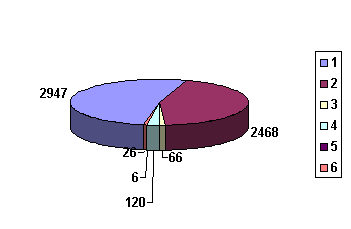
In 1999, 5633
applications have been made for ISBN. Within this sum, 2947 publishing houses
are indicated.
1.
Publishing Houses
2.
By
person
3.
Universities
4.
Associations and Foundations
5.
Newspapers and Magazines
6.
Others
Source: Turkish Agency of ISBN
But this sum does
not really represent the number of publishing houses in Turkey. Although Turkish
Agency of ISBN is the sole official and reliable institution for the number of
publishing houses, it is estimated that approximately 5000 publishing houses
function in Turkey.
This is because
a) There is not a
standard of being accepted as a publishing house
b) It is not an
obligation to take ISBN
c) Publishing
houses are not obliged to declare themselves to an official body
These 2947
publishing houses published 19311 books between 1999-2000.[1]
Among these publications are there 4108 translated works.
88.907 ISBN were given between
1984-2000 including literature, course books, basic sciences, applied sciences
etc. For the year 2000, 7463 out of which 1558 is translated works and 1999
11.848 ISBN were given and 2550 of these belong to translations
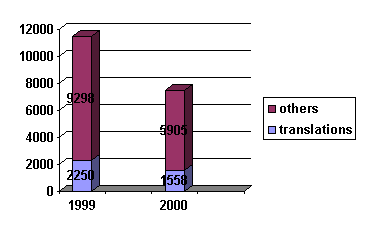
Source: Turkish Agency of ISBN
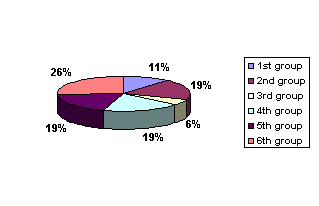 |
|
1st
group: Publishers of books and similar works (novels, scientific publications,
co
2nd
group: Publishers of periodicals
|
|
Source: REPUBLIC OF TURKEY, PRIME MINISTRY
STATE
INSTITUTE OF STATISTICS (SIS)
PROBLEMS OF THE
SECTOR:
In addition to
these standardization and ISBN problems, the publishing sector in Turkey is
today faced with 4 important problems. The most important problem is pirate
editions of books. It constitutes
the biggest threat to the sector. As copyright is breached, authors, publishers
and translators are affected financially. Cheap prices of pirate copy of books
attract readers. So, prevention of pirate copies is of great essence in terms of
book sales and of a decrease in book prices.
The second
problem is distribution. There is a time lapse between the distribution of books
and the payment of the deliveries. The publishing houses that we contacted with
solve this problem by setting their own distribution systems.
The next one is
lack of qualified employees. First of all publishing requires enthusiasm and
dedication rather than a precise high education. Secondly, low incomes and
exhausting work do not attract qualified people when compared with other
sectors, which offer higher salaries, more opportunities to translators.
The last problem
is lack of an efficient association. As we researched through the sector we
found out one association of publishers, YAY-BIR, which has only 230 members out
of nearly 5000 publishing houses. This lack hinders efficient solutions to
sector’s problems in the long run.
The publishing sector in Turkey cannot be described with economic huge
data. Nevertheless, the sector seems promising for the future and it already
contributes greatly to our cultural and educational life. But as learned by
publishing houses we interviewed, there is a steady economic decline in the
sector. That is, although the number of the books published each year is
increasing, book sales have been diminishing continuously since last three
years. In general newly established publishing houses, which are still in period
of investment. Don’t make splendid profits but old ones, public sector or
subordinate foundations are already making profits or don’t have economic
concerns.
THREATS TO SECTOR
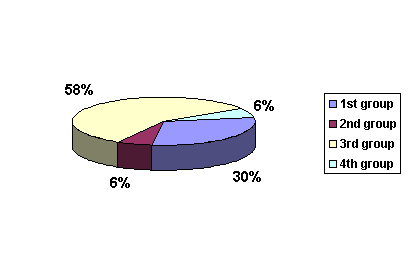
As for the future
threats to sector, pirate editions of books, the effects of multimedia and
changes in cultural structure, lack of qualified employees lead in the list. In
other words visual sources (internet, TV) are gaining importance, so the society
is beginning to abstain from reading.
|
Source:
A thesis submitted to Hacettepe University (1994), on the subject of ISBN and
Publishing Houses inTurkey
COMPETITION
IN THE SECTOR
Competition is
not a valid concept in the sector. In fact, there are only two publishing
centers in Turkey (Ankara, Istanbul) and we can’t mention any competition
between them.
MANAGEMENT AND Publishing
POLITICS:
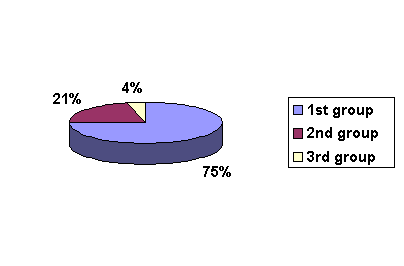
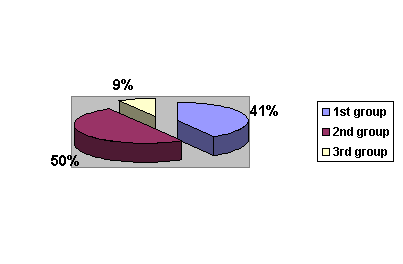
When it comes to
management and publishing politics, the managerial profile of the publishing
houses is as follows:
|
Source: A thesis
submitted to Hacettepe University (1994), on the subject of ISBN and Publishing
Houses inTurkey
As a part of our study we examined mainly
12 most imminent publishing houses:
1)
Altın
Publishing Co.
Founded in 1959,Altın Publishing publishes bestseller
fictions and non-fiction works as well as preschool books, children’s and
juvenile literature, auxiliary school text books and Langenscheidt Universal
dictinoraies, 40% of which are translated works.
2)
Arkadaş Publishing Ltd.:
Established in1980, it has been serving as the Authorized Replicator of
Microsoft products since 1997 to over 30 countries worldwide. Over 100 Microsoft
Press books have been translated to Turkish by Arkadaş.
3)
Directorate General of Press & Information of the
Turkish Republic: Founded in 1920 under the directives of Ataturk, it issues
various publications that promote Turkey from every standpoint or distributes
some publications purchased from other institutions.
4)
Can Publishing Ltd.:
Established in 1981, it has published nearly 1000 titles so far under following
series: children’s books, Turkish authors, classics, contemporary authors,
detective novels, dramas.25% of these are translated works.
5)
Metis Publications Ltd.: ,Established
in 1982, Metis published over 300 books in the following series (30 % of which
are translated works): history, society and philosophy, Black and White,
Women’s studies, Green Books, socialism, theory and history, psychiatry and
psycholoanalyses, fictions. It is also the representative of Verso Books in
Turkey.
6)
Pusula Publication Ltd.: An
independent publishing house specialized in information technologies, Pusula
publishes magazines and encyclopedias. It is also involved in a wide variety of
activities including multimedia and web design.
7)
Varlık
Publishing:
Established in 1946 by Yaşar Nabi, company provides its readers the
prominent works of Turkish and world literature, self-help, anthology, children
and science.12 % of its works are translated.
8)
Tübitak Popular Science Books:
Founded in 1993,Tübitak prints three separate series: namely books for kids,
books for young readers and reference books.18 % of these are translated works.
9)
Belge International Publication:
Founded in 1977,Belge aims at opposing any type of taboo. In association with
“The International Publishers’ Association” Belge publishes nearly 50
books in a year.27 % of their publications are translated works from many
different languages such as Arabic, Russian, Italien, Armenian, Spanish,
Kurdish.
10)
İletişim Publishing Co.:
Founded in 1982,İletişim
Publishing focused mostly on encyclopedias and periodicals in its early years.
Since 1988 İletişim has concentrated more on books published from contemporary
world and Turkish literature, researches specifically on Turkish history and
society, autobiograhies, cultural studies and essays.25 % of these books are
translated works.
11)
Yapı Kredi Publishing Co.:
Founded in 1992 as a subordinate foundation of Yapı Kredi Bank, it publishes
nearly 100 books a year in literature, Cogito, art, history.50% of its
publications are translated mainly from English, French, Germany.
12)
Inkılap Publishing Co.:
Established in 1930,Inkilap publishes nearly 100 books a year, 30 % of which are
translated books from mainly English, French, Germany and Spanish. The series of
Inkılap are bestseller books, law books and children’s books.
13)
Dost Publishing: Founded in 1997,Dost publishes
approximately 65-85 books a year in the series world and Turkish literature,
history of culture, law books, travel books.85 % of these are translated works.
PERSONNEL
PROFILES
As for the personnel of these 13 samples we found out that
the direction bodies are composed of university graduates from variable
departments.Foreing language is not a necessity but almost all publishers and
editors know at least one foreing language.The rest of the employees are
high-school graduates or university students.10 % of these employees can speak
one foreing language.(mostly English)
In the light of our study, we concluded that all of these 13 publishers
use translators. In 11 of these, translators do not work as personnel of the
publishing house; as a result they do not have any social security. Besides, the
owner of International Belge Publishing and one of the editors in İletişim
Publishing is a translator.
As publishing houses do not have strict hierarchy, promotion
possibilities are not available not only for personnel but also for translators.
In the sector, translators do not have personnel status with a regular
salary instead, they conclude a contract with the publisher for each book. The
publishing houses we interviewed have different methods of payment for
translators. Translators are paid in proportion with the copies printed of the
book. (Until 1000 copies). Supplementary payments are maid after 1000 copies.
Some publishing houses pay half of the proportion of the first payment for the
rest of the 1000 copies.
The proportion of the payment varies between 6%-12% of the profit. The
proportion of the payment depends on the quality of the translation. For example
while Tomris Uyar takes 12% of the profit, less experienced translators take
between 6%-9% of the profit depending on the reduction the translation requires.
The publishers
require some conditions while choosing their translators: A university diploma
of the language or of related departments (although it is not an obligation, it
makes things easier) and generally speaking, the publishers insist on experience
and a good usage of the both languages regarding translation work. As a result,
although in some cases, diploma plays an important role in application period,
the capability and experience are more important. Consequently, the publishers
give a sample text to translators in order to evaluate their capacity and
according to the results, translators are charged.
Big publishing houses prepare a contract in which all the details of the
translation, deadline of the delivery and the payment are written. However small
ones might not give necessary importance to mutual agreement. Consequently
translators begin to study on the works without a written act and after the
delivery; there might be some troubles about the payment between translators and
the publishers. Besides, translators are sometimes not properly informed about
copies printed and as they are paid in accordance with the profit, they can’t
get the money they deserve. One of the translators with whom we interviewed and
who experienced some of these problems linked them to lack of legal associations
of translators and insufficiency of the laws in the subject area.
Bu makale yaz okulu boyunca Esra Ortakan,Neslihan Demirkol ve Onur Şen tarafından hazırlanmıştır.
