The old world's romantic city
C
enturies ago when Lanka was ruled by the Sinhalese Kings, 'Gaalla' or Galle was the old
world's romantic city which owed its glory to its natural harbour. This picturesque seaside
resort was the centre of trade in olden days, because of its strategic position, where sailing
vessels laden with merchandize from the Western countries of Egypt, Persia, Arabia, China,
Malaysia and Singapore converged.
The traders bartered their goods with the produce of this country, which was reputed for its spices, gems and pearls. In the markets of the city there were gems comprising of Sapphires, rubies, cat's eye and semi precious gems as tourmaline, amethysts and moon stones. The people of Galle prospered with the sale of exquisite curios made of tortoise shell, ebony, porcupine quills and elephants' tusks. Even today a semblance of this trade is found attracting tourists. Besides traders and entrepeneurs, there are records of visits by important personages, such as Ibn Batuta, the Arabic traveller from Morocco, Fa Hein from China and Marco Polo from the West. This town got its name as 'Gaalla' in the native tounge due to the large number of bullock carts that entered there and were stalled in one place. The locality where there were more numbers of carts and bulls stationed was called 'Maagalla' or Magalle. In 1505, Lorenzo De Almeida, the son of the Viceroy of Goa set foot in Galle accidentally when his fleet of ships on the way to the Maldive islands caught in a great storm at sea was compelled to take refuge in this harbour. Thereafter he wrested the Galle harbour from the Sinhalese and were the first Europeons to set foot on the island and make extensive contact with the Sri Lankans. They constructed a barricade enclosing the projection of the land towards the sea and fortified it with a moat to avoid attack from the mainland. However by and by they conquered the whole of the sea coast border and finally established their government xcept in the Hill Country. They forced their religion, Catholicism on the innocent natives and ruled with an iron hand until the Dutch defeated them in 1640 and took over reigns of government. The long conquest of the island by the Portuguese and intervention between them and the Sri Lankans has left several sociocultural imprints on this country. The Portuguese stamp is particularly strong in the language, religion, education, administration, food, dress, names, music and drama. The surnames perera, Silva and Peiris and personal names peduru, Franciscu, Juvan, Singho, Don and Dona are some of them. Baila music was first introduced here by the Portuguese.
Clossenberg is an area of high ground projecting into the sea at Magalle. A British sea faring officer called Captain Bailey in taking a fancy for this delightful promontory bought it from the government in 1859. He built a beautiful house there with spacious rooms and large doors and windows where the lintels are in the shape of half moon, and with low roof covered with local tiles In front of this house is a large garden lined with coconut and palmyrah trees and elegantly laid out seats and resting places. Clossenberg faces the open sea and Bouna Vista on the East. From here could be seen the Galle Fort with the towering Light House and Clock Tower and the spire of the Anglican Church. The sea around affords safe sea bathing. After Captain Baily relinquished this house, a local businessman and planter, Simon Perera Abeywardena, son in law of the Moratuwa Philanthrophist C. H. de Soysa bought this residence where he lived until his demise. The present owner is his grand son who runs the place as a popular Guest House. The locals still call this place 'Bailey Kanda' meaning "Bailey's Hill". Present day Galle is shedding its melancholy gloom. The development of the Tourist Trade is bringing in Foreign Exchange that a number of Five Star Hotels have come up within the town. Galle's Cricket Stadium has been recognised internationally affording prominence to Galle. Source from- www.srilankainfo.com
|





 The Dutch drew away the Portuguese and persecuted them until they left these shores. The Dutch
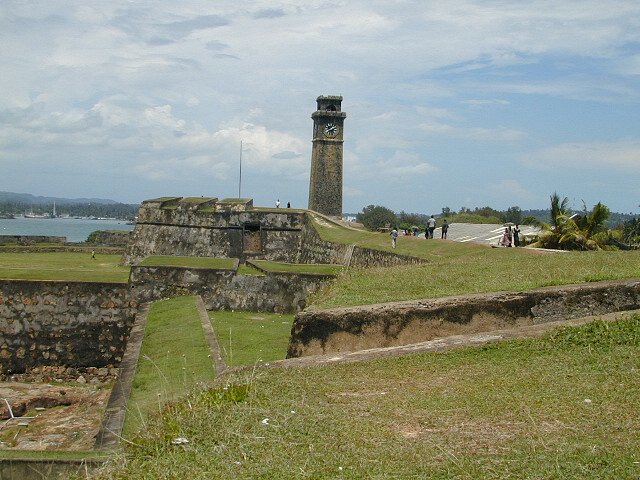
constructed huge ramparts and an enchanting Fort which forms a landmark in Galle that gives splendour
to the town. They planned a township inside the fort with criss cross roads and low roofed houses
with massive walls and large doors and windows. They constructed an underground system of brick
paved sewers, which was flushed by the action of the tides in the sea that surrounded the walls of the
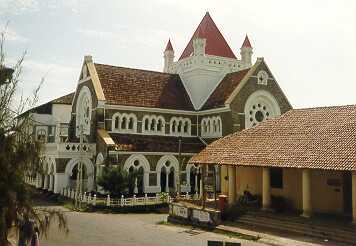
fort. They built a large church, which is called The Dutch Reformed Church that stands well even
upto this day. It was after 140 years of rule that the Dutch ceded the country to the British in 1876.
The British inaugurated a pipe borne water service from Hiyare with a reservoir at Beke to supply
the town with water. But electricity was introduced to the town only in 1926 with a power station
at Talbot Town in China Garden. The Law Courts and the Kachcheri are situated within the fort
while the Civil Hospital is at Mahamodera. A modern Hospital was constructed by Sri Lanka
government at Karapitiya to supplement the Mahamodera Hospital as it was difficult to maintain
the equipment and the Theatres in good use due to the effect of the sea opposite. Galle is fortunate
that nature has gifted it with enchanting natural features in the form of a safe harbour, the mountain
of Rumassala, called Bouna Vista by the British and the promontory called Clossenberg jutting out
into the sea at Magalle. Bouna Vista affords a magnificent view of the Galle harbour, the Fort and
the surrounding area. According to legend Rumassala is a chunk of the Himalayan mountain brought
by Hanuman, the monkey General of Rama. When Rama was at war with Rawana, the Raksha king
of Lanka after the latter's abduction of Sita Devi, wife of Rama, introduced a poisonous gas to
the battle field which caused Rama to faint and fall down. When Rama fell unconscious, Hanuman
remembered that on the Himalayan mountain there grew a herb which was an efficacious remedy
to revive the striken. Thither he forthwith flew but unable to locate the herb in his impatient
hurry tore off a large slice of ground from the Himalayas, which he was sure contained the herb
and flew with it post haste to Lanka. After locating the herb it was quickly administered to the
sufferer who was immediately revived. Thereafter the chunk of mountain was thrown away which
ultimately fell off Galle harbour and this promontory is now known as Rumassala, where a variety
of medicinal plants are still believed to be in extant.
The Dutch drew away the Portuguese and persecuted them until they left these shores. The Dutch
constructed huge ramparts and an enchanting Fort which forms a landmark in Galle that gives splendour
to the town. They planned a township inside the fort with criss cross roads and low roofed houses
with massive walls and large doors and windows. They constructed an underground system of brick
paved sewers, which was flushed by the action of the tides in the sea that surrounded the walls of the
fort. They built a large church, which is called The Dutch Reformed Church that stands well even
upto this day. It was after 140 years of rule that the Dutch ceded the country to the British in 1876.
The British inaugurated a pipe borne water service from Hiyare with a reservoir at Beke to supply
the town with water. But electricity was introduced to the town only in 1926 with a power station
at Talbot Town in China Garden. The Law Courts and the Kachcheri are situated within the fort
while the Civil Hospital is at Mahamodera. A modern Hospital was constructed by Sri Lanka
government at Karapitiya to supplement the Mahamodera Hospital as it was difficult to maintain
the equipment and the Theatres in good use due to the effect of the sea opposite. Galle is fortunate
that nature has gifted it with enchanting natural features in the form of a safe harbour, the mountain
of Rumassala, called Bouna Vista by the British and the promontory called Clossenberg jutting out
into the sea at Magalle. Bouna Vista affords a magnificent view of the Galle harbour, the Fort and
the surrounding area. According to legend Rumassala is a chunk of the Himalayan mountain brought
by Hanuman, the monkey General of Rama. When Rama was at war with Rawana, the Raksha king
of Lanka after the latter's abduction of Sita Devi, wife of Rama, introduced a poisonous gas to
the battle field which caused Rama to faint and fall down. When Rama fell unconscious, Hanuman
remembered that on the Himalayan mountain there grew a herb which was an efficacious remedy
to revive the striken. Thither he forthwith flew but unable to locate the herb in his impatient
hurry tore off a large slice of ground from the Himalayas, which he was sure contained the herb
and flew with it post haste to Lanka. After locating the herb it was quickly administered to the
sufferer who was immediately revived. Thereafter the chunk of mountain was thrown away which
ultimately fell off Galle harbour and this promontory is now known as Rumassala, where a variety
of medicinal plants are still believed to be in extant.