| Theo Loevendie-Igor Stravinsky in de Vlaamse Opera. |
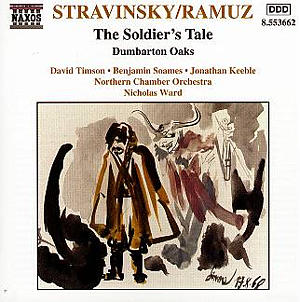
L'Histoire du Soldat (The Soldier's Tale) is an hour-long classical music-drama for violin, bass, clarinet, bassoon, trumpet, trombone and percussion written in 1917 by the giant Russian composer Igor Stravinsky (1882-1971). It came about through necessity in 1917 as the war that had ravaged much of Western Europe was raging still. Stravinsky and the poet/novelist Charles Ferdinand Ramuz were both isolated in the neutral enclave of Switzerland, cut off from publisher, severed from their public, deprived of royalties. The notion that their coffers could be restocked by touring a modest theater-piece in small Swiss theaters could be said, perhaps to have taken little heed of realities. But as the history of such events has often demonstrated, limiting circumstances stimulated the production of a masterpiece. Ramuz' tale reaffirms the notion that if you sell your immortal soul to the Devil, you will, inevitably get a bad deal. This familiar thought, which goes back to the l6th-century Faustbucher (Book of Faust), is given flesh in The Soldier's Tale by a modest Russian folk story, drawn by Ramuz from the vast collection made by Alexander Afanasiev some sixty years before. As adapted by Ramuz and Stravinsky, this makes a two-part dramatic structure, each of three scenes. The Soldier's Tale, its story, 3 main characters, and Joe's many moods during the hour-long drama are reflected in Stravinsky's powerful, jazzy, and unique musical language. It pioneered the brilliant scoring of pairs of strings, woodwinds, and brass with a single percussionist. While Stravinsky claimed this as a version of a jazz band, which it is said he has never heard, it strikes us that an orchestral balance is strongly implied. Most unfortunately, the work is rarely performed owing to its great challenges. The violinpart here played by Ann Vancoillie, is known as very demanding. The music and story begin with Joe, a tired and discouraged young soldier, returning home on leave from a war. He encounters the Devil, who manages to buy the soldier?s fiddle (his soul) in exchange for a magic book that can make him rich. Joe doesn't realize at first what he's done. He becomes depressed, then excited about all the money but soon realizes how empty it all is. Fortunately, surprises await the audience as the soldier actually manages to beat the Devil and take back his fiddle! ------------------------------------------------------------------ The narrator, takes on the many voices as our soldier weaves his way through his ordeals. The musicians will masterfully take us all back to the world of Europe in the year 1918 when many a soldier saw his choices in just as stark terms as our soldier. Igor Stravinsky was a refugee living in Switzerland when he composed L'Histoire du Soldat. Not only had he seen many close friends and relations killed by the First World War, but the Russian Revolution of 1917 had deprived him of his income. As he gathered with his fellow countrymen he found himself deeply affected by the abyss of war and the dislocation that appeared all around him. About this time he was introduced to the Swiss writer C.F.Ramuz who was to become his good friend and collaborator. The two pored over old Russian Folk tales and were inspired by the story of a soldier who tricks the devil, makes him drink too much vodka, and leaves victorious. In the hands of these two, it became, rather, the adventures of a Faustian deserter and the devil who eventually robs him of his soul. The many references to the inability to cross over the border, or to the "Mother" that doesn't know him, must surely refer to Stravinsky and his compatriots and their plight as refugees from Mother Russia. The first and subsequent performances of "L'Histoire du Soldat" in 1918 were a huge success despite the on-going war and the outbreak of a world-wide flu epidemec. The Soldier's March is the overture to the work. From the begining the violin is obviously the instrument of the devil in the hands of our soldier. The Little Concert and the Three Dances (Tango, Waltz, and Ragtime) are the most complicated of all the pieces. The Tango was very popular in Europe at this time, but the Ragtime was quite new, Stravinsky only just having heard Jazz for the first time before the creation of this work. The Suite ends grandly with The Devil's Dance and the Devil, although temporarily set-back, returns triumphant. The narrator, takes on the many voices as our soldier weaves his way through his ordeals. The musicians will masterfully take us all back to the world of Europe in the year 1918 when many a soldier saw his choices in just as stark terms as our soldier. THEO LOEVENDIE De Nachtegaal Theo Loevendie was born in Amsterdam in 1930. He studied clarinet with Ru Otto and composition with Leon Orthel at the Amsterdam Conservatory. Until 1968, he was primarily involved in improvised music with his own trio. In 1970, he became the chief teacher of composition at the Rotterdam Conservatory. He has contributed much with his performance, teaching and organising activities to the liveliness of Dutch musical culture. His compositions Incantations, Strides, Nonet and the opera Na�ma have been especially successful. Since 1988, he has taught composition at the Royal Conservatory in The Hague. Theo Loevendie holds a special position among the prominent living dutch composers. Born in Amsterdam in 1930 Loevendie's music does not sound `dutch' at all. What makes his work so different? There is no single common denominator that characterizes the music of such divergent composers as Louis Andriessen, Peter Schat, Guus Janssen or Tristan Keuris. Still, they all started their career in their early twenties with a solid conservatory background. At that age Loevendie was already a professional jazz musician, though umemployed for years. An engagement in Turkey became an experience which was to profoundly influence his later work. Only at twenty-five he entered the conservatory to study the clarinet and composition. After his conservatory days however, he composed almost exclusively for jazz musicians, `partly because of the preponderance of serial music at the time, with which I felt no affinity', as Loevendie put it later. He completed his first `serious' composition, Scaramuccia for clarinet and orchestra, not until he was thirty-nine. It is this different development that accounts for Loevendie being at the same time an outsider and a unique figure in the contemporary music scene. Although his `serious' music seldom explicitely refers to jazz - Strides being the exception on this CD - it always has an open, fresh and free flowing quality not unlike improvised music. His compositions have an immediate musical impact, even when he uses strict techniques. Loevendie's vast experience as a performing musician is always present in his music. It breaths a joy in the craft of composition and in the sensuous quality of sound as well as in the joy of performing. This is not suprizing for a composer who says `It could be argued that the so-called scientific methods of composition are not scientific enough if they discard the listener (as in serial music) and the performer as a human being (as in both serial and stochastic music)'. To Loevendie serialism is an excess of rationalism. He sees `more historical necessity in the parallel between society and musical practice' (as in jazz and ethnic music). Being attracted to Duke Ellington's humanistic approach as a composer/band leader, Loevendie writes music in which the individuality of each part allows the instrumentalists to fully reveal their creative personalities. The typical squareness and the no-nonsense quality of much new dutch music is alien to Loevendie's thinking. His work stands far from the `one thing at a time' ideology and the primitive force of Louis Andriessen's ingenous mixture of pop, Bach, Stravinsky and repetitive music, or the highly original, willful musical ironies of Guus Janssen. One common influence Loevendie shares with various other dutch composers however, is the music of Stravinsky. But whereas for most of them Stravinsky is a model, in Loevendie's music the traces are much more hidden. To him rhythm, melody and colour have priority over harmony. This concurs with his interest in the music of Turkey and the Middle East, wherein harmony - as opposed to the music of the western classical tradition - plays a subordinate role. Heterophony as used in the Middle Eastern countries, whereby the musicians improvise elaborate ornaments on the same melody at he same time, is a consistently recurring and naturally integrated component of Theo Loevendie's style. The six compositions collected on this cd provide a good insight in Loevendie's versatile chambermusic output. The music for Venus and Adonis was written for a stage production of William Shakespeare's poem with the same name. To the composer the text evoked an image of a renaissance like consort playing a heterophonic music in Middle Eastern style. By choosing an ensemble with mandoline and guitar at its centre - together with bassclarinet, violin and percussion - Loevendie could both achieve the archaic sound he had in mind and indulge in his fascination for heterophony. Instruments producing non sustained sounds, such as plucked string instruments so often used in non western cultures, are especially apt to provide the clarity in the ornamental melodic textures Loevendie was after. With the music for Venus and Adonis Loevendie demonstrated the possibillities of the unusual instrumental combination it was written for. This rich potential made the performing musicians decide to continue as an ensemble. Their main goal was to create a new repertoire. Within one decade the group became the renowned contemporary music ensemble it is today. Loevendie: `When I chose this combination of instruments I could not surmise that this would become the basis of a new ensemble: the Nieuw Ensemble.' While the Venus and Adonis suite (1981) is dominated by heterophonic writing, Strides (1976) refers openly to another source of inspiration: jazz. The middle section of this work paraphrases the characteristic jumping bass of the Harlem Stride piano style which was created in the thirties by Fats Waller and James P. Johnson. The first part of the composition is marked by a predominance of repeated single tones in different registers. Loevendie explains his life-long predilection for these Morse-code like ostinati by the telegraphist trainingcourse he followed when he was seventeen. Strides is a typical Loevendie piece: bright and colourful, and tightly constructed but direct in its rhythmic swing. In 1977 Loevendie suprized the public with the Six Turkish Folkpoems, his first vocal work. It was immediately recognized as one of the best song cycles written in Holland after World War II. In their sobriety the Folkpoems are as attractive as Berio's seductive Folksongs in spite of the fact they do not derive from accessible traditional songs, as is the case with Berio's work. Loevendie felt that the simplicity and the direct emotional content of the Turkish texts requiered a setting devoid of facile folkloristic overtones. These traditional texts could have induced the use of elements from classical Turkish music, but the composer decided to concentrate on strict rhythmic structuring according to the isorhythmic techniques of Middle Age composers like Guillaume de Machaut. With the applicition of repeated rhyhtmic patterns (talea) in combination with repeated melodic patterns (color) of unequal lenght, Loevendie produced one of his most strictly constructed pieces. But is not the technique that counts. It is the refined use of instrumental colour and the beauty and the bare quality of the excotic melodies that captures the listener. A more extended excursion into vocal writing followed with the composition of the opera Naima (1985). The Two Songs recorded here feature mezzo-soprano Jard van Nes who sang the title role at the premiere. The accompaniment was adapted in a special arrangement for the Nieuw Ensemble. Isorhythm recurs in the second song: a sixteen note passacaglia theme in the bass shifts within a twenty note rhyhtmic pattern. Above the gently bouncing instrumental texture the voice moves freely, not bound by harmonic ties. In the late seventies Loevendie's concentration on melody resulted in what he describes as his `curve technique'. The priciple is simple and allows the composer a great deal of freedom. All melodies in a given piece are derived from a basic melodic pattern by expanding or contracting its intervals. Each melody is different, but the curve remains essentially the same. In the lively and virtuoso Music for flute and piano (1981) curve technique and heterophony are combined in the raging octaves of the piano towards the end. Harmony is the mere consequence of the melodic flow of the music. Back Bay Bicinium (1986) is a good example of Loevendie's lyrical reflective side. As the word bicinium in the title indicates this work is based on two melodic lines; they gradually contract and speed up more and more before the epiloge brings back the droning bell chimes of the beginning. The elaboration of melodic and rhythmic patterns is central to Loevendie's composing. His curve technique, the use of isorhythm and ostinati and his heterophonic textures all stem from this interest. His unconventional independency and the expressive power of his work make Loevendie a remarkable protagonist of the new dutch music. Alan Hood The music for Venus and Adonis (1980) was written for a stage production of William Shakespeare's poem. To the composer the text evoked the image of a Renaissance-like consort playing heterophonic music in Middle Eastern style. By choosing an ensemble with mandoline and guitar at its core - playing together with bassclarinet, violin and percussion - Loevendie could both achieve an archaic sound and indulge in his fascination for heterophony. Instruments producing non-sustained sounds, such as the plucked string instruments so often used in non-Western cultures, are especially suited to provide the clarity in the ornamental melodic textures Loevendie had in mind. With the music for Venus and Adonis Loevendie demonstrated the possibilities of the unusual instrumental combination for which it was written. This rich potential made the performing musicians decide to continue as an ensemble and create a new repertoire. Within a decade this group became the renowned contemporary music ensemble it is today. Loevendie: `When I chose this combination of instruments I never thought for a moment that it would become the basis of a new ensemble: the Nieuw Ensemble.' For the first series of concerts given by the Nieuw Ensemble in 1981 Loevendie extracted the Venus and Adonis suite from the original stage music. Strides (1976) for piano solo refers openly to a 'Western' source of inspiration: jazz. The middle section of this work paraphrases the characteristic jumping bass of Harlem Stride Piano, a style which was created in the thirties by Fats Waller and James P. Johnson. The first part of the composition is marked by a predominance of repeated single tones in different registers. Loevendie says he owes his life-long predilection for these Morse-like ostinati to the telegraphist training course he was obliged to follow during his military service. Strides is a typical Loevendie piece: bright and colourful, tightly constructed but direct in its rhythmic vitality. In 1977 Loevendie surprised the public with Six Turkish Folkpoems, his first vocal work. It was immediately recognized as one of the best post-War song cycles written in Holland. In their sobriety the Folkpoems are as attractive as Berio's seductive Folksongs - in spite of the fact that they do not derive from traditional songs, as is the case with Berio's work. Loevendie felt that the simplicity and the direct emotional content of the Turkish texts required a setting devoid of facile folkloristic overtones. The composer decided to concentrate on strict rhythmic structuring according to the isorhythmic techniques of medieval composers such as Guillaume de Machaut. With the application of isorhythm - the combination of talea (repeated rhyhtmic patterns) with color (repeated melodic patterns) of unequal length - Loevendie produced one of his most rigorously structured pieces. But it is not the technique that counts. It is the refined use of instrumental timbre and the beauty and simplicity of the melodies that capture the listener. A more extended excursion into vocal writing followed with the composition of the opera Naima (1985). The Two Songs recorded here feature mezzo-soprano Jard van Nes who sang the title role at the premiere. The accompaniment was adapted in a special arrangement for the Nieuw Ensemble. Isorhythm recurs in the second song where a sixteen-note passacaglia theme in the bass shifts within a twenty-note rhythmic pattern. Above the gently bouncing instrumental texture the voice moves freely, not bound by harmonic ties. In the late seventies Loevendie's concentration on melody resulted in what he describes as his `curve technique'. The principle is simple and allows the composer a great deal of freedom. All melodic lines in a given piece are derived from a limited number of melodic patterns whose intervals are then expanded or contracted, while their curves remain essentially the same. In the lively and virtuoso Music for flute and piano (1981) curve technique and heterophony are combined in the raging octaves of the piano towards the end of the piece. Harmony is merely the consequence of the melodic flow. Back Bay Bicinium (1986) is a good example of Loevendie's lyrical reflective side. As the word 'bicinium' in the title indicates, this work is based on two melodic lines. They gradually contract and speed up more and more before the epilogue brings back the dreamy atmosphere of the beginning. The elaboration of melodic and rhythmic patterns is central to Loevendie's composing. His curve technique, the use of isorhythm and ostinati and his heterophonic textures, all stem from this interest. Theo Loevendie's unconventional independence and the expressive power of his work make him a leading protagonist of new Dutch music. Alan Hood Nonet was written by Theo Loevendie and was commissioned by the Rotterdamse Kunststichting. It is dedicated to the Ensemble M. It is a work in two parts. Part I establishes a connection of heterogenous elements of clusters, percussive sounds and diatonic material within a rigorous rhythmic organisation. Part I is symmetrical in its temporal organisation. Part II is in direct contrast to Part I. In this section, the important role is played by tonal pitch. While a series of 35 tones is repeated continuously, its rhythmic treatment is very free. The durations vary between a fraction of a second to dozens of measures. STRIDES, for piano solo 1976 "In STRIDES, as in many of my works, ostinato and repeated notes play an important part. The beginning is dominated by an ostinato on the lowest B flat, superseded later on by new ostinati. About halfway a passage appears pointing to the idiom of Harlem Stride Piano as played by Fats Waller, James P. Johnson and other jazz pianists of the thirties. The title originates there. This chordal motion proceeds gradually and in increasingly scattered form from the middle to the extremes of the keyboard. Ostinati press forward and at the end quiet is restored. Apart from the rhythmic cell, I used the same pitch organization, horizontally as well as vertically, as in Incantations for bass clarinet and orchestra: the major third is the central interval, to which minor seconds adhere (e.g. B - C - E - F, or C - E - F - F sharp)." Theo Loevendie |
 |
 |
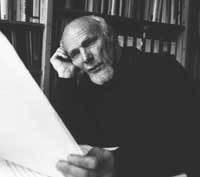 |
| Theo Loevendie born 1930 |
 |
| Igor Stravinsky born in 1882, died in 1971 |
| Filip Bral : dirigent. Ann Vancoillie, viool Servaas Lecompte, contrabas Fang Song, klarinet Remi Roux, fagot Didier Petit, trompet Joost Deryckere, trombone Roel Van der Spikken, percussie Gert Jochems, verteller Volwassenen : 4 euro Cherubino leden, jongeren tot 16 jaar en voorverkoop : 3 euro info tickets : 09/225 24 25 |
| Zondag 4 mei om 11h in de Vlaamse Opera te Gent |
| De verklanking van Andersens' sprookje De nachtegaal door Theo Loevendie, en een Faust-verhaal van Ch.Ferdinand Ramuz door Igor Stravinsky. Een wonderlijke reis naar het verre China....in De Nachtegaal. Een Faust-verhaal in een kruisbestruiving tussen klassiek, rag-time, quasi-jazz, vaudeville en een veeleisende vioolpartij die haar ziel aan de duivel verkoopt in... Het Verhaal van De Soldaat. |