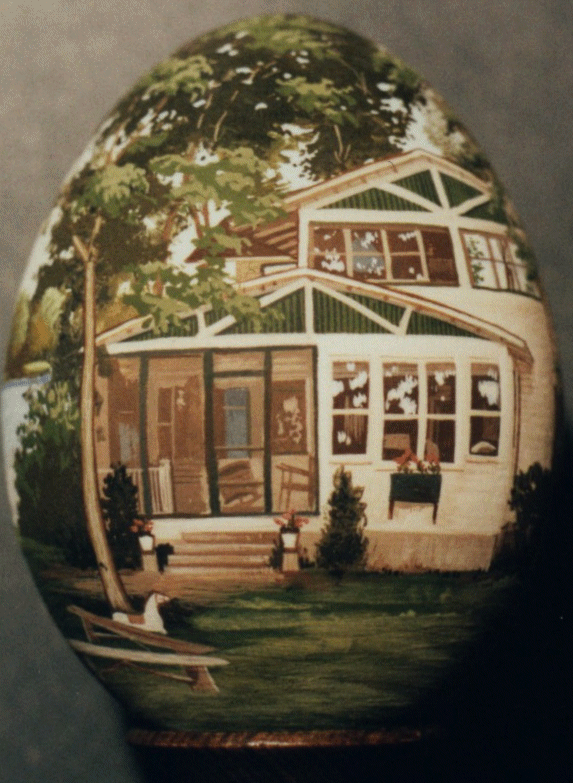
There is a lake in Michigan between Battle Creek and Kalamazoo called Gull Lake. Like the Great Lakes it was formed during the last ice age when glacial fingers stretched down into Michigan, picked up granite rocks, broke them apart, and ground them up into smooth round stones. As the ice melted, it left a crystalline lake where in 1907 my great grandparents built a cottage that they named, "Lafalot". Three generations grew up in this cottage and hold memories of a place somewhat akin to paradise.
Because a few in our family were photographers, we have some preserved memorabilia. But my sister, Sally, made a great discovery. Sally flies for a major airline and on a trip to Moscow during this past year found a remarkable artist who paints landscapes on eggs (he doesn't like to do portraits). He is of the great Russian tradition of Faberge and those Ukrainian artists who paint Easter eggs called Pysanka.
Sally brought him a picture of the cottage and he did an astounding reproduction, even to the point of capturing the rocking chair on the screened-in porch, the tops of the white wicker chairs through the windows in the front sun room, and even the blue skies of Michigan reflected in the glass. On one side of the egg is the cottage as seen from the lake. The other side is the lake viewed from the cottage. This remarkable artists name is Andre Savrasov (Cabpacob (Russian spelling)). Thank you, Andre. Andre once emailed me that he can normally be found at the art galleries of GUM or the Historical museum at Red Square.
For those of you curious about the artist, you can stop reading now and hit the back button. For those interested in nostalgic childhood memories you may continue on:
As I look at the picture on the egg I remember the ancient trees that arched over the cottage. I remember the coolness of the grass under our feet. We never wore shoes there. Even when we walked to the little town of Yorkville nearby, we walked barefoot. I don't ever remember any doors or windows being closed in the cottage. It was as though nature was permitted free reign over this domain.
The upper story of the cottage contained three bedrooms and a great sleeping porch that looked out over the lake. The sleeping porch was screened in on three sides so the summer breezes could pass through unobstructed. The sleeping porch held three large four-poster beds. We were forced to take naps each afternoon, mandated by and for the sole benefit of the adults. We would lie there awake for our mandatory hour, listening to the sounds of the lake (an occasional outboard or the laughter of some neighbors child). If we raised up too high out of our beds to investigate, our mother in an adjacent bed, her eyes still closed, would snap her fingers in warning. How she knew we were up without opening her eyes remains a mystery.
The cottage had running water for as long as I or even my mother can remember, but it was lake water and not for drinking. Drinking water came from a hand pump located in the kitchen. It was piped up from some subterranean aquifer and had a taste like no other on earth.
The living room had a large fireplace that received use even in the middle of the summer. But more often a potbellied stove provided heat on a cold Michigan morning. Although it was a large two-story cottage, the only indoor bathroom was located downstairs next to the master bedroom. The most utilized bathroom however, was an outhouse located behind the double garage outback. As far back as I can remember it had running water and flush toilets, but mother says it was only "modernized" about 1948. Prior to that it was a true outhouse.
My great grandfathers name was Sherman Schroder but we called him GG. For a man in his eighties he had a lot of hair, snow white, and complimented by a white mustache in vogue at the time. I can still remember playing Chinese checkers with him while he sucked on one of his cigars that left that sweet aroma in the air. My mother said that when they were young, as soon as GG got home with a box of his "Prince Phillips", they would always run to him and say, "Grand dad, open the box so we can have the ring!"
My great grandmother's name was Hattie Maud (Coulter) Schroder, but we called her Gabby. She could be a terror to the unruly. Each of us can remember at one time or another being chased by her, yardstick in hand. She lived to be ninety-one but even at that age commanded respect. She was never afraid to speak her mind. I remember the last summer at the cottage before Gabby died, my younger brother and I were left alone to take care of her, or she us, I am not sure which. Our primary duties consisted of tying her into her corset each morning and untying her each evening, an event we did not cherish. One morning she came to me and said, "Randy, I have a small problem. I can't find my teeth." I looked all over her room, under her bed, everywhere I could think to no avail. Finally I found them as they had somehow fallen inside her pillowcase.
I had a good friend who was Catholic. One Friday as we returned home Gabby proudly announced that she had made meatballs and spaghetti. My friend politely mentioned that as a Catholic he could not eat meat on Fridays. She said, "Sure you can, afterwards just ask your priest for forgiveness". I hate to leave the impression that Gabby was insensitive but I believe that if a person reaches the age of ninety-one, they have the right to be singularly defined. Gabby had been an excellent artist in her youth. Some of her landscapes I would rate as fine as produced by any other 19th Century landscape artist. Her forests are dark and mysterious, and her waterfalls are alive.
When I was in the fifth grade we lived in Florida. One time she said, "Randy, I want to show you something." I followed her outside where she pointed toward the west. The receding sun had ignited the sky to a fiery orange. She said, "Of all the senses we have, the one that would be the most tragic to live without would be sight." I thought at the time this was an intriguing remark coming from the mother of so gifted a pianist.
There was nothing like the smell of a storm as it came across the lake from the north. You could close your eyes and know a storm was about to hit. The best place for viewing the storm was the sleeping porch. You could see the veil of water approaching. When it reached the cottage it drenched everything outside, the roof, the leaves, the trees. Everything became renewed. Although the windows on the sleeping porch were open, we never got wet because of the overhang of the roof.
One time we were gathered around the front living room window when a storm approached. Someone noticed that our rowboat had come unmoored and had drifted out into the middle of the lake. Although I was about twelve, there was noone else who could handle the demands of the task at hand. "Randy", they said, "You have got to go retrieve our boat".
With only a moments hesitation to contemplate the impact of lightning on human flesh, I dashed out into the pouring rain, raced to the end of the dock and plunged in. I swam to the boat, climbed in and rowed back to shore. When I reentered the cottage, I was proclaimed a hero. Little did they know that there was no difference between doing what I had done on a sunny day and doing it in the rain. The rain had just created a more dramatic backdrop for the effort.
There was always music in the cottage. My grandmother had studied to be a concert pianist in her youth and could play anything at sight. We had music books full of songs from the 20's and 30's. Those were great years for songs that everyone could sing, and we all knew the words for songs like "Bicycle Built for Two", "I'm Looking Over a Four Leaf Clover", and all the other memorable ones.
My grandmother was a unique personality. She was great at organizing "activities" as they were called. Since there were no TV's in those days, people must have entertained themselves and others by telling stories, going to concerts, or producing plays which was my grandmother's forte. She was a master of the impromptu one act play, delivered before an audience of children hand selected for their willingness to endure insufferable boredom. Bucky, a neighbor boy who had a genius for cars, would be the villain and my sister, Susie would be the heroine and I was the designated cowboy hero. I had to suffer a slight tap on the back of the head with a toy gun, feign unconsciousness, and then wake up only to discover Susie tied up a few feet away.
Grandmother would invite all the neighborhood kids from at least ten cottages in each direction (that was enough for a sizable audience) and we would put on these plays. Chairs were dragged from inside the cottage to the front lawn where the audience would sit. The kids felt a certain obligation to show up. They were aware that at the end of July was my sister's birthday. I think they felt it imperative to appear to ensure their invitation for ice cream and cake was secure.
But all great things have to come to an end it seems. My great grandfather died in 1953 at the age of 87 and my great grandmother died in 1959 at the age of 91. After Gabby's death in 1959, my grandmother sold the cottage to fund her own lifelong dream of European travel. She can't be faulted for that. She could never have sold the cottage while Gabby was alive. I feel the cottage is like the "wonderful one hoss shay...that lasted one hundred years to a day". Had it been left to its own devices, I have no doubt it could have made it another one hundred years. But it was sold in 1960. The people who bought it kept it a year or two and then had it demolished to build a nice year-round brick home.
Now the cottage is a faint memory of a summer home that once stood on the shore of a crystalline lake. A home that as befits its name was always full of laughter, music, and good times. A home smelling of sweet smoke and an occasional thunderstorm.
My grandmother, Mildred Maurene (Schroder) Montgomery, was a unique individual that led a life unfettered by convention. She was a big woman, about five ten, and in her latter years carried over 200 pounds on her frame. She had studied to be a concert pianist and music was always a part of her life and those around her necessarily received the benefits. As her father ran a successful dry goods store in Battle Creek, and she was for thirteen years their only child and had a gift for music that would make any parent proud, she was given a certain amount of free reign. I am told she was one of the first women in Battle Creek to drive a car which I am sure gave her a certain amount of independence. But during her entire life she had a certain mischievious, childlike approach to life and thus there was no generation gap between her and her grandchildren.
Her method of ensuring that her grandchildren were released from any shell of inhibition was to embarrass them if they attempted in anyway to subdue her independent air. Because her soprano voice was like a great instrument, she would use it to full advantage in church. If any grandchild signalled her to hold down her voice, it merely caused her to increase the decibel level, not because we are told to make a joyful noise unto the Lord, but rather because it provided her an opportunity to shatter any evidence of inhibition among her grandchildren.
One time in church as the collection plate was passed around, she purposely dropped a tiny perfume bottle in the collection tray. I looked over at her in dismay and there was only a hint of mischief in her eyes. We all let the tray go on past mystified. Then we could see her making every effort to suppress a giggle. I leaned over and said, "Grandmother, why did you drop your perfume bottle in the collection plate". As tears of laughter welled up in her eyes, she said, "I thought one of you would pick it up". Again, this had merely been one of her tests to see if she had successfully gotten through to us. I am sure she felt some personal satisfaction knowing that none of her grandkids took the bait, none had observed social convention and retrieved the perfume bottle. I am sure it was a signal to her that perhaps her methods were paying dividends.
She died in Ashville, N.C. where she had gone for a checkup. Her heart could not keep up with her great body. She was cremated at her request and the funeral services were held in Pompano which had been her home for about fifteen years. I have never seen so many flowers at any funeral as her zest for life had apparently affected many others. Many came up to me and told me about the work she had done for the library, and with one organization or another. But the story I loved most was that told to me by an elderly lady that came up to me and pulled me aside.
"Randy", she said, "I have to tell you a story about your grandmother. It was following church services at the Presbyterian Church one Sunday and a thundershower had left a lake of water about a foot deep around the outside of the church. Everyone stood there in their finest trying to figure out how to make it to their cars. I looked over at your grandmother. She was taking off her high-heeled shoes and proceeded to wade, stockingless as she always was, through the ankle deep water. I knew right then that she was the kind of person I could always like."
I thanked her for the story. It was the only time during the funeral service that a lump gathered in my throat.
Two words which when used together have a certain synergy to define the right an elderly person has to carve out a definition for themselves without requiring a social frame of reference. Generally the person must be over the age of eighty and have suffered the "slings and arrows of outrageous fortune" to the point where not only do they not give a damn what others think of them, they have the right to do so. A child attempting "singular definition" is merely impertinent.