 |
|
|
|
|
|
|
|
|
|
|
|
|
|
|
|
|
|
|
|
|
|
|
|
|
|
|
|
|
|
|
|
|
|
|
|
|
|
|
|
|
|
|
|
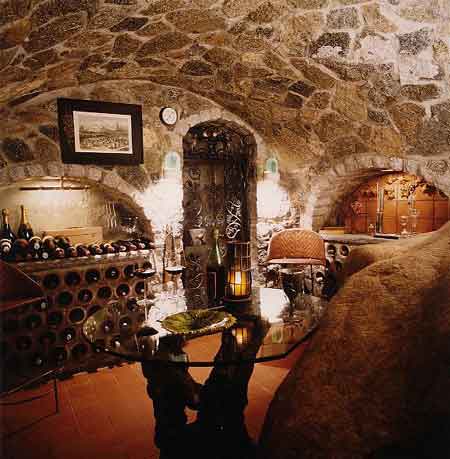
Wine Cellar |
|
|
|
 |
|
|
|
|
 |
|
|
|
|
|
[email protected] |
|
|
|
Plans |
|
|
|
|
|
|
|
|
|
Ever since I bought my house in 1969 and discovered a basement alcove with a dirt floor, an enormous mass of dirt-covered granite erratic protruding out of bedrock, and a false ceiling with a vapor barrier, I have dreamed about building a blown-in-the-bottle wine cellar. I had found over the years that the gigantic boulder gives an ideal temperature to the storage of wine in the niche. The temperature modestly cycles from 60'F to 65'F in all seasons. The false ceiling with a vapor barrier protects the cellar space from the heating of the house in winter and the 100% upstairs humidity in summer (when the temperature of the upstairs is higher than that of the downstairs wine cellar, the at-times 100% upstairs summer humidity would go to the downstairs wine cellar were it not for the vapor barrier). |
|
|
|
|
|
|
The humidity modestly varies between 60% and 80%, never going above 85% which is the mold threshold. No ullage and no moldy labels for the wine bottles held for over 10 years! In November 1991, after my stroke (and after losing my job), I started planning the construction of my fantasy -- a real wine cellar. As a chevalier of La Confr�rie des Chevaliers du Tastevin, I had just returned from the Clos de Vougeot where I had discovered some medieval vaulted-ceiling 'cave � vins'. This is for me! I spent about 2 months breaking apart the false ceiling, lugging the dirt away from the bedrock, and deciding the exact dimensions of my 'vaulted ceiling", arched doorways and elliptical alcoves. I did lots of library research, and got all sorts of ideas on how to build vaulted arches. But nowhere did the books indicate how smooth the stone sides had to be to support a vaulted arch. From my days in long-ago college, if the stone sides (of the voussoirs) were finely polished, no mortar would be needed to bind them, a just a keystone (the central stone). If the stone sides were machine cut, some mortar would be necessary, and again a keystone. And it was beyond my ken to what would support the arch if the stones had rough and jagged side edges. Although one side of the impost (the stone wall that hold up the arch) was a concrete foundation and behind it packed dirt, the other side was a stone wall. It would take some calculations to figure out the pounds per square inch, horizontally to the stone wall and vertically to the dirt floor. Would it hold? |
|
|
|
Vaulted Ceiling: Elliptical Arch |
|
|
|
According to Nickie in his book, The Stoneworker's Bible, "The elliptical arch is one of the strongest arches in stonework construction. It springs from springers (unit at the impost of an arch or the lowest voussoir of the arch) that sets on horizontal imposts. The impost is the stone where the arch rests at the spring line (imaginary line connecting the two opposite points at which the curve of the arch belongs). The way its hauch (that portion of an arch between skewback or springing and crown of an arch) is built gives it strength." I used the trammel square method for laying out the elliptical arch. When two points A, B, a fixed distance apart, are constrained to move along two mutually perpendicular straight lines, any point P in the line produced by ABP describes an ellipse. After a great amount of work, I came up with the fixed distance, AB=1', and BP=4' (or ABP=5') thereby giving the width of the room at 10'. It seems so easy, but it wasn't. The width of the room was 12'6", the ceiling joists were 8'8" high, the lower extremities of the heating ducts were 17" below the floor joists, horizontal imposts had to be a certain height to enter, and I had to have room to work at the top of the elliptical arch to set stones in place, to do electrical work, etc. So the final dimensions of the cellar: the wine cellar - 10'x10', with a height of 6'11" above the terra cotta tile floor; the storage area adjacent to the wine cellar - 5'x12'6", with a height of 6'5" up to the false ceiling. There are 5 more elliptical arches in the wine cellar -- 3 on the Belgium block intrados which bounds the lower extremities of the arches covering the 34"-high flagstone shelves, and 2 on the Belgium block intrados at the top of the gate and door opening. For the alcove areas, AB=6" and BP=1'9" (making the length of the flagstone shelves 54"); for the top of doors, AB=6" and BP=9" (making the width of the door opening 30"). The land-tiles wine racks in the wine cellar hold 122 bottles. On shelves in the storage area will hold approximately 22 cases. The actual planning took about 2 months. |
|
|
|
Vaulted Ceiling Construction |
|
|
|
I had to think of the easiest and most economical stone construction of the vaulted ceiling I had designed. I had to rule out the cut blocks of granite or similar stone. Cut blocks look too formal, and cost way too much (about $60,000 for the cut stone alone). I could do the vaulted ceiling in Belgium blocks, 4"x4"x9", either 500 blocks length-wise (about $1,000) or 1100 side-wise (about $2,200). And down from my house on Riversville Road, a friendly neighbor was blasting out 50 yards of granite bedrock for an addition to his house, and he said I could have 9 yards or so, gratis. I had to choose between these two alternatives (cut Belgium block needs a little mortar to hold up the arch, and it was beyond my ken to know how to support the arch made out of pieces of rough granite). With finalized plans in hand, I talked to architectural firms all over the country about the stone construction of vaulted ceilings for wine cellars. None of them helped, but I was referred me to a professional engineer, Ed Silva of New Fairfield, Conn. Ed and I discussed my plans and we agreed that the rough granite stone would be ideal building material. He recommended that I use 1/4" rebars, 12" on centers, and concrete reinforcing on top of the granite-stone vaulted arch. Ed also calculated whether or not the bare ground (the wine cellar did not have a floor) would hold up the vaulted ceiling and whether the imposts would hold. |
|
|
|
Tonnage of Stone (and Concrete, etc.) |
|
|
|
All together, I used about 35 tons of materials -- 7 yards of granite (17 tons), 6 yards of concrete (12 tons), 2 yards of mortar (3 tons), 90 Belgium blocks (112 ton), 122 land tiles for the wine racks (112 ton), 31 hand-designed terra cotta tiles of the grape vine, 3 2-21"x16"x54" flagstones, and enough 6"x6" terra cotta tiles for the floor. For the vaulted ceiling, I used 2 yards of granite (10,000 lbs. or 5 tons) or about 300 granite pieces weighing 10-50 lbs. apiece (on the average, 30 lbs.). These granite pieces were set in 1" of sand, then mortar, then 1/4"x15' rebars (reinforcing rods) 61' on centers (I'm conservative, since the professional engineer recommended that the rebars have to be on 12" centers), and then 6 yards (24,000 lbs. or 12 tons) of concrete. The granite was supported by a buck made with 2' wide, 3/8"x15' plywood on 3 elliptical (AB=V, BP=4') 1121, plywood supports, 8" on centers, held up by 15 2"x4"s. As construction advanced, I assembled, progressively, five (2') bucks to handle the length of the room (10'). The bucks were later removed, the sand discarded, and 1" of mortar set into the granite joints. The construction of the vaulted ceiling, the imposts, the front and rear walls with the two gate and door embrasures, and the three alcoves took me and three mason's helpers about 3 months. |
|
|
|
Gate and Wine Cellar Door Construction |
|
|
|
Because of the layout of the basement (9 rooms), and the floor joists directly above it, I had to have two entrances. Although I had planned a wine cellar gate (incorporating an antique English lock), I needed a second entrance on the other side of the gate to construct the vaulted ceiling (electrical conduits, granite, mortar, rebars and concrete had to be set on top of the plywood support buck). Because of the elliptical-arched rear wall and the location of the rock, the height to the center of this Lilliputian-sized door opening was 4'3" (and the door iambs were 3'9"). This rear-door entranceway was a challenge. The back side of the wine cellar had an outcropping of bedrock, and I spent two days with a 80 lb. jackhammer breaking up a cubic yard of granite. When the stone door frame was built (out of 15" elliptical soffit of Belgium blocks), I had to make an elliptical architrave (molding) out of 4 pieces of 1/4" bendable plywood. The 2-1/4" door was constructed by laminating together three 3/4"x5" white pine boards, then screwing on three oak rails and two 23" Acorn rough-iron strap hinges on the rear of the door and two custom-designed dummy strap hinges on the front of the door. When it was complete, I had to stain and varnish the molding and the door, add a door lock and a 2 lb. brass Bacchus doorknocker. This dwarf-door and its embrasure was the most difficult part of the total wine cellar construction. Over the outcropping of rock in the storeroom, I built a false ceiling, a vapor barrier and R-19 insulation to protect the room from heating in winter and the 100% upstairs humidity in summer. With the wine cellar storage room complete, I installed 8'x1-1/2' shelves along the bedrock, and painted the false ceiling and shelves in pearl gray to match the granite. The door and wine storage area took me two months to construct. The wine cellar gate and lock had to be impressive. I thought about a custom designed gate by an artist-blacksmith, Roland Greefkees (Aesthetica, Box 14, Gilbertsville, NY 13776, 607-783-2114). Too expensive. I decided on my own custom design gate, taking the rail top (it had to match the elliptical Belgium block soffit of the door frame), panels and valence of ornamental iron (9 parts in all) from Vineyard Designs (Lawlers Machine and Foundry Co., PO Box 320069, Birmingham, AL 35232). The gate opening is 6'4" high (with the door jambs being 5'7" high). Teddy's Custom Metal (100 Research Drive, Stamford, CT 06906, 203-359-6927) did the blacksmith work, put in the lock, and installed the strike and the gate with a special 2" ball bearing hinge set into a 1/2"-radius cylinder machined out from a 1-1/4" square frame surrounding the gate panels. I painted the gate to match the vines, grapes, grape leaves, doves and fruit. I looked for many months for a large-sized antique lock in locksmiths and in the East coast antique dealers. Present-day locks are too small and have a narrow (less than 3/4") bolt throw. I finally found what I was after. Bill O'Dwyer (93 Sherman Street, Fairfield, CT 06430, 203-255-4320) collects antique locks. The lock is an English wrought iron, large case (9"x6"), rim latch (3-position) lock with the original key and the escutcheon. The bolt throw is 1-1/4". I made the duplicate key in bronze casting. |
|
|
|
The Three Alcoves |
|
|
|
Each of the three alcoves has a land-tile wine racks underneath them, a 2-1/2", flagstone shelf (16"x54"), and a elliptical Belgium block arch above them. One center span (the tympanum) is faced in granite stones, the second is faced in a 2'x5' flagstone, and the third is decorated with 31 hand-made terra cotta tiles depicting a bas-relief grape vine by the artist, Nino Nunziati (2097 Saw Mill River Road, Yorktown Heights, NY 10598, 914-962-8011). Each alcove is illuminated by a recessed light. One has three custom-designed -brass wine stemware (one for Champagne flutes, a second for Burgundy and Bordeaux stemware, and a third for the Rhine wine glasses). A second alcove has an antique wine carrier and a wrought-iron French scroll rack with a my-design-and-made bronze-casting grape vine going up the middle. In these racks, I display my "show-off" wines. In the third alcove, I display my antique apparatuses of the alcohol content of wines, things like the Sikes' hydrometer, Blaise vulcanite hydrometer, vinometer, Westphal balance, a distillation device, Salleron ebulliometers and -- it is not antique -- the wine refractometer. It has been difficult to get these apparatus ... and their instructions. One example: I bought the Sikes' Hydrometer without the tables in New York, knowing I might be able to get the 1883 tables from the Museum of History of Science in England. But I had to wait over a year to get the tables and directions. A second example: I have bought the antique Cenco Westphal balance with no user's manual and was looking all around for the instructions or even a "modern" version with a user's manual. I did a lot of letter writing to the manufacturers who bought Cenco. Ultimately I found a Westphal balance made by Cobos in Spain (I now have one, complete with instructions). A third example: there are many sugar refractometers in the world, and I basically wrote to all of the manufacturers. Nothing. But I finally found an alcohol refractometer made by Bellingham and Stanley, Limited, in England. |
|
|
|
Accoutrements |
|
|
|
The wine cellar has an hand-colored etching, "The Vintage of Medoc, France -- The Vineyard of Ch�teau Lafite" from Harper's Weekly, November 11, 1871. It is mounted in an antique 17"x22" mahogany frame with a gold-leaf grape vine in bas-relief. A French tapestry, "Royal Picnic", with the aristocracy holding wine glasses in salute, hangs against the rear stone wall, lit by a spot light. A 100 year old Tokay grapevine serves as a table, with the cut glass table top "coming out" of the rock. A temperature-humidity sensor in the basement wine cellar reads upstairs in the studio. In all, the project took me about one year to complete. |
|
|
|
Wine |
|
|
|
Although I drink wine everyday, mostly red Burgundies and California pinot noirs, my interest in wine is mostly technical. I really want to study, for example, the alcohol content of wines, how the vineyards measure it and what the various alcohol content (say from 10-14%) tastes like. Then, too, I would like to study the soil, climate, vinification, etc., and relate these items to the quality of wine. I did a study of the wine production statistics of Germany for the past 15 years and did a multiple regression model of Peter Sichel's (the doyen of German wines) vintage ratings for each of five regions of Germany. The regression model gave me a calculated vintage rating within one point of Peter Sichel's rating (20 points being perfection). Once I had the formula, I applied it to the other seven regions of Germany (for which no rating were available), and came up the calculated numerical rating, from 10 to 20. The model gives an accuracy of +/- 1 rating point at a 90% confidence level. I think vintage ratings can be determined by a method similar to the one I used in regression, but taking into account the various soil, vinification, etc., independent variables. |
|
|
|
The House |
|
|
|
The house was built in 1940, is a stone "cape", and is set on a hill over bedrock. The wine cellar is at the north end of the house under a studio, and has bedrock jutting out of the wine cellar. One side of the width of the vaulted ceiling is the concrete foundation and packed earth, the other side is a stone wall almost 36" thick (after construction). You enter the wine cellar through the basement laundry room. |
|
|
|
Future Plans |
|
|
|
I want to have a trap door and a wrought iron vertical ladder from the upstairs studio down to the 5'xl2'6" wine storage area, complete with rock, adjacent to the wine cellar. Upon entering this storage area, there is a 21" arched wooden door, with a door knocker, etc. (now you have to enter from the basement laundry room). Although I have most of the most prestigious (the most expensive) wines from around the world, I want to sample more. The wine auction at Connecticut Public Television is a good place to buy. For my collection of antique apparatus for the alcohol content of wine, I want to get, among other things, a Tuther specific gravity balance. |
|
|
|
Books |
|
|
|
There are no useful books about wine cellar construction, expect for an uninformed one "How and Why to Build a Wine Cellar", by Richard M. Gold (Sandhill Publishing, Box 614, North Amherst, MA 01059). It did have a good section on absolute and relative humidity. Of particular note: the upstairs humidity versus the wine cellar humidity chart. But the following books were helpful: "The Stoneworker's Bible" (Chapter 10, Lintels, Arches and Walls), by J. M. Nickie (Tab Books, 1971, Blue Ridge Summit, Pa 17214) "Building with Stone," by Charles McRaven (Storey Communications, Pownal, Vermont 005261). "Structural Design of Brick Masonry Arches" and "Brick Masonry Arches" Brick Institute of America (1750 Old Meadow Road, McLean, Virginia 22101) "Concrete Information," Portland Cement Association (33 West Grand Avenue, Chicago, Illinois 60610) I made and have wine cellar etchings, collotypes and silkscreens. |
|
|
|
Curriculum Vitae |
|
|
|
I graduated from MIT in 1961 with a SB with a minor in Mechanical Engineering, the University of Rochester in 1965 with a MS in Statistics, and the Harvard Business School, Advanced Management Program, in 1981. I had a stroke in November, 1990. I have belonged to the "Confr�rie des Chevaliers du Tastevin" since 1990 and to the "Confr�rie de la Cha�ne des R�tisseurs" since 1987. I was the host on a talk show "Adventures in Wining and Dining" on WGCH (1490 AM) and a guest on WSTC (1400 AM) from 1989-1990. I was the "Dining Out Columnist" for the Gannett Fairpress (Conn.) from 1987 to 1992. I published the "Bob Lape Dining Guide" from 1983 to 1986 and wrote and published "Bob Lape's Restaurant Index" from 1986 to 1991. |
|