The Pegg Geometrical Model
Updated: June 18, 2002
Daniel B. Murray, Associate Professor, Department of Physics
Okanagan University College, Kelowna, BC, Canada [email protected]
In "A Complete List of Fair Dice" (M.Sc. Thesis, 1997
downloadable in Word format here) Ed Pegg
discussed what he called the "geometrical model" of the dynamics
of a dice roll. In this model, the probability of a die landing on a
given face is proportional to the solid angle subtended by that face
with respect to the center of mass of the die. ("Solid angle" is measured
in "steradians". There are 4 pi steradians in a sphere.) Pegg points
out that this model pays no attention to such features of the dynamics
as friction and the coefficient of restitution. Also, as Pegg discussed,
the geometrical model fails completely for the situation of a die which
has a face which is unstable. This can occur if the center of mass does
not lie above the face when the die is placed on a table with that face
down. The probability of landing on such a face must be zero, but the
solid angle subtended is nonzero.
Even so, the geometrical model is a useful starting point
to describing the behavior of non-isohedral dice. In the same paper,
Pegg also introduced his "energy state model" which takes into
consideration more details of the dynamics such as the coefficient of
restitution and the height of the center of mass when the die is resting
on a given face.
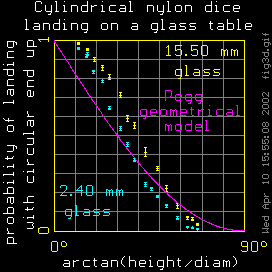
Test of the geometrical model
The figure at the right shows the results of the dice rolls
as before, but now a purple line is added to show the prediction of the
Pegg geometrical model. It can be seen that there are significant
differences between the geometrical model and the experimental data,
especially when the die is very short or very tall.
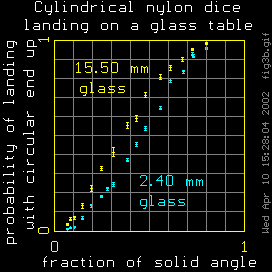 The figure shown at left plots the original data relative
to a new axis, which is the fraction of solid angle subtended by the
two circular ends. This make the graph look more symmetrical, and the
lines are closer to being straight.
The figure shown at left plots the original data relative
to a new axis, which is the fraction of solid angle subtended by the
two circular ends. This make the graph look more symmetrical, and the
lines are closer to being straight.
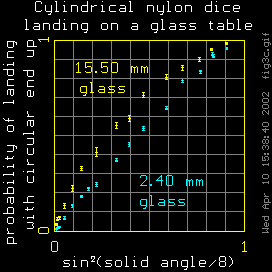 The figure shown at the left is inspired by the speculative
idea that probability could depend on fraction of solid angle, but not
necessarily in a linear way. Let us suppose that the probability of
landing on an end depends on the fraction of solid angle subtended by
the ends. Let us also suppose for simplicity that the behavior of the
die is symmetric so that the probability of landing on the side depends
in the same way on the fraction of solid angle subtended by the side.
If the dependence is linear, there is only one possible function.
But apart from the linear case, the next possibility is to have
quadratic dependence at both extremes. The result is as shown. The
data for the 2.40 mm thick glass now approximately falls on a straight
line. The data for the 15.50 mm thick glass shows a gentle bowing.
The figure shown at the left is inspired by the speculative
idea that probability could depend on fraction of solid angle, but not
necessarily in a linear way. Let us suppose that the probability of
landing on an end depends on the fraction of solid angle subtended by
the ends. Let us also suppose for simplicity that the behavior of the
die is symmetric so that the probability of landing on the side depends
in the same way on the fraction of solid angle subtended by the side.
If the dependence is linear, there is only one possible function.
But apart from the linear case, the next possibility is to have
quadratic dependence at both extremes. The result is as shown. The
data for the 2.40 mm thick glass now approximately falls on a straight
line. The data for the 15.50 mm thick glass shows a gentle bowing.
This page is still under construction.