Dice Rolling Machine in April 2001
 The machine
described here was first operational in January 2001. It is the first time that
anybody has built a machine to automatically roll dice and keep statistics of
the rolls. A single die is rolled, photographed and rolled again. One cycle
takes 2.5 seconds, allowing 34560 rolls in a day.
The machine
described here was first operational in January 2001. It is the first time that
anybody has built a machine to automatically roll dice and keep statistics of
the rolls. A single die is rolled, photographed and rolled again. One cycle
takes 2.5 seconds, allowing 34560 rolls in a day.
Here are pictures of
the dice rolling machine as it was in April 2001. This dice rolling machine
began in September 2000 as a project in PHYS 319 and PHYS 329 which are lab
courses for third and fourth year physics students at Okanagan University
College in Kelowna, BC, Canada. http://www.ouc.bc.ca/ Nine students were taking
both one-semester courses, which are required in order to get a B.Sc. in Physics
at OUC.
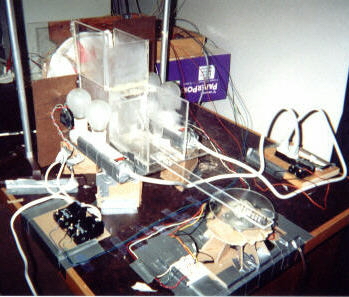 The next two photos show general views of the dice rolling
machine. In the foreground the crank wheel for the sweeper can be seen. A 72 rpm
motor was used to turn the wheel. The connecting rod is attached to the sweeper
shuttle, which sweeps dice off the table and into the casting wheel.
The next two photos show general views of the dice rolling
machine. In the foreground the crank wheel for the sweeper can be seen. A 72 rpm
motor was used to turn the wheel. The connecting rod is attached to the sweeper
shuttle, which sweeps dice off the table and into the casting wheel.
The
four 100 Watt light bulbs were used as the light source for the dice pictures.
The switch that flashes these lights is on the right edge of this picture.
Most of the structure was built out of plexiglass and corrugated
cardboard, and was held together with hot melt glue and duct tape. The
plexiglass table is about 30 cm by 30 cm in size, but the dice land on a 10 cm
by 10 cm region which is surrounded by high vertical plexiglass walls. Most of
the plexiglass is sanded to prevent light reflections.
 The sweeper
mechanism is clearly visible in this picture. An output signal from a computer
directly turns on a solid state switch (black rectangle just to the right of the
motor) which controls the 120 volt supply to the motor. A small light and
phototransistor sit just below the clear plexiglass wheel on the top of the
motor. A small tab of black plexiglass hangs down from the wheel and blocks the
phototransistor after one full turn has been completed. The voltage from the
phototransistor is read by the computer to determine when the motor should be
turned off.
The sweeper
mechanism is clearly visible in this picture. An output signal from a computer
directly turns on a solid state switch (black rectangle just to the right of the
motor) which controls the 120 volt supply to the motor. A small light and
phototransistor sit just below the clear plexiglass wheel on the top of the
motor. A small tab of black plexiglass hangs down from the wheel and blocks the
phototransistor after one full turn has been completed. The voltage from the
phototransistor is read by the computer to determine when the motor should be
turned off.
The two black switches on the left of the picture control
another motor which directly opens and closes a 6 cm high 10 cm wide plexiglass
door. The door is closed in preparation for dice dropping. The door is opened
just before dice sweeping. Without the door, some dice rolls would bounce right
back into the casting wheel. A special reversible motor is used to control the
door.
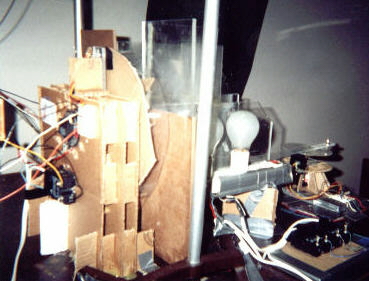 The casting wheel is visible in this view. A third motor with
a horizontal shaft is directly connected to the casting wheel, which is a 26 cm
diameter 3.5 cm long cylinder open on one side. Its rim is made of clear
plastic. A signal from the computer turns on the switch, which sets the casting
wheel in motion. A small nook in the circumference of the casting wheel catches
the die after it is swept from the table into the wheel. When the casting wheel
start to turn, centrifugal acceleration is large enough to keep the die pinned
in place. The wheel stops abruptly when the die reaches the highest point. It
then falls by gravity into a trough and bounces onto the table
surface.
The casting wheel is visible in this view. A third motor with
a horizontal shaft is directly connected to the casting wheel, which is a 26 cm
diameter 3.5 cm long cylinder open on one side. Its rim is made of clear
plastic. A signal from the computer turns on the switch, which sets the casting
wheel in motion. A small nook in the circumference of the casting wheel catches
the die after it is swept from the table into the wheel. When the casting wheel
start to turn, centrifugal acceleration is large enough to keep the die pinned
in place. The wheel stops abruptly when the die reaches the highest point. It
then falls by gravity into a trough and bounces onto the table
surface.
 This side view of the apparatus shows the two metal rods that
hold up the camera which photographs the die after each roll. Wires connect the
camera to the computer, which reads the image to count the number of dots
showing after each dice roll.
This side view of the apparatus shows the two metal rods that
hold up the camera which photographs the die after each roll. Wires connect the
camera to the computer, which reads the image to count the number of dots
showing after each dice roll.
Here is a close up of the camera looking
up from below. It uses a CCD chip. 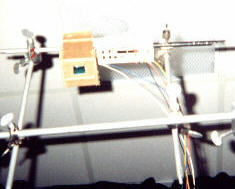
A green glass filter is visible in the small window
looking down. This filter is necessary in order to achieve sufficient contrast
when taking a picture of casino dice, which are made of transparent red plastic.
In the green filter, the dice appear to be black with only the white dots
showing.
For more information you can e-mail me (Dan Murray) at
daniel "dot" murray "at" ubc "dot" ca