 Overview
Booking the World
A communications study of Sheldon Library
City University: Tri-Cities Campus
Sheldon Library is a rare book dealer in Richland, Washington that has 70% of its sales on the internet, and thus is able to compete with the larger booksellers market by integrating their inventories with the giants. However, as the owner of the firm, Brian J. Sheldon, is out of the area on maneuvers and support of the US Army's Iraq war, this firm has unusual communications flow, which add to the question of how does organizational communications change when the organizational structure is changed by external forces.
Disclosures
Since July, 2004, it must be disclosed herein that the author of this paper, in the process of scouring yard sales in search of old hard-cover books, sells his discoveries to booksellers, such as Sheldon Library. By receiving a fiscal gain from book transactions, it might therefore be construed that the author might have a vested interest in this firm. For this reason that the author hereby attests that this report is being done without any such interest. To quote a great late rock critic, Lester Bangs, this report is so written in the "honest and unmerciful" appraisal approach that is required for analysis.
Overview
At the end of his term as a teacher for the Richland Public School District, Brian J. Sheldon decided to take his love of books and go open a book shop named Sheldon Library. What made his work different is that he opened his bookstore on the internet as well as at a storefront location at 1315 George Washington Way in Richland, Washington (Stang, 2004).
 Being an
independent
bookseller is not a
new field, but the
use of the internet
has had a dramatic
impact on the
market. Stores,
like Wal-Mart and
grocery chains,
have put a crunch
on the new book market, for these entities sell their stock at
prices lower than the small bookseller buy such books (Barker,
2004). It was for this reason that rare books provide a much
less competitive market, though competitive nonetheless. The
nation's top ten rare booksellers generate ten to fifteen million
dollars per year in revenues, while the average dealer in larger
cities generally make a half million in sales annually
(Greenberg, 2004). It is for this reason that when 70% of the
sales out of a small bookseller like Sheldon Library makes up the
annual sales of $100,000, the internet does provide a sizable
impact on book sales (Stang, 2004).
Being an
independent
bookseller is not a
new field, but the
use of the internet
has had a dramatic
impact on the
market. Stores,
like Wal-Mart and
grocery chains,
have put a crunch
on the new book market, for these entities sell their stock at
prices lower than the small bookseller buy such books (Barker,
2004). It was for this reason that rare books provide a much
less competitive market, though competitive nonetheless. The
nation's top ten rare booksellers generate ten to fifteen million
dollars per year in revenues, while the average dealer in larger
cities generally make a half million in sales annually
(Greenberg, 2004). It is for this reason that when 70% of the
sales out of a small bookseller like Sheldon Library makes up the
annual sales of $100,000, the internet does provide a sizable
impact on book sales (Stang, 2004).
Marketing rare books is tricky business based on very
subjective factors, including the reputation of the bookseller,
 which is why fairly
new vendors in this
market are at a
disadvantage. In
determining the
value of rare
books, such factors
as the printer of
the original book,
the type of paper,
and author are
certainly of great trust, but it is moreover the truth of
assessment of condition that is a great factor (McKay, 1998).
which is why fairly
new vendors in this
market are at a
disadvantage. In
determining the
value of rare
books, such factors
as the printer of
the original book,
the type of paper,
and author are
certainly of great trust, but it is moreover the truth of
assessment of condition that is a great factor (McKay, 1998).
Prior to the internet, many books were sold through book clubs (The Economist, 1998) and book fairs (Rosen, 2004) rather than book stores. These partnering factions allowed books to be selected, and the readership judged, based on a distinct set of values. However, the internet blurred the line between book clubs and booksellers (The Economist, 1998).
Thus, to allow smaller booksellers to compete in the world market, several websites have partnered with them, allowing these independent companies' inventories to be listed and integrated into the marketing by Amazon, Barnes&Noble, and others. In this way, a book buyer may find his or her choice on several websites, and there's a chance this person is actually looking at the same listing of the same book that has simply been posted on multiple websites (Stang, 2004).
Organizational Structure
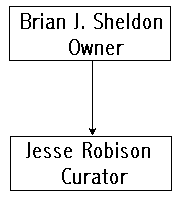 As this company has basically two operators, the owner,
Brian J. Sheldon, and his most knowledgeable curator, Jesse
Robison, the organizational structure, noted in the graphic to
the right, reveals what would appear to be a
very straight-forward approach to structure.
However, as noted in the next section, there
is a small wrench in the works when
considering the organizational communications
of this company.
As this company has basically two operators, the owner,
Brian J. Sheldon, and his most knowledgeable curator, Jesse
Robison, the organizational structure, noted in the graphic to
the right, reveals what would appear to be a
very straight-forward approach to structure.
However, as noted in the next section, there
is a small wrench in the works when
considering the organizational communications
of this company.
Organizational Communications Flowchart
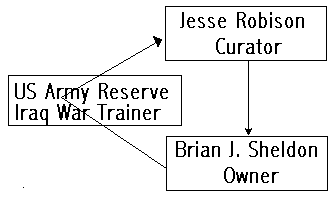 The owner, Brian J. Sheldon, is currently serving his
country in the US Army, having been returned to active duty to
aid training for the Iraq war. So, the flow of communications
have reversed. The internet
does provide faster
communications, but this
assumes that the owner is
somewhere near an internet
terminal. However,
considering Army conditions,
such is not always the case, and thus Jesse has found himself
running the company in absence of the owner, with the help of a
few unpaid friends and family members to take the burden of the
company off Jesse so he can be out of the office from time to
time.
The owner, Brian J. Sheldon, is currently serving his
country in the US Army, having been returned to active duty to
aid training for the Iraq war. So, the flow of communications
have reversed. The internet
does provide faster
communications, but this
assumes that the owner is
somewhere near an internet
terminal. However,
considering Army conditions,
such is not always the case, and thus Jesse has found himself
running the company in absence of the owner, with the help of a
few unpaid friends and family members to take the burden of the
company off Jesse so he can be out of the office from time to
time.
Jesse, being an expert in books, does take the time to make careful assessment of acquisitions. Thus, with Jesse's support and patience, Brian is able to make his tour of duty less stressful, for his reliance on Jesse, and the support of internet communications, allow his remote participation to sustain the company, even through such trials of war.
External Forces and Challenges
In the past six months, two new booksellers have opened within one block of this store, but they are not exactly in the same market. Hastings, a mega-multimedia store, sells used books up to about fifteen years old, and thus truly doesn't share the same customer base that Sheldon Library supports. The other bookseller, which is just around the corner from Sheldon, sells primarily old books that specialize in the theological support of the Church of Jesus Christ, Latter Day Saints.
Two positive external forces come from the facts that there is a coffee shop and bagel baker next to the bookseller, and an established doughnut shop/coffee house around the corner. Books and coffee seems to go hand in hand, and this is further supported by the fact that Starbucks has a shop in Barnes & Noble, as well as the Hardback Café was built into the new Hastings location.
The challenges that lie ahead for Sheldon Library will be from taking more advantage of the internet for marketing books. Currently their inventory's listings are limited to textual lists of data. However, in the ever-media dominated internet, there will be a demand for more images of books uploaded, which will require more time invested in web marketing time. Hence, there will be more need for additional staff as time progresses, and this may drive out the small booksellers from the market if they cannot make sufficient sales margins.
Conclusions
For the moment, with the staff and support that family and friends have provided, the company is remarkably healthy and stable. The firm's communications flow at a very even pace, and sales are remaining strong enough to sustain this company.
Making a mark: Internet bookselling. (1998, October 10). The Economist. p. 69(2), from INFOTRAC database.
Rosen, Judith. (2004, February 16). Fair play: school book fairs can help keep bookstores at the top of their selling game, but are they worth the trouble? Publishers Weekly. p. 63(4), from INFOTRAC database.
Barker, Richard. (2004 August 6). Independent view: an opportunity in Huntingdon, almost the biz in Wimborne, the dilemmas of compromise and the big squeeze. The Bookseller. p. 22(2), from INFOTRAC database.
Greenberg, David. (2004, February2). Rare books, rare collectors: antiquarian book dealers seeking new blood to bolster market. Los Angeles Business Journal. p. 12(1), from INFOTRAC database.
McKay, Ian. (1998, October). The Highest of High Spots, Golden Photographs, Fixed Stars, and a Whale of a Melville. Biblio. p. 62(1), (Abstract) from INFOTRAC database.
Stang, John. (2004, April 11). Books by the byte. Tri-City Herald, from Tri-City Herald archives database.
J. Robison. (personal communication, October 30, 2004).