


by Dianne Trimble
Ireland's Own Magazine,
May 9, 2003
Belfast might look considerably different if it weren't for the work of one man. Charles Lanyon designed and built many of the best known buildings in the city.
He was born in Eastbourne, Sussex in 1813 and began his civil engineering career in Dublin.
While residing there, he was one of several successive architects responsible for designing the National Portrait Gallery. Among his contributions is the impressive internal staircase leading from the sculpture gallery.
By the late 1830s, after working on projects throughout Ireland, he focussed his attention on Belfast.
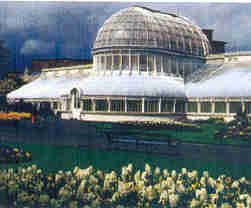
He designed the Palm House in the Botanic Gardens. Its cornerstone was laid in 1839, but it was not completed until 1852. It is one of the earliest curved glass and cast iron structures of its kind. The glass houses in Kew Gardens, London and Glasnevin, Dublin built later, were modelled on it.
Lanyon's original design featured a low central dome and wings with two terminal domes.
The final design is quite different with a 46-foot high central, elliptical dome, and two flanking wings. It was an entirely new concept in hot houses and much more efficient than previous models without glass ceilings.
In 1845 three Queen's universities were established throughout Ireland - in Cork, Galway and Belfast. One of the best known landmarks of Belfast, designed by Lanyon in 1849, is the beautiful main building of this university campus (later named the Lanyon building).
It is modelled on Magdalen College at Oxford and built in Tudor Gothic style. It is a visitor attraction for the city and features on many postcards.
The number of buildings Lanyon designed and built in Belfast is impressive. Styles ranged from Victorian Gothic to Italian Renaissance.
The Crumlin Road Gaol was built between 1843-45 and the Crumlin Road Courthouse was completed in 1850. The buildings are identical and directly across the road from each other with an underground tunnel connecting them. This feature was beneficial for the gaoller and an escape challenge for the prisoner.
Waring Street has some of the most impressive architecture in the city, including the Northern Bank, built in 1851-52. The bank wanted a building that would create a feeling of stability and inspire confidence in its customers and its style reflects this.
Throughout the 1850s Lanyon continued to design and build. The Union Theological College, in Botanic Avenue, opened in 1853, Clarence Place Hall in 1856 and Stranmillis House (later to become Stranmillis College, principal teacher training college for Northern Ireland) was completed in 1858.
The Sinclair Seaman's Church in Corporation Square is one of his more unusual creations. The pulpit is formed from the bows, bowsprit and figurehead of a ship. The baptismal font is a binnacle and the organ has port and starboard lights fitted.
The Custom House, built in 1857, in the Italian Renaissance style, is considered his greatest achievement. The erection of this impressive building marked Belfast's development into a major port.
In 1888, the year Belfast achieved city status, Lanyon died. As an architect, and later mayor, he had done much to progress Belfast towards its new status.
His burial place, at Knockbreda Church, is a stately mausoleum, decorated with classical columns and surrounded by cast iron railings, befitting his importance to the city.