Does spoke tension change with inflation pressure?
January 15, 2005
To find out, I measured the tension in the same spoke with tire inflated and deflated.
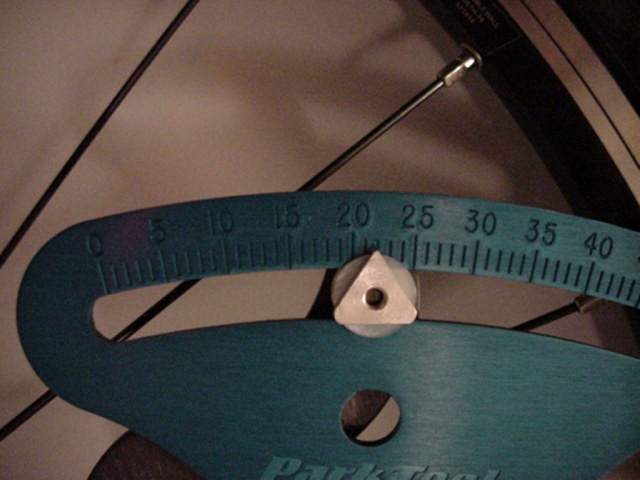
Figure 1. Tension with the tire inflated to 120 psi. The Park tensiometer reads a little less than 22; I'm estimating about 21.9.
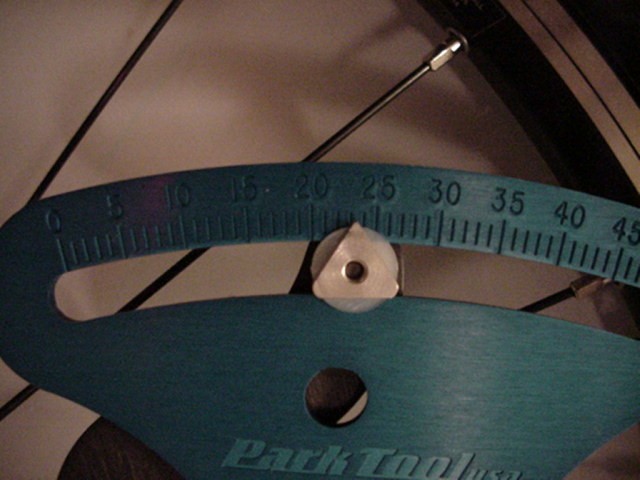
Figure 2. Tension with the tire deflated to 0 psi. The Park tensiometer reads a little more than 23; I'm estimating about 23.3.
For 2.0 mm round steel spokes, the "Tension Meter Conversion Table" that came with my Park tensiometer has the following column:
| reading | kgf for 2.0 mm round steel spokes |
| 17 | 51 |
| 18 | 56 |
| 19 | 62 |
| 20 | 68 |
| 21 | 76 |
| 22 | 85 |
| 23 | 95 |
| 24 | 107 |
| 25 | 121 |
| 26 | 137 |
| 27 | 156 |
| 28 | 179 |
I charted this data in Excel, added a polynomial trend line:

With an equation that fits that well (R2 = 0.9986), it's easy to calculated the tension values corresponding to my estimated fractional gauge readings above. I've added the new rows (in red) to the tension meter conversion table below:
| reading | kgf for 2.0 mm round steel spokes |
| 17 | 51 |
| 18 | 56 |
| 19 | 62 |
| 20 | 68 |
| 21 | 76 |
| 21.9 | 83 |
| 22 | 85 |
| 23 | 95 |
| 23.3 | 99 |
| 24 | 107 |
| 25 | 121 |
| 26 | 137 |
| 27 | 156 |
| 28 | 179 |
So inflating the tire to 120 psi dropped this spoke's tension from about 99 kgf to about 83 kgf, a decrease of about 16 kgf or roughly 35 pounds.
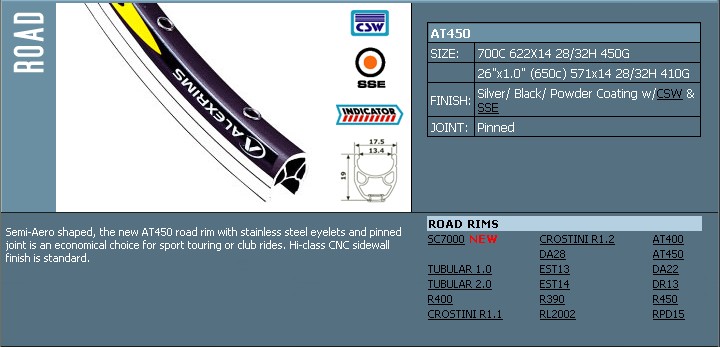
The wheel has a Shimano Tiagra hub, 32 DT spokes (2.0 mm), Alex AT450 clincher rim and Bontrager 700x25C Select clincher tire.
The rim properties may affect how much the tire inflation affects spoke tension, so I've included a screen shot of Alex's web page for this model:
Luns Tee mentioned that the tensiometer might have some measurement uncertainty, and it would be interesting to see the results of, say, repeating the same measurement a dozen times, and seeing the variance. Here are some gauge readings repeated to get a feel for how much variation there might be.
| Tensiometer Readings, same spoke | ||
| Trial | 120 psi | 0 psi |
| 1 | 21.9 | 22.7 |
| 2 | 21.9 | 22.9 |
| 3 | 21.9 | 23.0 |
| 4 | 21.8 | 23.1 |
| 5 | 21.9 | 22.9 |
| 6 | 21.8 | 23.0 |
| 7 | 21.9 | 23.0 |
| 8 | 21.5 | 23.0 |
| 9 | 21.3 | 22.9 |
| 10 | 21.7 | 22.9 |
| 11 | 21.4 | 23.0 |
| 12 | 21.6 | 22.9 |
| avg | 21.7 | 22.9 |
| max | 21.9 | 23.1 |
| min | 21.3 | 22.7 |
| range | 0.6 | 0.4 |
The table above shows there is some variation in the readings, but probably not enough to explain all of the difference between measured spoke tension with the tire inflated and deflated.
Below is an updated tension meter conversion table including two new rows, with the values in red now based on the averages obtained today:
| reading | kgf |
| 17 | 51 |
| 18 | 56 |
| 19 | 62 |
| 20 | 68 |
| 21 | 76 |
| 21.7 | 81 |
| 22 | 85 |
| 22.9 | 95 |
| 23 | 95 |
| 24 | 107 |
| 25 | 121 |
| 26 | 137 |
| 27 | 156 |
| 28 | 179 |
So the new measurements seem to show that inflating the tire to 120 psi dropped this spoke's tension from about 95 kgf to about 81 kgf, a decrease of about 13 kgf or roughly 29 pounds.
