
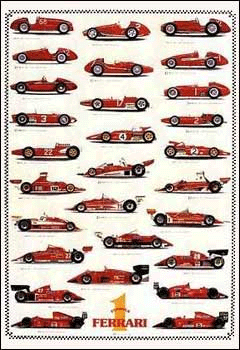
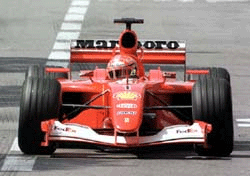

In 1929 he founded the Scuderia Ferrari in Modena, with the prime purpose of organising racing for its members. That was the start of an intensive involvement in motor racing which led to the creation of an official team and ultimately transformed the Scuderia into an engineering-racing division of Alfa Romeo, taking over the racing function entirely in 1933. In 1940 the Scuderia abandoned the Alfa Romeo connection and transformed itself into an independent company "Auto Avio Costruzioni Ferrari" which worked for the national aviation company in Rome, for Piaggio and for RIV.
In spite of a promise of non-competition (which at the moment of their divorce prevented Enzo Ferrari from building cars using his own name for four years), the company began to study and design a racing car, an 8- cylinder 1500 cc open car known as the 815, two of which were built to take part in the 1940 Mille Miglia. The outbreak of World War II put an end to racing.
In 1943, during World War II, the Ferrari workshop moved from Modena to Maranello and began making powered grinding machines for ball bearings. The workshop was bombed out in 1944 and rebuilt in 1946 the year in which it started designing and building the very first Ferrari. At the end of the war, the company changed its name to Ferrari and designed the 125 Sport, a 12-cylinder, 1500 cc car which Franco Cortese drove on the Piacenza circuit on May 11, 1947. The car had to retire, but it was ahead in the last lap, in what was a good debut. Two weeks later, in fact, Cortese and the 125 Sport won the Rome Grand Prix.
In 1963 Enzo Ferrari built his Istituto Professionale per l'Industria e l'Artigianato, a training school in Maranello. Since then, company cars, driven by the best drivers, have racked up over 5,000 successes on race tracks and roads all over the world, creating a legend. In 1969, to meet growing market demand, Enzo Ferrari sold 50% of the share capital to the Fiat Group, and investment that increased to 90% in 1988. In spite of this Ferrari has always maintained a strong autonomy, thanks to its specialist activities. The Fiorano test track was built in 1972 close to the Maranello plant, Enzo Ferrari's own brainchild. It is an experimental track where Ferrari racing and GT cars are tested. It is used by drivers for test and practice driving, and by mechanics and the racing team for training. An experimental track is very different from a racing circuit for at least two important reasons: the absence of spectators and the presence on the track of only one car at a time.
Performance, design and emotion encompass Ferrari's design criteria. Initially Ferrari built cars to finance their racing efforts, which in part is still true to this day. Utilizing their vast experience and success on the race circuit, Ferraris built today utilize their racing experience to design and build cars that are at home on the race track or on the street. One of the biggest attractions is the mix between high-tech design and handcrafted detail, together with the fact that Ferrari is one of the few manufacturers to make all parts for its cars, from engine to the chassis. Ferrari currently utilizes one of the world's state of the art "climatic wind tunnels" equipped to develop all types of car-bodies with regard to reducing air resistance and improving ground effect. The new wind tunnel can simulate not only different airflow situations but can also be modified in several ways; the temperature can be varied, as can relative humidity as well as solar irradiation and the simulation of movement. The Maranello tunnel is built to accommodate full-size models but can also analyze individual parts or smaller models when fitted with the smaller specification nozzles and diffusers.

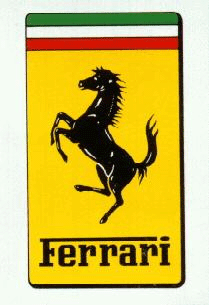
Since then the symbol has been scrupulously applied, with occasional exceptions, in its conventional form which has never changed, on all Ferrari cars of any category entered in races by the "competitor Ferrari". In 1952, Enzo Ferrari decided to bring back the racing badge of the old Ferrari Stables, modernised and stylised, to distinguish the official cars from those of the many customers who tried their hands at racing their own cars. It made its debut on March 16 on the cars competing in the Siracusa Grand Prix, the 500 F2's driven by Ascari, Taruffi, Farina and Villoresi. This was another triumph, with Ascari, Taruffi and Farina finishing in 1st, 2nd and 3rd place.
That same year Ascari won the Drivers World Championship, the first of Ferrari's 25 championship titles, in a 500 F2. The horse first appeared on the radiator grille in 1959. Produced by the Turin company Cerrato for the cars with body by Pininfarina, and etched by Incerti for Scaglietti cars, it was cut out of 3 mm thick sheets of brass pantographed and chrome-plated. It remained the same until 1962, and there was also a special version, serrated and bored by hand, that was used on a few exclusive cars and on cars destined for exhibitions and fairs.
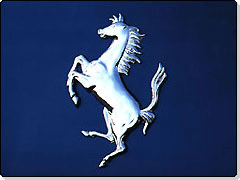
Between 1962 and 1963 the horse was produced in relief but it was not a success, and was only used for a year, being judged stylistically and proportionally unsuitable. A subsequent version was developed, with a flat horse pantographed on aluminium and then mirror polished; it was introduced in 1964, adopted until the BB model, and then recovered in 1984 for the Mondial, 328 GTB and GTS, while an identical, anodised version in black adorned the first Testarossa and 348. A new relief version of the horse was proposed in 1963, but this too met with little enthusiasm. It was considered superfluous because the flat version was now applied regularly on the radiator grille.
However, its development went ahead, so that it could be used if necessary on the rear of the car, as it was on the Mondial in 1988-89. And that was how the ornamental horse, destined to become an extremely familiar sight, came to be created, almost unwanted. It was to remain substantially the same for over 30 years, adorning the back of nearly all Ferrari models, with only small variations to the colour and size. In 1982 it also appeared on the front of the cars, replacing the flat pantographed version.
... Since 1992 it has featured on the entire Ferrari range, with well-defined forms for use on the front and rear. From 1953 to 1961 a trademark combining the initials of the Ferrari and Farina names in the naval alphabet, was used on cars designed by Pininfarina. The red rhomboid against a white background which indicated the letter F, was replaced by the letter P (white rectangle in blue field) when the designer changed his surname to Pininfarina. This trademark was generally abandoned in 1964, except for 2+2 models; and currently appears on the front tunnel of the 456 GT.Today's Ferrari trademark - Baracca's black horse against a canary yellow background - in the versions used for industrial production and technical and racing activities, are all registered, and are used on every graphical production of the company, for projects and drawings, Ferraridea promotional items, badges and decals, service and maintenance signage, official documents and for recognised Ferrari Clubs.
