|
This And That
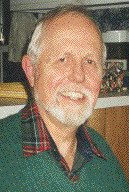
by François Brassard, Ladysmith, BC
Wanted: Prophets Of Change
 Numerous
polls indicate that a large majority of Canadian Catholics holds progressive
views on many issues that put them at odds with the official position
of the bishops. Most of these issues are related to sexuality: masturbation,
pre-marital sex, contraception, abortion, divorce and re-marriage, an
optional married priesthood, equality of men and women in ministry regardless
of sexual orientation, and open church governance truly representative
of all the People of God. Numerous
polls indicate that a large majority of Canadian Catholics holds progressive
views on many issues that put them at odds with the official position
of the bishops. Most of these issues are related to sexuality: masturbation,
pre-marital sex, contraception, abortion, divorce and re-marriage, an
optional married priesthood, equality of men and women in ministry regardless
of sexual orientation, and open church governance truly representative
of all the People of God.
Some would say that the last issue is the root cause of all the others.
They argue that autocratic rule reserved to elderly male celibate clerics
creates a cultural mindset that makes it difficult to understand fully
the crucial role of sexuality in God’s Creative Plan. It produces
blind guides who have eyes to see and, yet, do not see. How many times
lately have you heard people say in response to the bishops’ mismanagement
of sexual abuse cases: “they just don’t get it!”?
In view of the above, one might naturally expect that Canadian Catholics
holding these progressive views would band together in organizations
that sought creative ways to bring about healthy changes in the Church.
After all, that’s what’s happening in the United States because
of stunning revelations of sexual abuse by clergy and of irresponsible
cover-ups by bishops. There are groups like CTA (Call To Action), ARCC
(Association for the Rights of Catholics in the Church) and the newly
formed VOTF (Voice Of The Faithful). This last group (www.voiceofthefaithful.org)
just five months old and already boasting 19,000 members, called for
the gathering of a Catholic Constitutional Convention, and this, significantly,
in front of Faneuil Hall in Boston. Ahh! Shades of the American Revolution!
But this is not happening in Canada, despite the mighty efforts of groups
like Challenge The Church, Corpus Canada, Women’s Ordination Worldwide,
the We Are Church Signature Campaign or the now defunct Canadian Coalition
of Concerned Catholics. There is no ground swell. Why not?
Maybe it’s because most progressive Catholics are basically traditional.
They shrug their shoulders at the shenanigans of so-called celibate
priests and bishops; but they get quite upset - and rightly so –
when they are denied the sacraments and especially the full celebration
of the Eucharist (Mass), because an ever growing priest shortage has
consolidated parishes, closed others or down-sized the reception of
sacraments to the occasional ministrations of a circuit-rider priest.
When the faithful complain, the bishops blame the shortage of priests
on the “sexual revolution” and the secular attitudes of the
faithful, particularly their lack of generosity. It is beyond me why
the faithful would believe these false allegations and not see them
as a smoke screen covering the bishops’ stubborn refusal to relax
the “old boys’ club” rules that guarantees them absolute
power. It is all the more galling when it is clear to everyone including
the bishops that introducing an optional married priesthood of men and
women regardless of sexual orientation would provide an overflowing
wellspring of gifted candidates to the priesthood. No longer would bishops
be forced into secret decisions to shunt pedophile priests from one
parish to another. The faithful have asked the bishops time and again
to make these changes. Out of a false sense of loyalty and rigid uniformity
disguised as unity, they say they cannot do this and they pass the buck
to the present pope who is socio-culturally incapable or unwilling to
make such changes. In so doing, the bishops buy into the Vatican directed
un-catholic ‘heresy’ of “creeping infallibilism”
and they allow themselves wrongly to be reduced to the level of passive
functionaries, branch-managers for a multi-national religious corporation.
Why would Canadian Catholics tolerate this behaviour? Maybe they don’t
believe strongly enough that this is their Church too and that they
have a right and an obligation (Canon # 212) to speak out and be heard
and, even to participate in the decision making.
Maybe it’s because we’re Canadians, not Americans. You know,
it just isn’t the Canadian way. It would appear that our cultural
heritage has led us to do things differently here. My own study of Canadian
history has led me to believe that we generally mush along aimlessly.
Then along comes a charismatic visionary of integrity preaching common
sense, creative solutions to current problems. When enough people enthusiastically
embrace the message, creative things begin to happen. In recent Canadian
political history, people like T.C. Douglas and Pierre Trudeau come
to mind. In the Church we have people like Jean Vanier and Gregory Baum.
At this time, however, I see no visionaries of stature on the Canadian
Catholic landscape, people who can read the signs of the times and who
have a broad view of God’s Creative Plan. I strongly believe that
we need visionaries who understand profoundly what values must be preserved.
At the same time we also need prophets who can see beyond the present
church “box” in which we live and who can enflesh in new ways
Jesus’ universal vision of the “kingdom of God,” the
new Jerusalem, built “on earth as it is in heaven.”
Is this an impossible dream? I think not. Indeed, look at the powerful
example given to us recently in Toronto by John Paul II and the Catholic
youth of the world. I’m not referring to the clerical trappings
of the final Sunday Eucharistic celebration that included self-serving
speeches by bishops with red hats; that was a celebration of exclusivity,
not catholicity. Rather, I’m referring to that very powerful, meditative
presentation of the Stations of the Cross at the Friday night vigil.
The words written by John Paul II himself and beautifully dramatized
by those young people moved me profoundly. I felt challenged to follow
in the footsteps of Jesus and to carry willingly the cross that accompanies
the daily living of his message of love, peace and justice in a world
fraught with greed, hatred and violence. It was a freeing, life-giving,
universal message inviting us to evangelize, but not proselytize –
to share our faith wherever we are, not so much in words as in actions
that reflect the Beatitudes. Many things moved me deeply: the stalwart
courage of the pope in the face of age and painful disabilities; his
Mona Lisa smile as he gazed upon the multitude of enthusiastic youth;
that incredible moment on that blustering Sunday morning when he suddenly
looked up from his script as the sun burst through the stormy clouds,
and he spontaneously summed up the whole christian experience with those
three Spanish words: “lluvia, viento, sol” (rain, wind, sun);
and the unusual fact that his message was totally devoid of “church
box” thinking – it was universal, truly catholic. I was also
moved by the sincere and honest expression of faith by young people
of diverse colour, costume and language; it felt very catholic.
Like the pope, I strongly believe that those young people at the WYD
are the hope of the Church, but not necessarily according to the narrow
vision of the present clerical leadership. Youth today are far more
open and tolerant of different views, and that makes them less likely
than their forebears to fall prey to the “pay, pray and obey”
syndrome. Before long, Spirit filled youth emerging from the WYD experience
will challenge Canadian Catholics to live a new, inclusive expression
of Church, one whose light will better reflect the Gospel message throughout
the world.

|