|
Salvation History
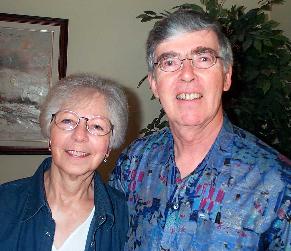
by Claudia & Maurice Sullivan, Ottawa, ON
 Throughout
our lives as Christians we have been taught to think of our faith in
terms of the story of Judaic-Christian SalvationHistory. In this context,
Christians of the pre-scientific era saw the earth essentially as a
platform of a divine but short lived drama. God created the earth about
6000 years ago, along with various species of animals, fish, insects,
etc. Adam and Eve were also created at this time and intermittently
God intervened in the history of the chosen people and in a definitive
way with the birth of Jesus. The full focus of Salvation History centered
upon the human: our supernatural origins, the drama of our Fall from
Grace, and the coming of our Redeemer. Throughout
our lives as Christians we have been taught to think of our faith in
terms of the story of Judaic-Christian SalvationHistory. In this context,
Christians of the pre-scientific era saw the earth essentially as a
platform of a divine but short lived drama. God created the earth about
6000 years ago, along with various species of animals, fish, insects,
etc. Adam and Eve were also created at this time and intermittently
God intervened in the history of the chosen people and in a definitive
way with the birth of Jesus. The full focus of Salvation History centered
upon the human: our supernatural origins, the drama of our Fall from
Grace, and the coming of our Redeemer.
Prior to the 18th century, the world of medieval thought was not an
atmosphere to encourage scientific exploration. Men and women were busied
about their souls, not about far voyages either in space or time. They
were basically contented with the Christian world view; they were devout
and centered on their own spiritual growth. Nature was not of much interest
because humans were seen to be elevated above nature and destined for
something better.
Cosmic History
But slowly over the past three hundred years, some strange discoveries
began which whisked us from this small tightly bounded comfortable spiritual
perspective to a vast new landscape. To oversimplify, we might summarize
these discoveries as “The Three Immensities,” (Timothy Ferris)
– the discovery of time, space and human ignorance. The scientific
discoveries of the past 300 years culminating in a exponential growth
of knowledge in the 20th century is rather like the trauma that accompanies
an individual’s transition from adolescence to adulthood; it’s
a big old world out there, and we know much less about it than we thought.
Time
The immensity of time was the first to reveal itself. The discovery
of the past seemed to happen by accident, from research that wasn’t
originally intended to explore time at all. This work started in geology,
but quickly moved into biology and cosmology. Someone found a shell
embedded in a rock on a mountain top; someone saw the birth of a new
star; someone watched a little patch of soil carried by a stream into
a valley. Some idler observed a fish entombed in a stone.
The great voyages that were to open up the planet began. The first telescope
was trained on a star. The first microscope was turned on a drop of
ditch water. By 1859 Charles Darwin realized that for so many species
to have evolved in such proliferation from a single common ancestor,
the earth must be very old—hundreds of millions of years old at
least. This was a great shock for the Christian community, including
Darwin himself, a man of deep traditional faith. Because of these events
and many others, the Biblical time-frame based on a literal reading
of Genesis, began to fade. By the 20th century, the empirical evidence
would suggest that the universe may be as old as 13 or 14 billion years.
Space
Equally daunting was the discovery of the immensity of space. From
the medieval perspective, the planet earth was the center of the universe,
and God resided in heaven above the sky. It did not become clear just
how large our universe is until the discoveries of the past 100 years.
In the 20th century, astronomers determined that our sun is but one
among several hundred billion stars in our galaxy, the Milky Way. And
the Milky Way is a mighty big affair. If, for instance, we had an atlas
of the Milky Way that devoted a single page to each star in our galaxy,
so that the sun and its planets took up just one page, merely to flip
through the atlas at a rate of one page per second, without taking so
much as a daily coffee break, would consume 10,000 years.
But the Milky Way is just one galaxy among many. The observable universe
contains something like 100 billion galaxies. However, the observable
universe is not the whole story. Cosmologists calculate that the totality
of the cosmos is a great deal larger than we can so far observe. In
these calculations, if the universe were to be mapped on the entire
surface of the earth, the observable part of it might amount to an area
about the size of a loonie.
Human Ignorance
The third great discovery culminating in the 20th century is that
of human ignorance. Having learned a little about the universe, we find
that our vaunted intellectual history, including Salvation History,
looks a little short in time perspective and a little myopic in its
anthropocentrism. We are just beginning to discover how blind we’ve
been to how much nobody knew both from a scientific and religious perspective.
This has been a humbling experience. So we are beginning to speak more
modestly. Rather than claim infallibility, scientific philosopher Karl
Popper says, “The more we learn about the world, and the deeper
our learning, the more we are learning about what we do not know.”
And in the words of physicist, John Archibald Wheeler: “We live
on an island of knowledge surrounded by a sea of ignorance. As our island
of knowledge grows, so does the shore of our ignorance.” And the
physician, Lewis Thomas: “The greatest of all the accomplishments
of the 20th century science has been the discovery of human ignorance”.
Religious and Scientific Questions
These three immensities are at the core of the excitement in our
Corpus Cosmology Group. We are learning to ask challenging new questions
about our traditional faith. For example are we correct in viewing our
faith only in terms of traditional salvation history, or need we begin
also viewing it in terms of a newly discovered “evolutionary history
of God’s universe”? What are the implications of doing so?
After about 2800 years of misinterpreting the Genesis Creation story
as “literal,” (the Genesis Creation Story may have been written
about 900 BC), and now realizing this mistake, we are wondering whether
there are other books of the Bible which may require a less literal
and more metaphorical interpretation in order to derive correctly their
contained spiritual truths?
Boundaries of Revelation
Traditionally we insisted that God’s revelation came from
Jesus, from the Bible and from the Church’s magisterial teaching.
But is it possible that the whole of the created universe might be a
source of divine revelation as well? Are we now learning about HOW God
created and not just THAT God created the universe? Is it possible that
as our consciousness of the universe grows, we are experiencing divine
revelation on a continuing basis outside the framework of Church magisterial
guidance? And is it possible that past formulations of theological truth
are much more relative than “infallible teaching” would have
had us believe? These are a few of the exciting questions being raised
by our new understanding of cosmology and the other sciences within
a spiritual perspective.
In the past, religion and science were seen as having two totally different
domains of reference – one physical and the other spiritual. But
is this just one more false dualism created to enhance political domains
of power for entrenched hierarchies in both fields? Is it possible that
the essential truths of both religion and science would find a far vaster
and more profound form if expressed within the context of the irreversible
emergent process of evolution?
As the Ottawa Corpus Cosmology Group grows in its new awareness of time,
space and the evolutionary history of life on earth, it has developed
a growing spirituality and consciousness which extends beyond the traditional
theological boundaries of institutional Catholicism. We meet, reflect
and meditate regularly on the great mystery of God’s revelation,
not only in terms of traditional Biblical Salvation History, but in
the newly discovered universe of God’s “cosmic evolutionary
history.” We invite everyone interested to join with us in this
exciting and inspiring journey. Call Maurice/Claudia Sullivan at (613)
820-5893.
|