 
|
|
|
|
by Chris Diamond
In the late 60’s, Naomi and I continued as well to go to our local parish
church in Don Mills and our daughters, Ruth and Lisa, were baptized there
at Annunciation by Gregory. Naomi and I had been married at the chancery
office in Toronto in an abominable farce that showed no respect for the
sacrament of marriage by three monsignors who ridiculed and made light
of what they were doing. Even though I had received an indult, they told
us our marriage would be registered “in the secret archives”, that we could
not publicly celebrate our marriage, and that they would deny it if we
made it public. We know that God forgave them. At that time, there was
not much experience in Latin Rite priests marrying. We had the good sense,
however, to have a sacramental marriage with family and friends. We remember
fondly the highlights of our time in Toronto with our friends. But it was
also a lonely time for us because we were isolated to a great degree; there
was little general understanding of catholic priests marrying, and
not everyone in our families found it easy, or supported us, or rejoiced
with us. In time they did and were at ease with our three girls and us.
About this time we met some people who were looking for more than what the parish church was offering. We started to gather with them in our homes on Saturday afternoons before going to the evening mass. We discussed the scripture readings, had supper, and then went to mass. When a mixed marriage couple joined us, we became aware of how uncomfortable we were that the Anglican wife could not receive communion at mass. Then an Anglican family joined us and we realized that breaking off our gathering to go to mass was interrupting the flow of our gathering, so we started to have our own eucharist. We began to meet every three weeks in our homes and to go to the parish church in between. The kids liked our home liturgy better and wanted to do it every week; by this time there were 12 of them and 13 adults. At first, we borrowed the phrase ‘Home Church’ from Vatican ll. The group liked it. We were growing. When it was rumoured that we had started an “underground church”, I suggested to the group that we call ourselves an Agape Group, and everyone agreed though some continued to use Home Church. The Agape group lasted for 8 years; besides our regular gatherings, we had work bees in one another’s homes, outings, yearly retreats, and funerals. It ended as families moved away, separated, and changed. Meanwhile, Naomi and I kept up our parish and diocesan activities in marriage prep, first communion class, liturgy committees, and so on. I was serving on the Bishop’s Council and was diocesan chairman for liturgy. I gave homilies occasionally on Sundays, helped parishes to train people for communion services, and was part of the diocesan preaching team when appeals were made. At this time, we helped with the yearly ecumenical service held in January and we had Remi and the Anglican bishop attend on three occasions. Out of those ecumenical services there began a scripture study group that is now completing its 18th year. This group meets every Wednesday night in each other’s homes for wine , supper, and study, and it has a steady number of 17 participants, all Anglican except for Naomi and me. Bill Morrison, an Anglican priest and I led the group for the first three years; then, he moved to another post and I have carried it on with the affirmation of the Anglican pastors. We also had at one time (for about three years) in the parish an RC scripture group but it folded when we had a change of parish council and the chairman told me that I was not a suitable person (being a married priest) to work in the parish. The pastor took the easy way out and did nothing. After that Naomi stopped attending the parish. I continued and, when the bishop called for a diocesan synod, I was elected and appointed to the synod which lasted from ’86 to ’91. The parish council and the pastor did not like the idea of the synod; the parishioners were interested, however, so I dutifully reported to the parish regularly at the Sunday masses. This diocesan synod was an event of genuine dialogue, discernment, and consensus in a local church, and it resulted in 400 decisions made by the People of God in the Diocese of Victoria and promulgated by the bishop. When the synod ended I made my farewell to the parish - it had become too exhausting to counter the outlook of the parish council and it was always up to Naomi and me to push for even minor improvements. There were better things to do. One of the better things was to join Corpus Canada (CC). Joe Gubbles had given our names to François Brassard and Connie Kurtenbach who were organizing CC on Vancouver Island. Naomi and I attended the meetings. We had admired Corpus USA and we were enthusiastic about the idea of CC. Things greatly improved after a meeting in Vancouver when the Island group decided to hold regular gatherings for prayer, discussion, meals, liturgy and business. This group rapidly formed a bond, a koinonia, and as a result of this we undertook to host the ’95 CC Conference in Victoria. At that Conference, CC added the formation of small faith communities to its aims. The CC group on Vancouver Island also undertook to give relief to Emil Kutarna from the job of publishing The Corpus Journal. When CC on the Island had grown to almost 40 members and it was becoming more difficult to meet in homes, we divided into three smaller groups for regular gatherings, with full gatherings at intervals throughout the year. Our mid-Island small faith group continues to meet every other Tuesday evening and we take turns hosting and setting the agenda for gathering, eating, prayer, liturgy, and discussion. Another of the better things to happen was the formation of the Basic
Christian Communities (BCC). Remi appointed Jim Sheppard SJ to bring together
the many small faith communities in the diocese and to form and guide their
leaders. The BCC meet in regional groups in homes and parish churches three
or four times a year for liturgy, lunch, and business. The mid-Island
Corpus group has hosted the groups. These gatherings provide a great opportunity
for sharing experiences and spiritual development. As Jim has not been
able to shoulder much of the work himself, regional leaders have taken
on more responsibility.
From this sketchy account, it is clear that church gatherings (one, holy, catholic, and apostolic) at our house have been a regular feature. In the words of John Shea, “Gather the folks; break the bread; tell the story.” I had learned the value and practice of this first hand because I was fortunate to have worked in northern BC where I celebrated the eucharist with the catholic people on the Queen Charlotte Islands. Most of this was done in homes. Later as I moved around the north, it was not unusual to set up an altar either in a home or in the open and have mass with anyone who was around. There was also an old adage “There is no canon law up north.” That mostly applied to fasting and abstinence and rules for liturgy. Service to people was the main purpose of my being there. I came into the ministry a cleric, but from the people that I served and the friends that I made I soon learned what it meant to be priest. It is possible to be both, and there are countless good clerical women and men in Holy Orders who are serving the people when the rest of us are taking life easy. The Holy Orders of deacon, bishop, and priest are catholic. Church governance is too, but hierarchy and legalistic monarchical papacy are not. (This kind of papal church is a second millennium aberration.) They are not one, holy, catholic, and apostolic. Jesus was familiar with hierarchy; he lived with it all his life. Hierarchy has been a mixed blessing for the church throughout the centuries. Recently on CBC a woman from the Toronto archdiocese affirmed that she was so happy that she was catholic and told all those who criticized the Hierarchy to join the United Church. She had no idea of what it means to be catholic, and I resented her telling good catholic people who do know that they should leave the catholic church. There have always been and still are many forms of the catholic church. I understand that the indult I received took me out of the hierarchical clerical corps. Not that I ever got anything to read or sign, just the word of Monsignor Foy in Toronto telling me that I could get married. A woman on Vancouver Island once asked me if I missed ‘saying mass’, and she was surprised when I told her that we celebrated the eucharist regularly, but that I did miss preaching. It was an opportunity to put forth spiritualities and explain things that seemed to me to be unclear to the average catholic in the pew. Home church, on the other hand, works because everyone feels able to participate equally. Just as with Corpus gatherings or producing The Journal- nothing happens unless everyone makes it happen. When we came to Vancouver Island, we told Bp. De Roo that we would not embarrass him or the church. We haven’t, and he in turn has not embarrassed Naomi and me. We did not ask him for permission to do things with people though we did keep him informed of what we were doing. We asked him once at supper in our house if he would confirm the kids in our Agape Group and he said that he wouldn’t as he would rather they were confirmed in the parish church. He also told me to be sure to register in the parish any baptisms that I did. During our time here, our spiritual development has not come from the parishes. In the diocese, we have had the benefit of learning from Raymond Brown, Bernard Cooke, Charles Curran, Tad Guzie, Gregory Baum, and many others who were invited by the bishop to give workshops and lectures. These people inspired many, but their influence did not reach the parish structure. For example, 25 parishioners attended a workshop given by Tad Guzie. Afterwards we met with the pastor to discuss how we could put to use what we had learned. We were informed at once that the pastor did not approve of Guzie- and that was that! For Naomi and me, our spiritual nourishment has come largely from the groups of people who gather with us and from reading good books too. We kept ourselves part of diocesan events even when the pastors of local parishes were not enthusiastic about having us do anything. I was determined not to disappear from the catholic community and we did what we could as opportunities came, but eventually, the effort was too great and for the past 10 years, we have restricted ourselves to regular gatherings of small faith communities. From our experience, the majority of the people in the parishes appreciated my service, but with few exceptions, the clergy have shown little interest in anything we had to offer. The church of the 90’s differs greatly from the church of the 70’s, even here in Canada. With the appointment of bishops vested in the Vatican, it takes only about 10 years for the Roman Curia to turn a country around if it does not like the way things are headed. In the 70’s we lived in hope. There were national conferences of bishops and regional conferences of priests. We remember well the enthusiasm of the Victoria meeting of the Western Priests’ Conference with Bob Ogle. There was much talk of collegiality and the synod of bishops meeting in Rome. If we had not been so optimistic, we would have seen the Roman Curia’s rout of the Dutch bishops as the writing on the wall. When other national conferences of bishops did not rally to the Dutch bishops, the church was in reverse. It would be only a matter of time before go-ahead bishops would retire and be replaced. An individual bishop or a small group of bishops is no match for the unabashed power of the Roman Curia. Gone now is the dialogue that is needed. Gone now is the reliance on the wisdom of theologians. Gone now is the value of the witness of the faithful. People often ask me: “Why do you bother trying to do anything about these things?” Naomi and I do it because we are part of the catholic church and we regret that we are not welcome in some parts of it. But we also ask ourselves: “What would Jesus do?” During his life, he did not try to found a new religion; he made no deacons, bishops nor priests; later the church community inspired, we believe, by the Spirit would make them “in Christ’s name”. Jesus did ‘apostle’ some people- that is he sent out disciples, 72 by one account and maybe as many as 500. But Jesus did not fight the Roman system. He gathered his women and men friends into his koinonia, and together they lived life the way it is in God’s house. They ate together, praised God, and talked. Jesus confronted the religious rulers and pointed out their abuse of power. Later, when Paul saw what Jesus had been about, it knocked him off his horse, and he gave up the security of being among the temple powers to join the struggling minority of Jesus’ followers. Naomi and I have noticed an RC phenomenon: You may be part of a parish for a long time, but if you stop going, no one ever inquires about you (unless you play the organ or lead the choir). You could drop off the edge of the world. You are on your own. In October ’99 when our little granddaughter died suddenly, people from our small faith groups were there for support but no one from our parishes appeared. Connie and Gordon, our Anglican priest friend, were at the hospital even before we were, stayed with us, and conducted the funeral and burial services. A nearby community church who did not know us at all sent in meals for a week. Naomi and I have not gone to a parish for what we could get but for what we could offer and for as long as there was any hope of open dialogue. Being marginated, however, has forced us to find our own way and has helped us to develop and to serve others in ways that we did not foresee. Along the way, we were fortunate to make community with small groups of caring people. A friend from our Agape group wrote to Naomi recently: “Our paths crossed sometime in the 1970’s when we were in the throes of bringing up daughters. The church was changing. I never consider crossing of paths to be accidental. We soon discovered that we had much more in common than our Irish heritage. Those times hold cherished memories not only for us but for our daughters. We struggled and searched together and found many ways to have fun, delight, and numerous experiences. You were a gentle, generous and reliable friend.” What else would Jesus do?
|
|
|
| |
|
| |
|
| |
|
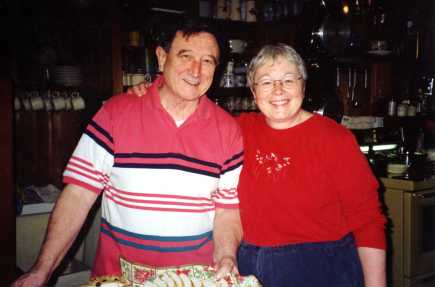 Church gatherings at our house are a regular
feature. I have done this for almost 40 years since I asked for a
leave of absence from my Oblate community in the summer of 1965 and
my Provincial Superior, Gerry Cousineau OMI, told me I would have
to leave town (Ottawa). Still a cleric, I often had a eucharistic gathering
at my place or in someone else’s home as the occasion arose. It seemed
natural then that after Naomi and I were married in Toronto that we should
carry on doing this, mostly with friends many of whom were also married
priests in transition from the clerical corps. We often hosted couples
sent to us by Gregory Baum, then at St. Mike’s. We had some great gatherings.
Church gatherings at our house are a regular
feature. I have done this for almost 40 years since I asked for a
leave of absence from my Oblate community in the summer of 1965 and
my Provincial Superior, Gerry Cousineau OMI, told me I would have
to leave town (Ottawa). Still a cleric, I often had a eucharistic gathering
at my place or in someone else’s home as the occasion arose. It seemed
natural then that after Naomi and I were married in Toronto that we should
carry on doing this, mostly with friends many of whom were also married
priests in transition from the clerical corps. We often hosted couples
sent to us by Gregory Baum, then at St. Mike’s. We had some great gatherings.