|
By Chris Diamond, Cobble Hill, BC But I was wrong- not about liberating myself and marrying Naomi- but about liberating priests for the good of the church. The most important thing to do for the church is to liberate the bishops. A while back, there was a bit of humour going around, and "Bless me, Father, for I have sinned. I have used it myself a few times." It went like this: "Why are catholic bishops asked to retire when they reach 75? So they can practice their catholic faith before they die!" Most of our bishops are good men (at this time) and given half a chance they can lead the church well. Vatican II was a great example. There the bishops wrested their freedom from the powerful Vatican curial bureaucracy, and they began a turn-around in the church that would have led us all to greater expression of the Kingdom of God. But politics in its worst sense has prevented this from happening: the structure of the church presently restricts much that is good from happening. When one hears the term Roman Catholic Church, one is not hearing a mainly religious but a political term. The driving force behind what the RC Church does is mostly political. The people in the pews may not think of it or know of it, but above that level, political correctness is paramount, from trivial decisions to scandalous acts. Ladislas Orsy in asking the questions, "Who are the bishops? and What is their task?" writes: "We see that the great multinational corporations are successful when they are centrally organized and uniformly disciplined. From their subordinate branches, they demand obedience and loyalty; they do not want autonomy and originality. But that is not the structure and the way of life that the Spirit has given to the church. Our catholicity is not perfect without diversity." He sees the bishops as "The architects and the guardians of this diversity within an all-embracing unity." (America, Oct., '99) Again, in answering Avery (now Cardinal) Dulles who states that the local churches as "the people of God with their pastors and regional structures developed as a byproduct of missionary expansion." Orsy returns to the structure of big corporations as unsuitable for the governance of the church: "The multinationals are internally unified and disciplined; they are shaped and governed from the centre down to the last details. Their way of doing business, however, is utterly unsuitable for any christian communion that honours God's gifts in their diversity no less than it respects God's design in its unity. Wisdom tells us: here is a temptation to be watched and resisted." (America, Nov. 25 '00) A few years ago while on holiday in Ireland, I heard a young girl telling her mother that the bishop was always saying "Please God". For example, to the confirmation class, he said: "I'll be back to see you in a few weeks time, Please God." And again, "We'll have confirmations in May, Please God." We all chuckled at her telling the story, but when I thought about it later, I thought "What a good guiding mantra not only for bishops but for all of us! Our decisions, all of us bishops included, might be different if we kept in mind to "Please God". Governance is hard enough when keeping to God's Kingdom. The Jesuits had it right when the made their motto "For the Greater Glory of God." With that in mind, I suggest the following. If we liberated our bishops from the tyranny of the curial watchdogs, they would be better leaders and we could get on with the service to God's Kingdom. The bishops would be happier and we would be happier too. We could do something about the ills that plague our church. I am reminded of D.H. Lawrence's poem Courage: "What makes people unsatisfied/ is that they accept lies./ If people had courage, and refused lies/ and found out what they really felt and really meant/ and acted on it,/ They would distill the essential oil out of every experience/ and like hazel-nuts in autumn, at last/ be sweet and sound.... As it is, all that the old can offer/ is sour, bitter fruits, cankered by lies." So our ministry is to go and see the local bishop and give him (at the
moment) our wholehearted support for wholesome things and offer continued
support in the matter of good governance. Imagine the difference it would
make if the bishop did not have to look over his shoulder all the time.
|
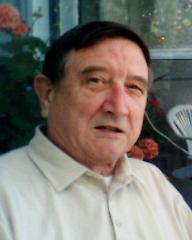 When
I changed my ministry in 1965 from serving the people in the pews, I believed
that the most important thing to do was to liberate priests. I had to start
with myself. At the time, I thought that was a big enough task; a year
later, Naomi had faith in me and what I was doing, so I went to Chicago
and asked her to marry me. We were married in Toronto that year.
35 years later we are still doing pretty good.
When
I changed my ministry in 1965 from serving the people in the pews, I believed
that the most important thing to do was to liberate priests. I had to start
with myself. At the time, I thought that was a big enough task; a year
later, Naomi had faith in me and what I was doing, so I went to Chicago
and asked her to marry me. We were married in Toronto that year.
35 years later we are still doing pretty good.