|
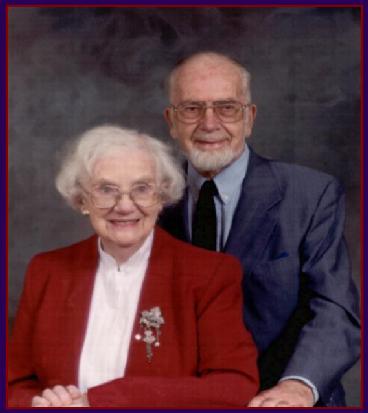
The Story of Marguerite and Dick Perrott, Sidney, BC
M We will talk about our spiritual life as background for our other life. I discovered that the Mennonites call it "The walk with God." Our life of faith, our ministry if you like, has been part of our ordinary life, our "being there" to listen, and if possible, to comfort and encourage anyone in need . D Before we got married when
each of us lived our separate lives, we each had our own religious experiences.
My parents brought us up spiritually into a world of fundamental Wesleyanism.
Church was for Sundays and we went morning and evening. As we got older
we went to Sunday School in the afternoon. At the same time, I discovered
a hidden psychic world, a world anathema to my parents, but into which
I could escape at bedtime or when I went for walks by myself. I found that
with concentration I could levitate and I experienced psychic windows into
the future. In my teenaÕge years, we moved next door to an Anglican
Church and I started to attend their services and became an altarboy serving
many times a week. I enjoyed the richness of the ritual, the candles, the
incense, and particularly the language of the KJB.
M My family was catholic and I went to catholic school though the Council school was closer. My friends did not go to the catholic school. There was no shadow of discrimination. We went to a non-denominational highschool which had scripture readings every morning but catholics were not required to attend. There was no prejudice there among the staff or the students. For example, in history class or exams, I could express a different opinion without penalty. I have always been very blessed to have met people who were very open and accepting. When I went to college I met nuns for the first time. I fell for the idea of the garb, but the nuns did not fall for me and they told me that I should try the world for a bit first. Then the war came. That was £the end of that for convent life. The only time in my life I felt that I was spreading the "Catholic" version of christianity was during the years when I belonged to the Catholic Evidence Guild and we had our "soapbox" in the Birmingham Bull Ring every Sunday night. D One of my early teaching experiences was with the Benedictines. We lived in a cottage in the monastery garden and I taught in the highschool. The Benedictine family was very good at looking after their retired priests. Eventually, we had to look for accommodation elsewhere. Then I taught in a Dominican school. There the headmistress ran a very open school and everyone had a loving relationship with the children under their charge. M During the war, I spent four years
in Coventry. I was sacristan in our church until it was flattened. Our
Anglican neighbours opened their church and school to us. Dick and I were
married in the ruins of the Catholic Chu M Hilary went to the Sacred Heart
convent school and enjoyed it. All of our children went to catholic schools
and always did well in them. We came to Vancouver mainly÷ because
the school provided us with a house to live in. The students slept in the
dorm on the top floor. Between 1953 and 1960 we moved five times into other
school houses on the same basis- we seemed to have a way with the students.
Out of the blue, Dick was asked to go and teach in Campion, and I said
"Why not? We have never been to the prairies."
D Teaching in a Jesuit school was
very different from teaching with the Benedictines and Dominicans: discipline
was very strict, and there was a form of elitism in that it was necessary
to have a relationship with people in the corporate and political world.
I began to question whether the catholic highschool was producing a better
student than the secular highschool. I had my doubts. It seemed to me that
if a catholic child had a good foundation in the primary grades, then that
student would be well equipped to have an influence in the secular highschool.
M The prairies were not beneficial
to Dick's health, and so we had to relocate. We moved to Manitoulin Island
to the reservation and worked with aboriginal people. When we stepped out
of the car for the first time, I felt that we had come home, and we heard
later that the people there felt the same way. It was the beginning of
a very fulfilling relationship with aboriginal people wherever we have
been. We next went to Alberta and worked on a Blood Reserve.
D On Manatoulin Island, we had Jesuit
priests who were great with the people, but the Sisters were not as a good
with the people. On the Blood Reserve, the reverse was true: the Sisters
were great to work with but the French priests were difficult to get along
with.
M In 1965, we moved back to Ontario
and Dick was principal of the catholic school and I was a consultant with
the public schools.
D The ten years at Holy Cross were
the happiest years of our lives. The school had 850 students in an English
and French school. I had help from French speaking students and teachers
whenever I had to address the assemblies and the public in French. It was
a very loving relationship. I spent each recess in the school yard. Each
student knew that they could come to my office anytime. I often had to
go to the hospital with a student who had an accident during the school
day. I would be there until the parents arrived. I tried to beÚ
a "good shepherd" who knows his sheep.
M I took a job as a part-time teacher.
D A new school was built in Annapolis
Royal and I was offered the job of principal of the intermediate school.
M We had about three pastors in Nova Scotia;
the last one had been a Naval Chaplain and he had a wonderful spirit of
ecumenism.
D We decided to retire and we slowly
headed west stopping in Ottawa for a year and in Georgetown where we had
lived once previously.
M We stopped for a while on Salt Spring
Island, but we decided it was not big enough to hold us so we moved to
Sidney. We have been in St Elizabeth's parish ever since and we find it
a warm community. We welcomed again the contact with the aboriginal people
who think of us as family. In the Indian schools, we would not allow injustices
to happen by prejudiced people wishing to lord it over others. There were
many who tried. We fought for our Indian neighbours, and thankfully, they
realised it, and we were good friends. This is still so today; we are often
treated to a bear hug in the parking lot at the supermarket. Each one of
us reaps what we sow. Today we still try to love and care for anyone whom
God sends us.
D Our life has been very mundane;
it is not always easy to disassociate the mundane from "the spiritual"
and that, we believe, is a good thing.
|