|
This teacher found his school painted with a swastika and the words "f...g Jew get out". Being that he was the only Jew in the building, he had reason to be a bit nervous. I provided to this colleague the best support and advice I could, including accompanying him to the offices of the Human Rights Commission. At the same time, I found myself in trouble with the same school board, and I experienced a disciplinary transfer to the armpit of the school board. Naturally I filed grievances only to experience betrayal by OECTA and its mandarins. I think I had embarrassed the "Catholic system" by providing too effective support to this Jewish teacher, whose grievances were also lost on technicalities that were suspiciously obvious. Before I received my "due" from the board, this teacher had told me "when push comes to shove, the Catholics will circle their wagons and make sure that the Jew is on the outside". I naively thought that I would make sure this didn't happen. How wrong I was! When I went to talk this colleague and now friend, and told him of my own punishment by the board (and the complicity of OECTA) he smiled and me and asked me "how does it feel to be on the outside with the Jew?" It didn't feel very good. Not then and still not now. But somehow it was a grace in my life, a grace that I perhaps would prefer not to have received, but in the end one of those defining moments. The proper place to be was outside of the circle and standing out thereµe without protection and without prestige and without power. To be standing out there with the "Jew" was the proper place to be and consistent with my baptism and my ordination. I never knew what it was like to be so much in the minority and so much identified with the rejected and the oppressed. I got sent to what is perhaps the worst school in the separate school system but I still got paid a top salary with all the benefits that goes with being a teacher in Ontario. My disgrace was more internal, but in terms of what counts in this world - I am still being rewarded. So what is my point - perhaps. We "married priests" all left for many varied and diverse reasons - disenchantment, loneliness, burn-out, relationships, alienation, .... probably some other reasons? For me it was probably more about the vow of obedience, certainly something about "chastity", quite certainly nothing to do with poverty (most of us have never had it so good as when we had "the vow of poverty" - right?) Regardless of those original motivating factors, we made a decision that in some ways has cost us dearly. Few of us would want to turn back the clocks, but there is a curious yearning to want to get back into service. That I think would be a betrayal of what we have learned. My other experience didn't teach me what it was like to be a Jew in a Christian culture. All I learned is what it is like to stand with the Jew. It hurt, it wasn't nice, but it was where I should have been. When we were still in the saddle many of us were not as sensitized to the situation of those members of our tribe who are forced to stand on the outside of the circle. Many eloquent church women like Chitister and Kolbenslag have spoken of their anguish as women who knew the pain of being kept on the outside and being listed as less-than-male and unable to be other "Christs" because they didn't have the right genitals. We could listen but barely understand. I think our decision to be married priests can also be a decision to stand outside the circle with all those who are forced to stay on the outside. It is true that we have so much to offer, but then so do all those others on the outside of the circle. And they are denied continually and totally by a system that is disconnected from the gospel of Jesus. While we may have chosen to leave the active ministry for other reasons, this much we have learned. We had become part of something that was - that is - so very wrong. Only in leaving that inner circle were we given the grace to stand with our sisters, and others, who only too well know what it is like to be on the outside. We shouldn't refuse that grace. We have much to give and we
can serve the mystical body of Christ in so many ways outside
the circle of the three temptations - which Albert Nolan describes
as "power, prestige, and exclusivity over others".
|
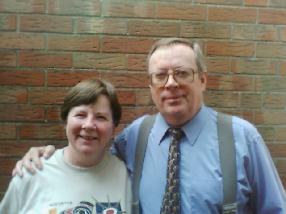 A few years ago I was an active
volunteer with OECTA (the Catholic teachers union in Ontario)
at the local and provincial level. As a grievance officer I was
asked to support a colleague who was experiencing a most grotesque
form of harassment - anti-Semitism. This poor fellow had been
transferred against his wishes in 1986 under the terms of Bill
30 which extended public funding to separate schools on a number
of conditions including the agreement that teachers declared
surplus in the public system would be accommodated in the separate
system with the protection afforded under the Ontario Human Rights
Code.
A few years ago I was an active
volunteer with OECTA (the Catholic teachers union in Ontario)
at the local and provincial level. As a grievance officer I was
asked to support a colleague who was experiencing a most grotesque
form of harassment - anti-Semitism. This poor fellow had been
transferred against his wishes in 1986 under the terms of Bill
30 which extended public funding to separate schools on a number
of conditions including the agreement that teachers declared
surplus in the public system would be accommodated in the separate
system with the protection afforded under the Ontario Human Rights
Code.