|
What I didn't say to my future boss was that in fact I did have experience in adult psychiatry. I had been a patient in fact, twice, on in-patient wards and altogether four and a half years of suffering serious psychiatric symptoms after the birth of our second child. As I was about to make the leap into professional social work, I remember having to go through the mental gymnastics of assuring myself that I would be able to do the basic work adequately enough. I redoubled my self-assurance by reminding myself that the psychiatric work would last just a short while. With that I pretty well put to bed any remaining niggles about being caught out by my past psychiatric history. At that time I certainly had no idea that my own painful experience would come to play a positive role in my work. I was taken by surprise soon again when early on in my new job I realized that I felt very much at home with and, yes, devoted to, the people I was serving. Other advantages lay in the diversity of the work. Like other social workers at the ROH, any one day can see me involved as a service broker (e.g., for disability pensions or other financial assistance, work opportunity resources, or supportive housing), or as an individual, family, and group counselor, or as an educator. Over the years, the hospital programs I've worked in have changed. For example, that general psychiatric service I first worked on (which served people presenting all sorts of psychiatric problems e.g., depressions of various types, manic depression, schizophrenia, personality problems, addictions) became in 1990 the Schizophrenia Service. I stayed on, wondering how I could be of service to people with schizophrenia. In the first place, what did I know about the illness of schizophrenia? Did I know enough about the problems of their family members? Would I ever be able to provide any real help? Again, I was to find myself pleasantly surprised. I know that as a mental health practitioner I am, in some ways, a rare bird. I quip when giving public lectures that my personal psychiatric history has given me more than a bit of empathy. As well, from Raymond's experience of my struggle with mental illness, I knew from the start the importance of reaching out to family members and letting them know at least two things: (1) that they are, in all likelihood, doing the best they can; (2) that we are present to be of help to share their burden and to introduce them to others with similar struggles so that they don't feel alone. As well, early on, I realized the importance of teaching people directly affected by psychiatric illness that there are ways of coping including ways of managing persistent serious symptoms -- so that they feel in charge of their lives, rather than having the sense that their illness has free reign. In retrospect, the past sixteen years of this work, this ministry of mine, is marked with some professional highlights still surprising to me. For example, my book Grieving Mental Illness: A Guide for Patients and Their Caregivers was published by University of Toronto Press in 1994. The book is based on my work with patients as well as on my own personal psychiatric history. I wrote it because I had concluded that there was a need to assist people with the psychological and emotional consequences of the experience of mental illness. In the book I suggest first the identification of the grieving process attendant on experiences of mental illness, and then the constructive use of this normal process. To my delight, a cord was struck in the professional community, and I was asked to contribute a chapter to another book. I called it "The Grief of Mental Illness: Context for the Cognitive Therapy of Schizophrenia." Believe me, I did live in hope after I submitted this chapter because I felt if the editors accepted this concept, some important progress in the world of psychiatry might well occur. They did and Cognitive Psychotherapy of Psychotic and Personality Disorders (Perris, C. & McGorry, P. [eds.], Wiley & Sons) was published in 1998. And, as I've said to my students, "It's one of the best anthologies on cognitive behavioural therapy out there!" And Raymond and I visited Australia last summer because I was invited to give a conference keynote address on the subject of working with the grief of mental illness. (Another surprise: my expenses were all paid!) Through the years, I've been blessed with the ways and means of fulfilling the professional obligation of keeping abreast of new developments in therapeutic approaches. This has not been a hardship for me. In fact, I've enjoyed the pursuit of life-long learning. Of necessity I've done a lot of this (because mentors are not geographically near) through systematic self-directed study. Through self-directed study, cognitive behavioural therapy for schizophrenia (a therapy which teaches ways and means of controlling voices, paranoia, and other delusions) has become not only a part of my practice but a subject I teach. At the present time, I am on sabbatical and am writing another
book which contains success stories of those who continue to
struggle with serious and persistent symptoms of mental illness.
I know their stories well. Sorrow, loss, and desperation are
featured big-time, but theirs are also stories of hope and goodness.
Sometimes I think the most blessed part of my work lies in being
in the position to facilitate the telling of personal stories.
A close second would be affirming people in their struggle. On
a daily basis I bring the people I try to serve to prayer. I
need to give thanks for being there with them. They have given
me so much. It's been a long time since I took the job "for
the money" but I know that in it I have surely encountered
the God/de of Surprises.
|
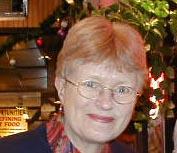 For
the past 16 years I have worked at the Royal Ottawa Hospital
(ROH) and for the most part with people who have schizophrenia
and their family members. Sometimes I still shake my head in
wonder at how I came to a position of such privilege. Originally,
I went to the ROH only to do the final practical requirement
of my Master of Social Work program. While I was at that, concentrating
on learning the practice of family therapy in the children's
out-patient department, one day I received a call from the head
of the Social Work Department, offering me a job on an adult
in-patient service. I hesitated. Raymond and I did need the money
(for starters, to get us my husband, two budding teenagers
& me -- to B.C. to visit my ailing father & then to get
a new furnace) but I knew I didn't want to work in adult psychiatry.
"There's only one problem with you, Virginia. You have no
experience in adult psychiatry." "But I think I could
learn," I said, surprising myself by my response. In the
recess of my conscience I counseled myself: "Just take it
for now God/de help me, for the money and look for
something else later."
For
the past 16 years I have worked at the Royal Ottawa Hospital
(ROH) and for the most part with people who have schizophrenia
and their family members. Sometimes I still shake my head in
wonder at how I came to a position of such privilege. Originally,
I went to the ROH only to do the final practical requirement
of my Master of Social Work program. While I was at that, concentrating
on learning the practice of family therapy in the children's
out-patient department, one day I received a call from the head
of the Social Work Department, offering me a job on an adult
in-patient service. I hesitated. Raymond and I did need the money
(for starters, to get us my husband, two budding teenagers
& me -- to B.C. to visit my ailing father & then to get
a new furnace) but I knew I didn't want to work in adult psychiatry.
"There's only one problem with you, Virginia. You have no
experience in adult psychiatry." "But I think I could
learn," I said, surprising myself by my response. In the
recess of my conscience I counseled myself: "Just take it
for now God/de help me, for the money and look for
something else later."