|
François Brassard, Ladysmith, BC Jesus' Chaburah "The Medium is the Message"
When Jesus lived and worked in Nazareth as a carpenter,
there were in Palestine many different Jewish sects and parties. Some used
violent means to attain their goals (the "sicarii"). Some believed that
you had to separate yourself from the corrupting influences of society
if you were going to be saved by Yahweh:
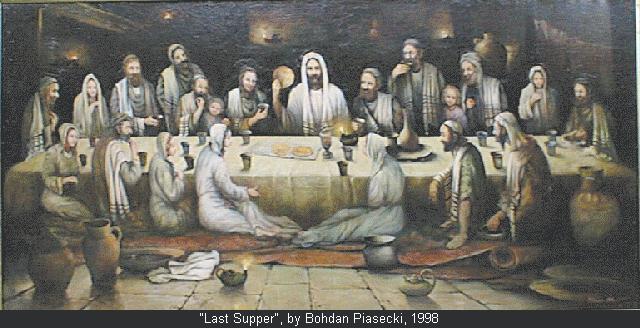
These groups were varyingly intolerant of opposition, particularly from prophets who pointed the finger at their abuses and, especially, at their dereliction of pastoral responsibilities. That's what John the Baptist did, and he was soon arrested and terminated. Interestingly enough, John the Baptist exercised his prophetic mission in true Essenian fashion, in the isolation of the desert near the Jordan river. Common people, good Jews at heart, sincerely searching for connection with Yahweh, went into the desert to hear the message of John. Jesus was one of those people, was deeply affected by John, and felt a prophetic calling of his own. When John was arrested, Jesus left the desert and returned to Galilee to begin his own ministry. When Jesus began to preach the "Good News" about the "Kingdom of Godde," he adopted a radically different style of ministry. And he did this because his target audience was not primarily the elite of society; it was rather the common people, the outcasts, the marginalized. That's why he didn't start his ministry in Jerusalem, the seat of Temple power. He went first to the synagogues of the larger towns of Galilee, his home province. These synagogues were houses of communal prayer, spiritual discussion and education in the scriptures and traditions. As an institution, it was male dominated and controlled by the Scribes, the Pharisees and the occasional Sadducee. These leaders were impressed with the knowledge and simple eloquence of this Galilean carpenter. The common people were attracted to his very hopeful and inclusive message: they were welcome with love and respect in the "Kingdom of Godde." They were even more impressed, if not astounded, by his power to heal, that is, to free them from spiritual and physical restrictions that made them outcasts of society according to the complicated rules of the leadership elite. Jesus empowered them: by total trust in Godde's Power, they were healed and re-integrated to society with respect and dignity. On occasion, Jesus confronted the priests and Pharisees with the evidence of healing, thus forcing them to recognize officially the person's re-entry into society. The elite quickly saw Jesus as a threat to their power and authority, and he was soon unwelcome in the urban synagogues. And whenever they could, they sought to discredit him publicly by declaring him a friend of the devil or by showing him to be opposed to the Law of Moses and to the sacred Traditions. Undeterred by such opposition and buoyed by the enthusiastic support of a coterie of friends and disciples, Jesus changed tack. He adopted a more grassroots approach. He went to the smaller villages and hamlets where he and a few of his disciples (of men and attached women) were invited to share the hospitality of ordinary folk in their homes. Over bread, fish, cheese and wine or whatever they had to share, he would tell them stories that illustrated the "Good News" of the all-inclusive "Kingdom of Godde." In these smaller family gatherings where traditional Middle Eastern hospitality was fully extended, women were included in the lively discussions. That had not been possible in the synagogues. For Jesus, this new method of promoting his prophetic mission was far more inclusive, intimate and effective, and he made it his preferred promotional medium. As a medium, it wasn't new. Small, free-flowing discussion groups of family, friends and guests (where women could also participate) already existed. It was called a "chaburah" in Hebrew. We might call it today a small faith community Jesus formed his own chaburah of family, friends and disciples (men and attached women). Indeed, the Last Supper was a gathering of Jesus' chaburah. And when he said: "do this in memory of me," he was referring to the chaburah as the best way to make the "Kingdom of Godde" real and alive. One gets a feeling for the wholistic, energizing experience of the chaburah from Bohdan Piaseki's recent painting of the "Last Supper." It offers by far a more historically accurate picture of the event (except for the table) than Leonardo DaVinci's famous rendition (See below). Re-read the passage from Luke (24:13-35) that describes a chaburah experience in the home of Cleopas and his wife. Ponder in particular their reaction to the experience: "Wasn't it like a fire burning in us when he talked to us on the road and explained the scriptures to us?" (v.32) Can you not sense the peace, joy and excitement that flooded the very being of those disciples? One can feel the creative energy of the Holy Spirit bubbling up inside them: "they got up at once and went back to Jerusalem." (v.33) Is it any wonder then, why, after the death and resurrection of Jesus, his disciples continued to gather, to tell the "Good News" stories about the all-welcoming "Kingdom of Godde," whilst they broke bread and drank wine in heartfelt conviviality. In repeating this special chaburah experience, they were convinced that Jesus was alive and present among them in a very powerful way. Thus, Jesus' chaburah became the trademark medium of this nascent Jewish sect called the "followers of the Way." It became the operational model for Paul and the other apostles. The gospels as well as the letters of Peter, Paul, James, John and Jude were written to specific "chaburot" (communities) for the faith enhancement of its members. Because Jesus' chaburah responded well to the universal need of people for a profound connection with the divine, this tiny Jewish sect, barely visible in the midst of so many diverse religious movements in the Roman Empire of the time, grew and grew and grew. Down through the ages and to this very day, christians have remained faithful to the tradition of the chaburah established by Jesus. However, in the last 1600 or so years, the Roman Catholic Church has progressively re-instituted a Sadducean Temple priesthood that claims for itself total control over christian sacramental ministry. And because there is at present a critical shortage of priests, the traditional celebration of the Eucharist in our official communities is at risk. Not to worry! The Holy Spirit is busily at work raising up servant leaders (men and women) who are called to return us to our christian origins. Recently, I attended an Advisory Board meeting of CITI Ministries (Celibacy Is The Issue) in Boston and a National Coordinating Team meeting of Corpus Canada in Ottawa. Both these renewal organizations endorsed a plan by which they will invite and train married priests and others to build Small Faith Communities in the Jesus tradition of the chaburah. The primary target audience is the unchurched: Catholics and others who no longer go to church. I am very excited by this project for the following reasons:
Jesus gave us the chaburah. And he said: "Do this in memory of me!" Who will answer the call?
Francois Brassard, Ladysmith, BC
|