Computer Through The Ages
Early Computing Machines and Inventors
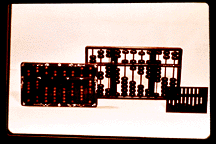 |
ABACUS :The earliest and the simplest calculating device, developed about 3000
years ago in the Asia Minor, was named abacus. It used a system of sliding beads to represent and perform
calculations using decibel numbers. It consisted of a wooden frame with thin rods with beads stung on these wires.
It utilized the concept of compliment of a number for subtraction, a concept utilized today by the modern digital
computers. |
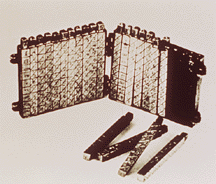
| NAPIER'S BONES :This was another calculating device developed by a Scottish
man named John Napier. He used a set of eleven rods called BONES with numbers carved on them. This made
multiplication and division involving large numbers much easier. |
 |
PASCAL'S CALCULATOR: Blaise Pascal developed the first mechanical calculator ,
also called Pascaline. This machine could add and subtract numbers. His father was a tax collector in Paris and he
developed the machine to help father in his calculations. This calculator used gears, cogwheels and dials. This
brass rectangular box used eight movable dials to add sums up to eight figures long. Pascal's device used a base of
ten to accomplish this. For example, as one dial moved ten notches, or one complete revolution, it moved the next
dial - which represented the ten's column - one place. When the ten's dial moved one revolution, the dial
representing the hundred's place moved one notch and so on. The drawback to the Pascaline, of course, was its
limitation to addition.
 |
LEIBNITZ'S MACHINE: In 1694, a German mathematician and philosopher,
Gottfried Wilhem von Leibniz (1646-1716), improved the Pascaline by creating a machine that could also multiply.
Like its predecessor, Leibniz's mechanical multiplier worked by a system of gears and dials. Partly by studying
Pascal's original notes and drawings, Leibniz was able to refine his machine. The centerpiece of the machine was its
stepped-drum gear design, which offered an elongated version of the simple flat gear. He used a series of sliders to
perform the shift operation. This helped in moving the numbers right or left while multiplying or dividing. |
Charles Xavier Thomas de Colmar, a Frenchman, invented a machine that could perform the four basic arithmetic
functions. Colmar's mechanical calculator, the arithometer, presented a more practical approach to computing
because it could add, subtract, multiply and divide. With its enhanced versatility, the arithometer was widely used
up until the First World War. Although later inventors refined Colmar's calculator, together with fellow inventors
Pascal and Leibniz, he helped define the age of mechanical computation.
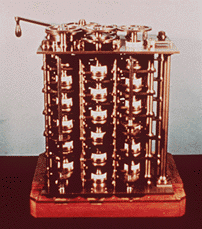
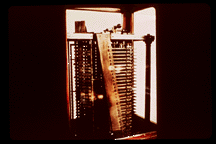
| DIFFRENCE ENGINE: The real beginnings of computers as we know them today,
however, lay with an English mathematics professor, Charles Babbage (1791-1871). Frustrated at the many errors he
found while examining calculations for the Royal Astronomical Society, Babbage declared, "I wish to God these
calculations had been performed by steam!" With those words, the automation of computers had begun. By 1812,
Babbage noticed a natural harmony between machines and mathematics: machines were best at performing tasks
repeatedly without mistake; while mathematics, particularly the production of mathematic tables, often required the
simple repetition of steps. The problem centered on applying the ability of machines to the needs of mathematics.
Babbage's first attempt at solving this problem was in 1822 when he proposed a machine to perform differential
equations, called a Difference Engine. Powered by steam and large as a locomotive, the machine would have a
stored program and could perform calculations and print the results automatically. |
 |
 |
ANALYTICAL ENGINE:After the success of the difference engine, Charles
Babbage designed another automatic machine, Analytical Engine, in 1833. This engine was to have five units as
given below :
- Store: this part was to store the numbers fed to the machine and also those numbers that were generated during
the process of solving, along with the instructions.
- Mill: this unit was to peform all the arithmetic calculations automatically by rotation of gears and wheels.
- Control: this unit was to supervise all the other units and direct their working. Another task of this unit was to
transfer the numbers and instructions from the store to the mill and vice-versa, by rotation of gears and wheels.
- Input: the input unit of the analytical engine was to supply data and instructions to the store. The input edia
were punched cards similar to those used by Joseph Jacquard in his loom.
- Output: the output unit was to display the results of the calculations.
|
 |
The layout of the analytical engine was very similar to the modern computer. Though Babbage's analytical engine
could not be completed, yet it was a commendable effort and it rightly earned him the title of "Father of Computer".
Babbage's assistant, Augusta Ada King, Countess of Lovelace (1815-1842) and daughter of English poet Lord
Byron, was instrumental in the machine's design. One of the few people who understood the Engine's design as
well as Babbage, she helped revise plans, secure funding from the British government, and communicate the
specifics of the Analytical Engine to the public. Also, Lady Lovelace's fine understanding of the machine allowed
her to create the instruction routines to be fed into the computer, making her the first female computer programmer.
In the 1980's, the U.S. Defense Department named a programming language ADA in her honor. |
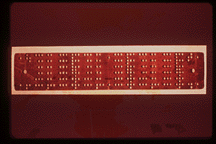
| HOLLERTH MACHINE: In 1889, an American inventor, Herman Hollerith (1860-1929),
also applied the Jacquard loom concept to computing. His first task was to find a faster way to compute the U.S.
census. The previous census in 1880 had taken nearly seven years to count and with an expanding population, the
bureau feared it would take 10 years to count the latest census. Hollerith suggested that information may be
represented by combination of holes on punch cards. Unlike Babbage's idea of using perforated cards to instruct
the machine, Hollerith's method used cards to store data information which he fed into a machine that compiled the
results mechanically. He developed punch card machines and tabulators to process the information on these cards.
Each punch on a card represented one number, and combinations of two punches represented one letter. As many
as 80 variables could be stored on a single card. The tabulators used electrical contacts which rushed these cards
and made the contact through the holes in the cards as these cards were passed through the machine. Instead of
ten years, census takers compiled their results in just six weeks with Hollerith's machine. In addition to their speed,
the punch cards served as a storage method for data and they helped reduce computational errors. |
 |
Hollerith brought his punch card reader into the business world, founding Tabulating Machine Company in 1896,
later to become International Business Machines (IBM) in 1924 after a series of mergers. Other companies such as
Remington Rand and Burroghs also manufactured punch readers for business use. Both business and government
used punch cards for data processing until the 1960's. The punched card system also spread to Europe and in
Britain it was used in the field of astronomy while Austria used it for taking census.
In the ensuing years, several engineers made other significant advances. Vannevar Bush (1890-1974) developed a
calculator for solving differential equations in 1931. The machine could solve complex differential equations that had
long left scientists and mathematicians baffled. The machine was cumbersome because hundreds of gears and
shafts were required to represent numbers and their various relationships to each other. To eliminate this bulkiness,
John V. Atanasoff (b. 1903), a professor at Iowa State College (now called Iowa State University) and his graduate
student, Clifford Berry, envisioned an all-electronic computer that applied Boolean algebra to computer circuitry.
This approach was based on the mid-19th century work of George Boole (1815-1864) who clarified the binary system
of algebra, which stated that any mathematical equations could be stated simply as either true or false. By extending
this concept to electronic circuits in the form of on or off, Atanasoff and Berry had developed the first all-electronic
computer by 1940. Their project, however, lost its funding and their work was overshadowed by similar developments
by other scientists.
INDEX PREVIOUS CHAPTER NEXT CHAPTER