


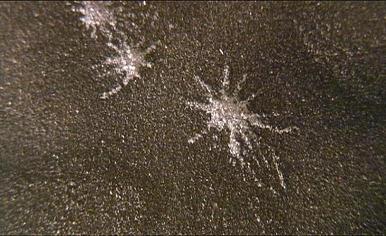
by electric discharge
through loose material on a CRT
An avenue of science is emerging which looks like it will be correcting failed theories from many of the soft sciences which have been attempting to provide solutions, for over a century, to what we observe around us on earth and above us in space. This new science is plasma cosmology and it looks like it will likely become regarded as the science of the next millenium that will lead us to a better understanding of solar system history.
I can honestly say that I could only have hoped to aid in the advancement of the efforts of the people developing this field of research through hard work and much study and persistence for anything beond hoping would have been next to impossible considering my limited education.
Through circumstances of uniqueness, what wasn't even hoped for may have happened. A odd set of circumstances may help to open up a line of understanding into a longstanding mystery kept in a fog because of too few living eyewitness and too many theorists with limited willingness to go out on a limb.
The credit will be shared by all who inspired as well as those who take the next steps to identify details and aspects which combine to develope broad understanding.
Our creator's inspirational force, who has led people for countless generations, began my adventure into an avenue of study unfamiliar to me but not to the folks of Thunderbolts.info who were years into their investigation of the Electric Universe, yet he has opened up a door that will be recognized some day as his involvement in my life by shaping an opportunity to contribute to their efforts in a highly unususal manner.
So begings the saga of the backyard experimenter and the experiments with electric discharge to the surface of a dust covered CRT. My hope is that the current degree of development of The Electric Universe subject will motivate you to look at wider ranging forms of evidence from our experiments and your own to better explain the mechanisms which form crater-chains, trenchs, martian spiders, rim-craters and many more features seen throughout the solar system on variously sized bodies .
Crater chains were the first of many patterns to be revealed in the CRT experiment and over several years and through more unique moments of inspiration than I can count the other patterns occured and were recognized to have such a striking similarity to features on celestial bodies, such as Mars, Jupiter's moon and other bodies of this solar system, that there seems to be little doubt of the potential importance to understanding solar system history and all related areas to be considered.
The discovery of similarities between discharge patterns to a dust covered CRT and crater features (seen on moons, asteroids and some planets) came in an unusual manner, while marveling at the amount of dust that had accumulated on an old VGA CRT. As I reached out to swipe the surface with my finger i was surprised by a sizeable discharge that made a curiously perfect circular crater, with an undisturbed middle, in the dust. Additional passes with my finger yielded a wide variety of patterns shown below and labeled with common names.
Chained Craters, scaloped trenches, craters with internal radial features and donut-looking craters and craters formed on the rims of other craters.
These were the first patterns to be revealed and over time and through more unique moments of inspiration other patterns were recognized.
You can compare these images with adjacent images of features commonly seen on Mars, Moons and asteroids.
We are aware of the plasma nature of the space enviornment and the plasma sheaths that form around bodies in space as they move within the solar stream of charged particles. We have reason to conclude that these bodies become charged bodies with their own state of charge. We know that two objects of differing charge potential will discharge in arc mode as they come into close proximity but even before that happens there are other modes of discharge which can reveal their activity in loosly bound material on the surface of an object such as a CRT.
In this paper each of these modes of discharge will be mentioned and associated to specific patterns seen on surfaces of celectial bodies.
The CRT experiments give us a unique opportunity to see the reaction of different materials to discharges of several types. Field dust gives us a surface that resists discharge until a point at which intensity has built up and upon discharge material is removed from the surface and redistributed in specific manners. Another material, fiberglass, gives us a surface which is highly excitable and holds a static charge after power has been terminated to the CRT tube. The surface builds up a field and discharges in a less intense manner while the CRT is energized. Once the power is turned off the material will leap off the CRT surface to the surface of an approaching body, a finger in this case. The departure of material is one detail but the pattens left behind are significantly more important for they are exact matches of the mysterious Martian Spiders and many other features. Compare the images at he links to the left with images from any space mission and see for yourself and decide for yourself, from this evidence and that obtained from your own experiments, what is the most believable explanation for the formation of surface features in this Electric Universe .