----------------------------------------------------------
Dharmasena Pathiraja Retrospective
by Robert Crusz
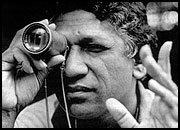
Dharmasena
Pathiraja has been described as a 'rebel with a cause' who
appeared on the Sri Lankan filmmaking landscape in the late
1960's wanting to create a new cinema that 'proposed a counter-discourse
to the bourgeois artistic cinema and the formula-based popular
cinema of the time.' He is generally considered as the leader
of the 'second revolution' in Sri Lankan filmmaking, the first
being initiated by Lester James Peries in 1956 with Rekava.
Born in
1943, Pathiraja was educated at Dharmaraja College, Kandy
and graduated from the University of Ceylon, Peradeniya in
1967 with an honours degree in Sinhala and Western Classical
Culture. He lectured in Drama and Performance Arts at a senior
level in various universities in Sri Lanka and was head of
the Dept. of Performing Arts at the Sri Palee campus of the
University of Colombo from 1999 to 2001. He obtained an MA
in Drama from the University of Peradeniya in 1989 and a PhD
in Cinema Studies from Monash University, Melbourne, Australia
in 1998. Dr. Pathiraja is presently a senior lecturer in Film
Studies at the University of Colombo.
Pathiraja's
early academic career, both as a student and staff member,
in Sri Lanka's universities spanned the years of the growing
worldwide anti-imperialist Marxist/socialist influenced student
and worker unrest against the rapidly spreading ethos of capitalism
with its economic and cultural class-based divisions. Alongside
this, Sri Lanka was experiencing the violence resulting from
the growing conflict between the majority Sinhala and minority
Tamil communities which resulted in all out war from around
the mid-1980's.
Pathiraja
learnt the language of cinema from the films of Peries and
others, but he also recognized their socio-political limitations
in a country which was heading for a period of deep turmoil.
He had studied the radical activist filmmaking of Europeans
like Godard, 'Third Cinema' filmmakers like Solinas, Littin
and Rocha, and South Asians like Sen and Ghatak. So he was
prepared with the tools for a critical film practice, when
he made his first feature length film Ahas Gawwa in 1974.
This was just two years after the April 1972 insurrection
of educated but unemployed rural youth from Sri Lanka's southern
and central Sinhala heartland. They had waited in vain to
enjoy the fruits of the social, political and economic revolutions
promised by the landslide parliamentary victories of the socialists
in 1952, 1962 and 1970. The insurrection was put down with
brutal force and many lives were lost on both sides.
In Pathiraja's
films, visual, narrative and ideological motifs intertwine
in a complex and fascinating manner. He is a filmmaker who
moved away from bourgeois idealism, and paved the way for
a socially engaged and critically humanist cinema, a path
now being taken up by the exciting younger generation of filmmakers
like Prasanna Vithanage and Asoka Handagama who are leading
Sri Lanka's third cinematic revolution.
(The following
two texts are gratefully acknowledged as sources of information
and analysis and have been freely quoted from - Profiling
Sri Lankan Cinema by Wimal Dissanayake & Ashley Ratnavibhushana,
Asian Film Centre, 2000, and "Capturing Reality"
by Piyal Somaratna in Framework 37, Sankofa Film & Video,
1989).
Robert
Crusz is a writer, researcher, filmmaker and editor of Cinesith,
a Sri Lankan film journal.
Feature
Films
Saturo
Enemies. 1970
10 mts short film, won the film critics and journalists, Sri
lanka, award, 1972.
Ahas
Gauwa
One
Leage of Sky. 1974
Won 8 FCJAC awards including the awards for Beat Film, Best
Director, Best Actor, 1974. and won the Office Catholique Internationale
Du Cinema (Sri Lanka) awards for Best Film and Best Director,
!974.
Pathiraja's
first feature length film broke new ground in Sri Lanka with
its urban lower middle class emphasis. Three young men have
to face the realities of adult life as they move on from youthful
frolicking to battle issues of unemployment, restlessness, and
the allure of the city. Two of them, Jaye and Gune, unlike their
other friend who finds both a job and a wife, have only each
other for company. In search of quick and easy money they fall
into the hands of a scheming network of underworld figures.
They become hustlers and decide to outwit their contact. Will
they succeed? Drawn subtley but sharply, the youthful characters
point to the increasing concerns of postcolonial Sri Lanka:
class, youth, employment, sex and desire.
Cast:
Amarasiri Kalansooriya
Wimal Kumara de Costa
Swarna mallawarachchi
Wickrama Bogoda
Vijaya Kumaratunga
Eya
Dan Loku Lamayek
Coming of Age.1977
Sri Lanka's Official entry to
the 8th Moscow international film festival, won Special Diploma
for Female Performance 1976 and the Special award from there
peace council of U.S.S.R. Invited and screened at 18 Mostra
International Film Festival, Bergamo, Italy 1975.
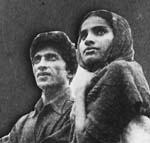
Coming
Of Age is a film about the stresses of life in a small rural
village. Susila's mother struggles to bring up the family alone
in the absence of a father who had passed away. In order to
make ends meet she keeps a lodger, the Gramasevaka, the chief
village authority. One day Susila comes of age. The sudden social
prominence of her sexuality attracts the attention of young
men around her. The Gramasevaka begins to court her and asks
her for her hand. But she does not seem to have control over
either her sexuality or her own person. Her surroundings dominate
her life and she is forced to make choices that are no choices
at all.
Cast:
Malini Fonseka
Vijaya Kumaratunga
Wimal Kumara de Costa
Bambaru
Avith
The Wasps are Here. 1978
Represented Sri Lanka at the
9th Moscow international Film Festival 1977, Invited and screened
at Mostra and Los Angeles Film Festivals. Won Sri Lanka's Presidential
awards for the Best Film, Best Director 1979 at the first Presidential
Awards Festival, and also won OCIC awards for Best Director
and Best Film. Won the Presidental Award as the 4 th best of
the 10 best films selected by critics at the festival fascilitating
50 years of Sri lankan cinema. 1997.
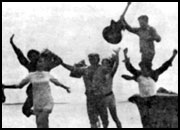
Kalpitiya
is a fishing village. When the regular dealer there falls sick,
his son Victor - Baby Maha.Ththaya (little master) arrives at
the beach to take over the buying of fish, accompanied by friends
The new comers bring in a different ethic of buying and selling,
one based on an economy still rather foreign to the village.
Helen, the village beauty, is at the centre of this strife as
the whole village divides along the line of whom she favours
- Victor or village boy Cyril. This sets off a series of cataclysmic
events plunging the village into a network of intrigue, suspicion
and violence.
Cast:
Malini Fonseka
Vijaya Kumaratunga
Joe Abeywickrama
Wimal Kumara de Costa
Ponmani Younger
Sister.1978
A Tamil Language Film. Represented
Sri lanka at the International Film Festival in India, 1977.
Pathirja's
only Tamil language film is about a starkly different socio-economic
culture and political climate. Set in the northern city of Jaffna,
it traces the fortunes and concerns of an economically depleted
upper caste lower middle class family. Ponmani, the youngest
daughter of the family, has to wait until the marriage of the
middle daughter, Saraoia, before she can escape the bareness
of her life in the house. But Ganesh, the brother who works
in the capital city Colombo, has no money to pay for Saraoja's
dowry. In the meantime Ponmani has fallen is love with a Christian
man belonging to the fishing caste. What does the future hold
for her? An evocative film about land, women, romance and tragedy,
narrated in an idiom of understatement, Ponmani brings out the
texture of the political economy of Jaffna society and its disturbing
connections to the rest of the country.
Cast:
Subhaisni
Balachandran
Kamala Thambiraja
Dr. Nandi
Para
Dige
On the Run.1980
Recently screened at UCLA in
the Third World Cinema Program and screened in France and Melbourne.
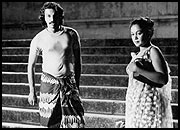
Once
again, this is a film about the instabilities of youthful urban
life, its search for roots, and its lust fur survival. Chandare
works for an insurance company that repossesses vehicles from
customers who have defaulted on payments. Both he and his girlfriend
are part of a generation of young people who have flooded into
the cities in search of work. They are part of the cityscape
of Colombo. When the girlfriend discovers she is pregnant both
she and Chandare try to put together the money they need for
an illegal abortion. But theirs is an arduous journey as the
film repeatedly and insistently narrates a story of life's uncertainty.
Full of twists and turns, the film ends as inconclusively as
it begins.
Sri lanka's official entry to
8 th International Film Festival of India, 1980. Won Presidential
Awards for Best Film, Best Director and Best Script, Won OCIC
awards for Best Director and Best Film. !980. Selected and awarded
as the Best Film of the Decade 1980-1990 by the OCIC in 1990.
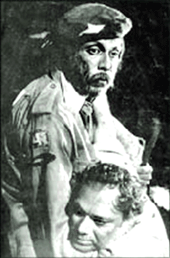
Old
Soldier is a film about four people, all exiles from society,
bound together by ties of affection and mutual jnter-dependence.
The old soldier himself, a shell-shocked veteran of the second
world war; Prema Akka, an abandoned woman who has taken to prostitution;
Willie Mahattaya, a homeless and now decrepit clerk out of a
job, a habitué of the city's bars; and Simon, a pickpocket and
Prema's pimp, The action of the film takes us through three
consecutive days surrounding the 4th of February - Independence
Day in Sri Lanka. The film moves between the dreams and memories
of these outcasts and the realities of their lives trammeled
under foot by ideals of the nation and the state. Yet they heroically
carry on trying to create a space under an old tree as abandoned
as they are.
Cast:
Malini Fonseka
Joe Adeywickrama
Henry Jayasena
Neil Alles
Wasuli
Whirl Wind. 1994
Mathu
Yam Dawasa
Some Day in Future. 2000/2001.
Had world premiere at Singapore
International Film Festival, 2002 and Sri Lanka's entry to the
4th Cinefan Festival, New Delhi, 2002.
Italy
is their dreamland. They speak of the excitement of the travel,
of illegal passage and of the golden opportunities that await
them in the land of milk and honey. Two marginal underworld
characters, they move centre stage in this dynamic unfolding
of political violence and social tragedy, as they become actors
and agents seeking adventure, romance, excitement and power
in a society that is quickly roller coasting towards disaster
and tragedy. It is a cops and robbers story, but with one crucial
difference. There are no victors or victims here.
The
film is evocative of the political violence that has engulfed
Sri Lankan societies from the mid '80 onwards. The deceptively
simple narrative dynamically describes the contours of the land
steeped in violence, its national boundaries and inter-national
aspirations. It forges a cinematic idiom that interests with
the multicultural, the idyllic, the popular, the urban, and
the global cultural economy. The popular and the avant-garde
are mixed together, resulting in a thriller, comedy and tragedy
at one and the same time.
Cast:
Soumya Liyanage
Vasantha Moragoda
Radha de Mel
Rukshana Miskin
TV
Dramas
Gangulen
Egodata
Crossing the Stream. 1985
4, (27 mts) episodes, Tele Drama -Won Gold Award At International
Epilepsy Audio Visual Festival, Hamberg. 1985.
Maya
Mandeera
Mansion of Maya. 1986
27mts.Tele feature For National TV.
Ella
langa Walawwa
The House By the Waterfall. 1988
14 (27mts) episodes, Tele Drama for the National TV.
Wanni
Hamilage Kathawa
Story Of Wannihamy. 1989
4 (27mts) episodes, Tele docu drama produced for Ministry of
Mahaveli Development.
Sudubandelage
Kathawa
Story of Sudu Banda. 1989
2 (30mts) episodes Tele docu-drama, For Mahaveli development
ministry.
Pura
Sakmana
2 (45mts) episodes Tele Drama, An adaptation
of Anton Checov's 'Lady with the Dog' for National TV. 1989.
Kadulla
The Hurdle. 1992
21 (26 mts) episodes, Tele Drama sponsored by Commercial Bank
of Sri Lanka, Won 9 UNDA international awards (Sri Lanka Office)
Including Best TV Feature, Best Director, Best Script, Best
Male and Female Performances, of the year 1992.
Suba
Anagathyak
16 (26mts) episodes, Tele Drama, An Adaptation
of Charles Dicken's ' Great Expectations' For National TV Sponsored
by CTC Eagle, 1993
Nadunana
Puttu
Unknown Sons. 1994
21 (26mts) episodes, Tele Drama, for ITN, Sponsored by Commercial
Bank.
Durganthaya
34 (26mts) episodes, Tele Drama, An adaptation
of Emily Bronte's 'Wuthering Hights' Sponsored by the Sampath
Bank, 1996.
Won the Best Teledrama of the year award including other awards
at Sumathy Television Awards Festival
Documentaries
Anduren
Eliyata
From Darkness to Light
A 40 mts documentary on Land Reforms , produced for the Ministry
of Agriculture and Land Reforms. 1972 (35mm -Black and White)
Werala
The Coast
A 30 mts documentary on coast conservation for the Ministry
of Fisheries, 1974. ( 35 mm Colour)
Putting
The Last First
A documentary on local level community
based projects for NORAD 1984 (35 mm Colour)
Shelter
for Million Families
A 15 mts documentary produced to commemorate
the International Year of Shelter for the Homeless, Screened
at ST. Anne's Theatre, London on the occasion of the ceremonial
award presentation for the best housing program of the year
won by Sri Lanka. 1988. (35mm Colour)
Our
gratitude to the contributors of articles seen in this website
Last updated 29 March 2003
website design. edward ginger. melbourne australia.