How to create an Empire
This is one of the more frequently asked questions I receive. The best way to get an empire growing is dependant on many factors. It depends on what type of Empire you want, who you want to work with, how big you want it. In addition, the larger the empire, the more time you will have to put into doing your orders so be sure to consider this before embarking on this path.
The first element to having a large empire is that you need funds, so you need to be able to tax regions. Especially the more valuable regions (like settlements). This requires soldiers and armies: to invade, tax and protect your land. These troops will often need equipment, to realise their full potential, so you’ll need to be able to produce items (which is the second element). The third element is mages, which can be of vital importance, in the latter stages.
The easiest way to meet these criteria is to join an established alliance and allow them to provide you with land and resources. If that is not an option, then form one with some players, and divide that work between you. An alliance will allow you to specialise in one area, say War, which means your points are used more efficiently. As a pure faction, be it War or Trade or Magic, you will get more regions/mages, than factions which mix their faction points. A good alliance needs support from a dedicated Trade faction, at least one War faction and the aid of at least one Magic faction. A War faction needs to ensure all allies are protected from attacks, and all allies have the funds they need. A trade faction will provide the alliance with weapons, armour and mounts, as well as roads, defensive structures and increasing settlement size, through trade with the settlement as well as building roads in the settlement (they also provide an income). The Magic faction provides high power units later in the game that will assist in preventing assassinations and allow you to assault your enemies easier. Magi can also assist by providing magical items.
The larger the alliance, the harder to control and the harder it is for the alliance to act. This is a game, so people will quit if they are unhappy. You will need to keep alliance members happy, so you need to provide your allies with incentives, as well as give them power over their future and alliance decisions. Keeping the alliance democratic is the best way to do this, though it is very slow for making decisions. You need to adapt your alliance plans to match those of your allies. They are more likely to work with you if you give them tasks to do which they want to do, and they are more likely to do things you wish if you provide them an explanation as to why this is important. In times of war it is sometimes best to go with a kind of dictatorship; an elected Dictatorship. The elected leader would make decisions on diplomacy and tactics for the war. This method is not always required.
Trade, War or Magic?
That is the big question, what path should I walk? To start with, I will discuss the pure paths.
War: This faction is the relatively easy to run, because it is not especially complicated. Your only concern is the creation of armies, the expansion of the faction, and the production of income. Later in the game, this faction can become very complicated and can take a lot of time to process the orders. You need to be vigilant for any possible attacks, and ensure that you have forces ready for deployment. In some games the amount of level 5 Tacticians a faction can control is dependant on the War point allocation.
Trade: I think that this is the hardest type of faction to run. It is the most complicated, takes the most time to set up, any small error can screw with your whole turn, and it provides the least visible reward. Trade faction players are a special type of player, they need to be to run the faction. They need to take delight in the micromanagement of all resources and deliveries, be patient and take pride in their alliances accomplishments, as well as their own. This faction can take the longest to write orders for, yet if well maintained and managed with repeated orders. Once set-up, it can be simple to run. In some games (those with this feature) the amount of Quartermaster a faction can control is dependant on the Trade point allocation.
If you don’t play a trade faction, yet there is one in your faction, please be sure to recognise them for their effort and praise their work. Without them the alliance would not be as powerful as it could be.
Magic: This is the type I recommend to players with little time to play. Usually people’s circumstances change and they may need to quit the game, using a pure Magic faction they can stay in the game. A pure Magic faction can write orders in five minutes if they needed to, which can make this a little boring, at least till the action begins. Magic factions are very powerful later in the game, so they usually take precedence in gaining silver and other resources. Some games allow Apprentices, the amount you can control will be dependant on your Magic point allocation.
Mixed types: If you are playing solo, or no one wants to take the pure faction role, someone will need to mix the points a little. There is no rule for what to expect from mixing points, it really depends on your allocation and the game (some games have varied amounts available). I find it most beneficial to not become locked into a certain mix. I like to be able to change to match the situation. For example: I might be M0, W3, T2, then if a player needs to dump a skilled mage, which no-one in the alliance can take, I could drop a trade point to become M1, W3, T1.
Assassination
I believe that this most effectively utilised by pure Magical factions, the assassin is a very useful tool in the world of Atlantis. A successful and well timed assassination could fatally disable an enemy faction. I have seen whole factions disband, and alliances dissipate due to a Magic faction loosing its Magi, so assassinations should be regarded as an effective tool. Your enemies will not let their ethics prevent them from following this path.
An assassin can be any single man unit which issues the ASSASSINATE order. It does not need to be a specifically trained or named unit. The only requirement to attempt an assassination is for the assassin to have a higher Stealth (which can be attained through skill or magical items) than the Observation level of any enemy unit's in the region. Once the attempt is made, the assassin has a free round to try to complete his deadly task, the target is not assisted by any other units and can wear only cloth armour. This chance is related to his attack abilities and the defensive abilities of the target. The more skilled the unit, the higher the chance of success. Most commonly, factions train specific units to fulfil this deadly position. There are various schools of thought on what skills the best unit should have. In my experience the most successful assassin requires STEA5, and either XBOW5 or LBOW5. Other skills are useful, yet not required. I like my assassins to have the additional skills of OBSE5 (to allow the unit to find targets), RIDI5 (allows a higher chance to escape should you be discovered), and ENTE (to allow the unit to make a living for itself). I also have some of my units study the trade skills of HORS, MINI, LUMB and QUAR (yet only if they have enough funds and not studying anything more important). This allows them to also scout for high end resources. The successful unit also requires equipment to complete the job with precision, a RING of Invisibility, DBOW (Double Bow) or SBOW (Super Bow), CLAR (Cloth Armour; the only armour available for use while assassinating), and a WING (Winged Horse). It has been calculated that a unit skilled as I have mentioned above, has a 99.9% chance of succeeding.
If an assassin unit fails to kill its target, the target faction will be advised of the assassin’s ID. This is undesirable, in addition to loosing a valuable asset, it could allow the enemy faction to work out who may have tried to assassinate their unit.
I once noticed in a game which I ran, there was a faction which was geographically removed from other players. This faction (MAGIC3/WAR1/TRADE1) was using its 3 Magi to create RINGs, while it’s Producers made WING, DBOW and CLAR. He was training groups of 50 Assassins at a time, and then they were sent out. This faction had assassins in most GATE regions and cities, as well as just roaming the country. It was quite impressive to see.
I need to note that some games have varied rules in relation to Stealth, assassination and theft. The entire Stealth skill is something that annoys many players. Many GMs have tried different tactics to diminish the role which an assassin can play in a game. Be sure to know your games rules before you train up any units.
[Note: Some games allow factions to train apprentices, personally I find these units the most effective assassins as, in my opinion, they are of limited value in other missions. If these are available in your game I highly recommend using them, as long as they are equipped appropriate to their class]
Protecting Against Assassinations
Depending on the age and type of game you are playing, Assassins may be of varying concern. Usually in the first few months of a game there is little chance of a unit meeting its end via an assassin, as most factions are spending most of their time establishing their holdings. In the older games, Assassins are a very real danger. Most games feature protected starting cities, so a unit which is inside is protected against assassination attempts. It is usually a common practice for Magic factions to set up school in these starting cities, waiting till they have gathered sufficient skills and items to allow them to go about the land with confidence.
If you are unable to stay in a protected starting city, units may be protected by an OBSE unit, yet this only goes part of the way to protect units. In most cases it is desirable to have one AMTS for each Mage, and one for the OBSE 5 unit. The AMTS possessed by each Mage will protect them from any assassinations and thefts by a unit wearing a RING and the OBSE unit will be able to see any thieves or assassins without a RING.
The above mentioned method is not 100% fool proof. A skilled Mage (practiced in STEA 5 and INVI) or a STEA 5 unit which has been the target of an INVI spell the previous turn will be able to steal from or assassinate any unit unless they are protected by a True Sight (TRUE) 5 mage with OBSE 5 (or within a protective city).
So, in short, anything but remaining within a protected Starting City, or being watched over by a TRUE 5/OBSE 5 Mage, means your units could be at risk.
As mentioned, this depends on your games rule-set. Check to be sure.
Tactics – Attacking
Many players have different ideas of the best methods of conducting an assault on an enemy. Below are a few examples of tactics which I have found useful in the past.
Attacking in a triangle formation
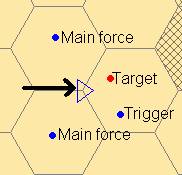
This is a simple formation. The Trigger unit is also the assassin (although it does not need to be an assassin, just skilled in STEA to level 5), it can assassinate should it come across a highly valuable unit, or it can just initiate the attack, relatively free from fear of assassination itself. The main body of the forces are split into two regions neighbouring the Trigger. This formation is easiest to manoeuvre, yet it is smaller in size then others and therefore, less able to pick up targets to attack.
Wedge formation
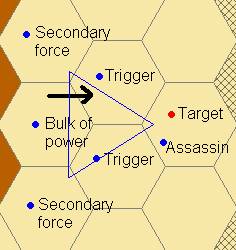
The above picture is what I call the wedge formation. The force is led by the Assassin unit, who moves ahead of the force and targets any possible TACT 5 Leaders. This can be an important edge for the attacking force. The assassin has the noaid flag set to prevent the Triggers from being brought into a battle should it occur. The Triggers are the next level, when they reach the target's region they either attack or are attacked by the target. They usually presented by a vulnerable looking unit, it doesn't even need to be a special unit, any race will do. The Trigger has the hold flag set, and is open to aid. Finally, the main force; the reason for the bulk of the force in the centre is so they can rush to aid any unit which needs help. These units are free to aid the Triggers once they initiate combat. This formation can be bulky and unwieldy, yet it will help to root out targets.
Line Formation
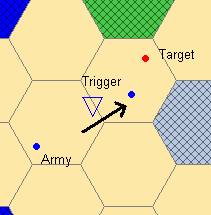
I find another of the best formations, especially for smaller forces, is the simple two region attack force which I call the Line formation. The first region contains a trigger unit, this is best if it is a STEA 5 unit with RING. They can then trigger the attack without the enemy being totally prepared. If this is not available then a more mundane unit would suit this purpose. The one draw back is the enemy will see which region this unit is in before the attack is triggered, which would alert them to expect an attack. The second region contains the bulk of the force, the front line troops, the rear archers, as well as the TACT5 unit and an OBSE 5 unit.
Diamond formation
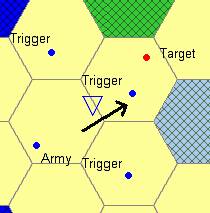
Finally, there is the Diamond formation. This is useful when you want to cover a lot of ground with the minimum of fuss. The force is concentrated in the rear, with Tacticians, archers and frontline troops. The Triggers are spread out so they can spot the best direction for the army to move towards… finding the best targets. This is best used in guerrilla type conflicts where you are seeking targets of opportunity.
Tactics - Defending
Of course, it is of little use to attack areas if you can not keep them, so defence is a valuable tactic.
In potential tactically important areas, I recommend buying the maximum amount of guards which can be sustained. Most settlements can maintain a larger force then other regions, so it is best to maintain your defences there. On borders or strategically important areas it is advisable to forgo any financial benefit from holding the city over defensive ability. In the below city it is possible to create a huge army in residence.
plain (152,22) in Hullevala, contains Mundport [city], 20040 peasants
(sea
elves),
$100200.
------------------------------------------------------------
The
weather was clear last month; it will be clear next month.
Wages: $15 (Max:
$60120).
Wanted: 132 grain [GRAI] at $18, 170 livestock [LIVE] at $21,
52
stone [STON] at $42, 110 fish [FISH] at $20, 59 swords [SWOR] at
$111,
93 crossbows [XBOW] at $105, 64 chain armor [CARM] at $129,
81 wagons [WAGO]
at $186, 32 floater hides [FLOA] at $171, 24
rootstone [ROOT] at $206, 38
double bows [DBOW] at $383, 62 axes
[AXE] at $119, 66 lassoes [LASS] at $99,
75 bags [BAG] at $95, 57
spinning wheels [SPIN] at $117, 99 tarot cards
[TARO] at $227, 52
chocolate [CHOC] at $266.
For Sale: 90 wood [WOOD] at
$61, 53 furs [FUR] at $48, 93 truffles
[TRUF] at $70, 92 cotton [COTT] at
$106, 801 leaders [LEAD] at
$120, 4008 sea elves [SELF] at
$60.
Entertainment available: $6680.
Products: 75 grain [GRAI], 21 horses
[HORS], 77 livestock [LIVE].
-----------
This city could
potentially hold over 8,000 soldiers at a tax rate of $50. If these were
specially trained BARB, VIKI or ORC, equipped with Armour and weapons, they
would withstand most enemy forces. If these were Leader troops then the amount
of units are almost halved, yet they more them make up for this in other ways.
If Leaders were used, these 4,000 Leaders could be equipped with HORS in
addition to RIDI and COMB skill. A very formidable guard indeed!
It should not be forgotten to include Missile armed troops. If half the above force was equipped with XBOW, as well as holding the correct skill, they could easily defend their position against all but the most determined force.
Finally, fortifications should not be ignored. If possible, placing your troops inside multiple defensive structures could add a +2 defensive bonus to those housed inside, quite useful for mundane units without RIDI.
All these points should be combined to ensure that your borders are well protected. These are really useful in games which allow working, please be sure to check your rules before going along this route.
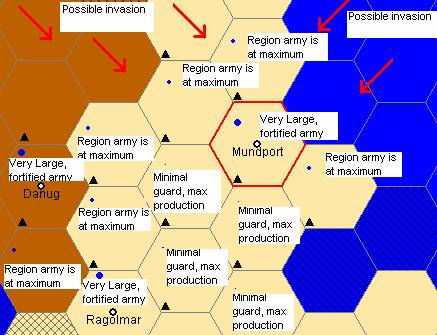
The above figure shows a possible defensive structure. The settlements of Mundport, Danug and Ragolmar, are all holding very large forces, capable of sallying forth to aid the neighbouring regions, which have large armies and no real production. The well protected regions closer to the centre have minimal guards, and these are the real production centres. This is only a sample diagram, yet I am sure it illustrates my point that settlements are useful in maintaining very large forces, capable of defending the borders.
One last point, do not forget that there are other borders which are not so obvious. These include regions with Shafts, GATEs, and coastal regions. These areas, if not well defended, could be an entry point to your empire. Imagine if a large enemy force erupted from a shaft into a production region… they would have at least a turn or two to cause you trouble before you could organise a response.
Balrog Harvesting
To Harvest Balrogs (BALR) you need at least two things. The BALR you wish to harvest and forces enough to defeat the BALR, preferably while taking little in the way of losses. Some of the more recent games have endeavoured to limit the benefit of harvesting the beasts, by preventing freed BALR from receiving orders (also stopping the Balrog Bomb tactic, see below), by diminishing their spoils accumulation rate and other methods. What this means is that once you have freed your BALR you may find they have wondered off in the wrong direction, and once they have been located they don't produce any spoils. BALR harvesting in such situations requires a careful balance of knowing when to attack and being prepared to take some losses.
One option is to release the BALR on to a prepared location, for example a peninsular with a city blocking the only real exit, or an island. The BALR could then roam free, develop spoils, and eventually offer themselves for harvesting. Of course, this plan can be fairly useless if the BALR can move over water (which can be the case in some games). This can be a time consuming method as it requires the BALR to move into the right position. One way around this is to fill the trigger region with a force in excess of 200 men. This will fulfil the requirements the BALR requires for it to attack. It should be noted that using this method can leave any Magi you use vulnerable to assassinations. Due to that it would be preferred to arrange to harvest the BALR from a starting city.
Diplomacy
Diplomacy is one of the most important skills in Atlantis. There are several aspects to this, including making or joining an alliance, replying to messages, etc.
Joining forces with other players is the key to increasing your strength and chance of survival. It is important to have a good level of trust, as you need to be sure your allies will be there when you need them. To foster this trust I would recommend being a good ally, i.e. being dependable. This will create a good relationship. Communication is also key to a good alliance. The creation of a Yahoo group (or similar mailing list) will assist in getting messages to all allies. Alliances can provide some safety, they can provide friendship, and most importantly they provide the support to build your factions. This is especially important for Magic factions who require funding, time and support before they are powerful enough to make a mark in the game.
It may be tempting to create a huge alliance, yet this can lead to problems. Large alliances are difficult to control, hard to manage, and can lead to problems such as Moles (Moles are players who share secret information with an alliance’s enemies. The Mole’s reasons for this betrayal could be many). This is slightly offset by the large amount of power which can be wielded. Smaller alliances can be much simpler to manage. They can be easily moved, and they are usually more trustworthy, yet they could be easily over run by a larger alliance. There are exceptions; a poorly managed large alliance could be beaten by a well developed small alliance, there are many examples of this occuring.
While alliances are important, you should be warned against entering into the wrong alliance. You may be forced into attitudes you do not follow, or you may join a group who have such a bad reputation that you will be tainted with the same brush.
In short, find people you can trust, or if you don't know anyone, then set a good example to those you do join with and they should follow.
Another important aspect of diplomacy is communication. I feel it is very important to reply to all messages received, even if the answer is a simple "no". They did go to the trouble of writing to you, so it is polite to provide them with a response. Diplomacy can help build your reputation, or diminish it with poorly structured messages. If someone finds it difficult to understand what you mean, then they will likely not put effort into replies. I know one example of a player who was reasonably skilled, yet his almost impossible to decipher emails made any prospect of work with him very tiring.
An alternative to the above recommendation is to use silence. While I do not follow this tactic, I understand it can be quite effective. This method is to simply refuse to write any Times articles, or reply to any emails. This creates an air of mystery around the player, causing people to be reluctant to engage the player in battle. It also causes people to be unsure what tactics or direction the player will use. Personally, I find this tactic rude, and I make it my business to attack players who use this, yet it is still a valid method.
Magi training
Knowing which skills to work towards are important for Magic factions. The most powerful spells require many pre-requisites, so careful planning is needed to make sure turns are not wasted. The player needs to decide what direction they intend to have their Magi move toward: should they be artificers, war mages, or transportation specialists? Or perhaps you need them for protection against assassination. There are various directions you could have your Magi work towards, most of that depends on how many Magi you own, and if you are working with other factions who may influence your decision.
It is far easier to have your Mage become an Artificers, enchanting Magical items. At low levels these items are useful, although not very exciting. Production of Mithril Swords and Mithril Armour should be an Artificer’s first goal. These spells can be cast while studying, ensuring that the Mage is contributing to the faction. There are many items which can be created by the skilled Artificers, RINGs of Invisibility, CLOAks of invulnerability, Starves of Fire or Lightning, etc. It is best to consider the direction you wish the mage to move to carefully, as it can be many game years before they reach their goal.
Battle Magi are possibly the second easiest to produce. Having a mage study FIRE can make him a simple, yet effective (especially early in the game) battle Mage. After this simple spell is reached it is important to decide which direction the mage should move towards: summoning DRAGons, or summoning BALRogs? These are the most powerful creatures in the game and a few of these can make the Mage almost an unstoppable force, but be aware of the Mage’s limitations. Summoning Blackwind is a useful battle spell, yet it is a very remote goal due to its high level. There are other spells which are quite useful to the Mag: CALL lightning, Banish Demons, Summon Storm, Summon Tornado, and this doesn’t include the defensive spells! It is recommended that careful examination of the Magical skill list is completed before a decision is made.
There are many other roles which a mage can fulfil, some of which are: -
GATE courier – this mage will scout for new GATEs, deliver goods and units to
and from GATE colonies.
FARSight Mage – a useful role which allows the
scouting of remote regions, as well as spying on neighbours.
TRUE sight Mage
– can be one of the most important roles for a mage. This unit seeks and removes
assassins, as well as prevents assassinations.
Sneaky Tricks and Tactics:
Ship/Aircraft Carrier Tactic.
Ships can be used as Aircraft carriers if you have the right units. This tactic can add to your exploration range or even be used to spot possible targets for the next turn.
To do this you need a Ship (of course), as well as sailors. In addition you need units equipped with a means of air transport over water. The best method is to use single man units equipped with GLIDers, which are pretty cheap and expendable. The process works due to the Ship orders being processed before the unit orders. So the Ship can sail, and at the end of its movement the flying units will move.
The units will usually die at the end of the turn, due to drowning (unless they happen to make landfall), yet if they are also equipped with BOOTs of levitation they will survive the turn. Check your game to find out if these are enabled in your game.
If you have fighting forces on the vessel, you can then attempt to intercept the ship, attacking them when you pass them - if your attitude is hostile.
In addition to this a flying unit can intercept a friendly vessel at sea and enter. This is useful for bridging large tracts of ocean. The unit needs to ensure it issues the order to enter the vessel:
Move N N N N #
The Direction of the vessel is entered and where # is the ID number of the ship is placed so the unit will enter the vessel.
If you have the vessels to act as landing platforms you can easily send large forces across the ocean and launch a surprise attack. Overloading the vessel is not an issue if they are stationary and act only as an island to land upon.
Maxing out a regions structures.
This is a tactic which takes advantage of an exploit (not enabled in every game, it may have changed in games from Atlantis 5 onwards), so if you use this be prepared to stop should the GM make a ruling. From examination of the code, it appears that a region can not have more then 99 structures within (although this appears to be a number which is a little flexible). By building around (or more then) 99 buildings, and keeping possession of the structures by keeping a unit within, a faction can prevent all construction within the city. The structures do not need to be completed for this to work, and that may be one of the requirements. It also prevents construction of Ships, which are counted as buildings. As mentioned, this might not work in Atlantis 5 as vessels appear to be different to buildings.
Blockading starting cities.
Something which many players frown upon yet happens in almost every game. This is the action of moving Guard units in to the surrounding regions of a starting city and preventing any unauthorised movement outwards. Usually only the first factions in a game can put themselves into this position, unless an established faction/alliance quits, creating a power vacuum. The action requires combat ready units setting the Guard flag in all land regions surrounding the starting city, and declaring all non-allied factions unfriendly. It then requires the creation of a large enough garrison in the starting city to uphold your ownership of the surrounds. Many people will complain about this action, so it is important to point out to people that they can sail or GATE away, should they enter your city in error.
In time you will encounter many attempts at breakouts, by mundane units, and by skilled STEAlth 5 or RIDIng 5 units or flying units. To prevent this you need to make sure that all regional guards around the city have support from an OBSErvation 5/Amulet of True Sight unit in residence as well as being mounted on a flying mount with appropriate skills. It is also recommended that you send out a TRUE sight Mage at random intervals to check for any other units which may be lurking.
Skeleton Scouts.
This is something used by some Magic factions as soon as they arrive in the game, starting in the Nexus. The Mage studies FORCe 1, SPIRit 1, NECRomany 1, Summon Skeletons (SUSK) 1. The Mage then begins to summon the monsters, and once one is summoned the Mage sends the Skeleton through one of the portals to arrive at a starting city. It is a nice way to explore each city before making a decision as to where the Mage will arrive. It does have the draw back of keeping the Mage in the Nexus for longer then most would remain, and it can also annoy factions who dislike someone sending Skeletons to their cities. In my opinion it would be easier and faster to read the Times or contact other players to see which is the best Starting City. It is less likely to annoy people and may make you some allies too.
Destruction of buildings.
A tactic used by players who either do not care how people see, or players who want to really annoy people. This is fairly easy to set up, although it is easier to do if you have lots of funds.
The best way to do this is to have multiple STEAlth 5 units in regions which are possessed by the intended enemy. Before the battles are to commence, order the units to enter the structures and destroy them in the same turn. For example:
ENTER 1
DESTROY
As Destroy is processed after ENTER, you can easily do this without being seen. The enemy will have one less structure and should have no idea what happened. It will only work if the enemy has no units within the structures, because if they do they will be considered as the structures owner and will prevent DESTROY orders.
Be warned. If you do this too well, you will upset a lot of people. This is considered very underhanded.
This tactic was once used by a player in the Realms game, who used this to destroy a road running 130 regions long. This move has earned the player an almost eternal and infamous place in the history of Atlantis amongst some of the older players.
A variation of this tactic is used when you are attacked by a superior force. If you think you will not be able to hold your ground then it might be better to adopt a scorched earth policy; destroying all structures and pillaging before the enemy advancement. This will prevent their capture and will make the regions less valuable.
Removing your neighbor.
A very skilled player once offered me the advice to always remove the first faction which you encounter, totally wipe out your neighbor. This works well at the start of the game, when all players are relatively defenseless and when the player has random GATEd from the Nexus. Using this tactic, the player puts all effort into scouts and creating an army. The first faction the player encounters suffers the full force of the army.
This can be useful, as you gain spoils from the enemy, you gain their land if you move in fast enough, and you can also boast that you have removed a player from the game which lends you some negotiating power.
Instant Magi.
This tactic is useful for a faction which has none or very little Magi, yet still requires or desire the capability to launch a Mage attack. When used in the right circumstances, this can easily turn the tide in a war or battle. Yet, it is best when used in small bursts, or for a single offensive, as it can leave the rest of the faction's empire in financial trouble.
Ideally, it is most effective with well trained units, having units skilled in OBSE/STEA/RIDI are a good idea, as well as having them equipped with TRUE/WING/RING and STAL. The last item, the STAL, is the pivotal part of this tactic. Of course, the unit would not have the required skill to use this item in battle (needing a Magic skill: SPIR, PATT or FORC, or MANI for games which allow apprentices), so the unit would sit in a location awaiting its part.
When the need for these units (and this works best with multiple units so be sure to be prepared) arises, the faction points for the faction needs to be changed. DO NOT forget to ensure all your regions have stockpiled enough SILVer to survive for a brief period of time WITHOUT taxing! The faction points need to be put exclusively into MAGIC (and this needs to be done somewhere BEFORE the unit's study Magic, or an error will be created). The same turn that the points are changed, the special units mentioned above need to study the required skill to wield the STAL (for Apprentice free games this is one of the three foundations Magic skills. For Apprentice enabled games be sure to utilise these too, as this could add a potential 14 Apprentices! The next turn the units can move out and assist in any battle, providing additional units which can deal large amounts of damage with their STAL (be sure to set each of these units to behind). Once their task is complete, the units could return to their previous state of Non-magi-hood, awaiting the next time they are needed.
This tactic only works in games which allow Magic points to be redistributed.
FIRE Magi.
This is a tactic best used by at least a couple of factions who have allied and only at the start of a new game. In the first turn, the alliance puts all faction points into Magic, and creates the maximum number of Magi who then all study FORC1/FIRE1. They use Unclaimed Silver to pay for any study. They then move out (with a TACTics 1 unit to support them) and they can take out the nearest settlement within the first few turns. The more Magi you have, the larger the settlements which can be taken.
Often a good tactic, if you are in an alliance, as it gains you the taxable income of the settlement within the shortest length of time.
BALR Bombs.
This is a tactic which is not used very often due to GMs introducing ways to prevent its effectiveness.
To use this tactic, you need a Mage to summon the BALR, and a direction in which you wish to send the beasts. The Mage will issue an order to give the BALR to a new unit, creating it in the same turn, for example: -
unit 100
;My Mage (100), 2281 silver [SILV], leader [LEAD], horse [HORS],
Balrog [BALR]… etc
@study SUBA
give new 1 1 BALR
@cast SUBA
form
1
move n
end
The new unit will consist of the BALR, which will move in the direction given, in this example the BALRog will move north.
This tactic is useful for sending BALR to Harvesting areas, or for moving them to regions to attack an enemy, with little danger to you. As mentioned, most current games disable this feature by preventing BALR being handed to units without SUBA skill, and not allowing you to issue the beasts with directions.
An overabundance of BALR.
A tactic witnessed recently, although it is not new. A faction’s Magi (works even better when done by a whole alliance) travel to an enemy Starting city, preferably unprotected, and sets up camp. Once ready, the Magi begin summoning BALR, and continue to produce them. Eventually, they either break loose or are released. This will cause the defending enemy to increase defenses to deal with dozens of escaped BALR. Possibly outstripping their silver production, or even being over-run with monsters.
The only drawbacks with this tactic (apart from doing little to endear yourself to the other factions) is that it can cause the enemy to create such strong defenses that you would be hard pressed to defeat them and the other problem is that you do not have any control over the BALR once they are free, so they may eventually bump into your regions or attack your allies.