
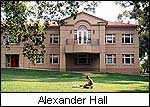
On February 1, 1993, 5-C students took over Pomona's Alexander Hall and closed it "due to racism": they refused to leave until the Claremont Colleges agreed to their demands for a more diversified curriculum--including more AAS courses--faculty base, and student representation.
While the protest at Alexander Hall directly affected Asian American students, it was not entirely focused on AAS; instead, the focus was on the retention of faculty of color in the Claremont Colleges. Students were upset that faculty members of color were only given temporary positions, and that they were later denied full-time positions. Moreover, even when faculty members of color were hired, they only stayed a few years before living.
When Alexander Hall on Pomona�s campus opened in the morning, a group of students stormed the building and secured the entrances and exits. Although the students knew that the protest would be a large subject of debate, they did not anticipate the impact. Even the local media came out and covered the takeover.
Student protests are, by definition, dynamic and unstable�no one had the slightest idea that Alexander Hall would grow to the proportion that it did. Besides a core group of forty protestors, who had barricaded themselves in the building, many other students decided to join the protest. Since the core group was not letting anyone inside�not even other students�the newcomers instead formed a perimeter around the building, declaring that they were the group�s "protectors."
However, even with "protection," a student protest like this has a lot of potential for abuse. In Alexander Hall, the core leaders were beginning to replicate other forms of oppression: the males were always the spokespersons and the females were always behind the scenes. Also, because of the fact that student protest leaders, while charismatic, tend to be passionate and unstable people, two key leaders were unwilling to go along with any compromise. Instead of being concerned for the good of the movement or its people, they were driven by personal reasons and needs; they therefore became a hindrance to the protest as a whole.
All in all, the strike lasted for two days. The situation all over campus was tense and touchy. Although Peter Stanley, the President of Pomona, was sympathetic towards the protesters, he was facing a lot of pressure from the conservative trustees to just call the police and have them arrested the students. The fact that Stanley was a new president did not help matters either. Additionally, the academy is one of the most conservative organizations, and they were not going to change their views overnight.
Nevertheless, out of all five undergraduate colleges, Pomona was the best place to hold the protest. There was no use in challenging the other colleges, especially CMC, because they knew that the other schools would not budge in their views. However, the situation thus became extremely sticky for Pomona. From Pomona�s perspective, it seemed unfair that the students locked themselves in one of their buildings, when the protest itself was over 5-C policy.
During the strike, Professor Ruth Chung was the only faculty member let inside the building. Because she had personal involvement and experience in similar protests and was a faculty member of the Claremont Colleges, Chung was able to help the students see what they could reasonably ask for and demand.
With her help, the protest was resolved peacefully. There was a negotiation between the students and the administration, and a resolution was achieved between the demands of the students and the ideas of the college. One of the demands that was agreed upon during the negotiation was that an IDAAS program was to be created by May 1, 1993.
However, a year after the protest, students declared that Pomona and the other Claremont Colleges basically failed in holding up their end of the bargain. For instance, while an IDAAS program was written, it was not implemented by its deadline.
Additionally, Jennifer J. Rycenga, a faculty member of the Religion Department who specialized in Asian religions, was denied a tenure track position. When she first applied for tenure, the position was labeled �interdisciplinary.� However, when Stanley found out the names of the applicants on the short-list, he declared that the new faculty member had to be either a Judaic or an Islamic scholar�thereby eliminating Rycenga. Because of Stanley�s unorthodox demand, the Religion Department aborted the search.
In sum, while the Alexander Hall takeover drew great attention--from the media, student body, and administrators--the final result was much less than that was hoped. Nevertheless, a later protest would change the idea of Ethnic Studies in Claremont forever...