
Affirmative Action and Racial Quotas
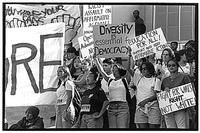

By the mid-1990s, the debate over affirmative action in higher education polarized Asian Americans. On one hand, many conservatives--who believe that there is no institutional structure of racism--thought that such programs are condescending to Asians because it implies that they cannot achieve through their merit. On the other hand, many liberals believed that the programs were necessary for Asian American students to overcome and rise above the inherent racism in education and society. However, due to recent events, the affirmative action debate had gone beyond all party or ideological issues for Asian Americans.
After all, evidence has surfaced recently that such affirmative action programs--and other admissions programs--actually do more harm than good: allegations of possible quotas or limitations in the admission and enrollment of Asian American applicants to some of the country�s most selective public and private colleges and universities arose. As George F. Will, a columnist, said, "Affirmative action discriminated against Asian Americans by restricting the social rewards open to competition on the basis of merit. We may want a modified meritocracy, but it should not be modified by racism and the resentment of excellence�. At a time of high anxiety about declining educational standards and rising competition from abroad, and especially from the Pacific Rim, it is lunacy to punish Asian Americans--the nation�s model minority�for their passion to excel."
Consequently, the Office of Civil Rights of the Department of Education began to conduct a full-scale Title VI anti-bias compliance investigations of potentially discriminatory admissions practices and policies toward Asian American applicants at UCLA and Harvard.
Asian American applicants to many of the country�s most selective schools�Ivy League universities, as well as Stanford and Berkeley�now have lower rates of admission than other groups, including whites.
Acceptance Rates in 1985
Princeton = 17% all, 14% Asian
Harvard = 15.9% all, 12.5% Asian
Yale = 18% all, 16.7% Asian
Moreover, between 1982 and 1985, Asian American applicants to Stanford had admission rates ranging between 66% and 70% of the admission rates for whites.
This is surprising considering the fact that Asian American applicants have the strongest group-level academic profiles as measured by high school grades and standardized tests, and those who are ultimately admitted usually have far stronger academic qualifications than other groups of admits.
1. Quotas, either informal or formal, do not exist, especially after the Bakke case = admissions rates are simplistic indicators and do not fully take into consideration that multilevel aspects of the admissions process
2. Admissions policies are not always meritocratic = Asian Americans are less likely to be legacies and less likely to be great athletes (ironic defenses for many of the top schools)
3. Geographic diversity is important = Asian Americans are at a disadvantage because they are from New York, California, or the Western states
4. Asian Americans often show a disproportionate interest in specific future college programs (like the sciences) = in interests of diversity of students in each major or program, some of them must be left out
1. Admissions officers are engaging in intentionally discriminatory practices to limit the �over-representation� of Asian/Pacific students = over 20% of the Fall, 1987 class at Berkeley was Asian American (compared to 2% of the national population and 6% of the California population); however, Asian/Pacific Americans now represent an increasingly sizable proportion of the total applicant pools at schools, especially Berkeley (30.8% of the applicants to Cal were Asian Americans)
2. UC Campuses have started to deviate from their long standing academic, merit-based admissions process and began to take subjective criteria into consideration
3. Asian/Pacific American faculty and administrators in the universities are systematically excluded from participating in admissions committees.
1. How large a difference in admission rates will be tolerated by a university before changes are made?
2. How much of an Asian American presence will be accepted and tolerated by institutions of higher learning?
If changes are not made in the Admissions Departments, there may be grounds for either an individual or a class-action lawsuit against the colleges with discriminatory admissions percentages. In fact, in January of 1989, attorney Grace Tsuang provided the necessary legal foundation in an issue of the Yale Law Journal.
However, a potential lawsuit should not be the motivation for colleges to solve this problem: it is simply an issue of fairness. Professor L. Ling-Chi Wang, a national spokesperson for fair and equal admissions practices for Asian Americans, avers that �universities, public or private, should allow full access to their admissions policies and data to avoid suspicion and the abuse of power. Asian Americans are not asking for numerical increases in their enrollments, nor are they challenging the merit of existing affirmative action programs. Not unlike whites, they are asking only for fair and equal treatment and demanding equal participation in decision-making processes. In other words, Asian Americans want only equality and justice, no more and no less.�