| Carpet
Corral 1646
Bayly St., Pickering, ON
(905) 683-1731 Proudly serving Durham Region since 1972 |
 |
|
|
|
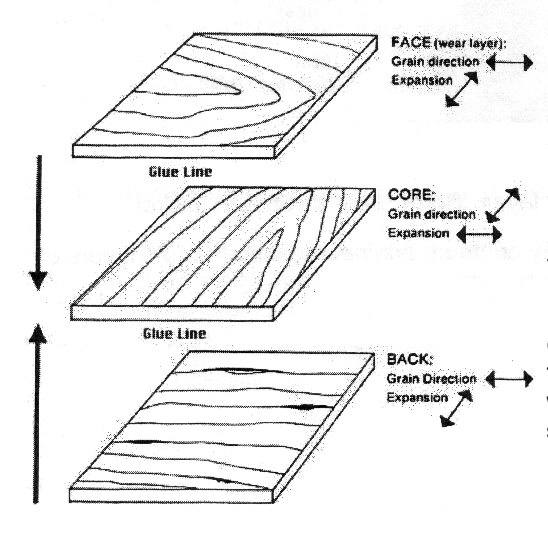
Celebrating 35 years of covering your floors! Judging Hardwood Construction and DurabilitySolid vs. Engineered HardwoodHardwood flooring is available in two different constructions: solid and engineered. Here are the primary differences between the two: Solid: As the name suggests, solid hardwood is made from a solid piece of lumber. It is available in 1/2”, 3/4”, and 1” thicknesses, with 3/4” being the most common thickness. Solid wood is hygroscopic, meaning that it expands by absorbing moisture, and contracts by evaporation. Due to this, solid wood cannot be installed over concrete, or over radiant heat. It must be in an environment in which the humidity level and the temperature are steadily maintained. Engineered: Engineered hardwood uses the same wood as solid hardwood, however there is one key difference: the wood is “sliced” into layers, and then bonded back together. The top layer is the “show wood”, and the middle layers are “support wood”. When glued together, the layers are alternated at 90 degrees so that the grain direction changes with each layer.
The purpose of alternating the grain direction is the resulting dimensional stability. Engineered wood is up to 8 times more stable than solid wood. Thus, it can be installed below grade, over concrete, and over radiant heating. Engineered woods virtually eliminate the problem of expansion and contraction, thus eliminating the problems of cupping, buckling and warping. The Green Alternative Another major advantage of engineered wood is that it is more environmentally economical. Because the cutting process is different for engineered wood than it is for solid wood, more of the tree is used. Therefore there is less waste from the production of engineered wood. Solid wood flooring requires more than twice the number of trees to produce the same square footage of engineered wood floors. So fewer trees are used in the production of engineered wood, leaving more of our forest areas intact. Can engineered floors be refinished? In a word: Yes! There are two processes through which hardwood is resurfaced: 1. Screen & Recoat - This is the most common of the two processes. This is when the factory finish on the wood is “roughed up”, and a urethane finish is reapplied. Screening and recoating is done when there are minor scratches in the surface of the wood, which would be removed when the surface is roughed up. This process is also done in the event that the finish is actually wearing off due to hard use. On both solid and engineered floors, screening and recoating can be done an infinite number of times, because the sanding is not penetrating the wood. 2. Sand & Refinish - This is when the sanding actually penetrates the wood, requiring that the wood be re-stained and then refinished. True sanding and refinishing is done when changing the colour of the floor, when there are deep scratches or gouges that penetrate the wood, or when the floor has crowned or cupped due to moisture. A solid floor can be sanded and refinished 3 or 4 times, while an engineered floor can be done 2 or 3 times. The Colour StoryOne of the main considerations in choosing your wood floor is colour. Light, dark, red, yellow...there are many colour choices. However, there are a few things you should know about the colour of a wood floor, and the things that can affect it:
To minimize the colour change, keep blinds and drapes closed during the day, and roll up area rugs when you go away to let air and light reach the floor underneath Adapted from Mohawk University: Product Knowledge - Hardwood
|
|
|