MY DARLING CLEMENTINE
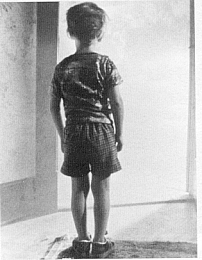
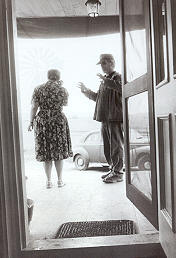
This is one of those fine classic westerns (1946) about small towns, taming the west and the undercurrents for women. Basically about the story about Wyatt Earp, the legendary Sheriff who came to Toombstone and cleaned up the out laws, culminating in an amazingly choreographed shoot-out at the end. Earp is driven to clean out Tombstone as a way to find out who was responsible for the death of his brother. And to understand the significance of this, you have to look at the qualities the little brother is given. The boy is portrayed in almost female ways, and his death in a way represents the death of civility and domesticity, and this is what is a driving force behind the narrative. I think John Ford was big on the contrast between home and the frontier, and it is almost as if 'domesticity' and 'the west' are diametrically opposed creating conflict and death to the domesticated if they remain in the outback - hence the death of the brother in that space and also the absence of any women outside the towns. Another director influenced by this Ford style is Steven Spielberg, who has also used the Fordian imagery of the "domestic" space in many of his films, and you can see it in the classic "Close Encounters" still of the behind shot of the boy standing at the door entrance with light streaming in from the outside (a more extraordinary image because the unchartered "outside" is the entire universe), and again in SPR where the mother learns the news of the death of her son from another behind shot taken from inside. I have scanned in pictures of both images (the right one shows Spielberg giving direction, but the left is perhaps one of the greatest images when in full colour), but unfortunately have none from the john Ford movie... but when you watch a John Ford movie, you will notice this behind shot used.
Anyway, back to MyDarling Clementine. The Skinny Dude was telling me about the religious metaphors in Ford's most classic film "The Searchers", and in this movie, religion is used again through the realm of building a church. And the church here seems to be more of a democratic one, which is built by the people for the people. And then there's Clementine, who of course is the great woman of virtue, but who displays an independence and youthfulness by venturing into this town to follow her boy friend. As with all Western films, I suppose it depends on taste as to whether one watches them, but I never realised that there are deeper meanings attached to them than appear on face level until a year or so ago. John Ford however, would never say that, and one can spend too much time analysing a film as though it wasn't enough that it was enjoyed. However, the point of writing and reading into the film is that it is about showing the film wasn't pointless, that there are reasons why someone could enjoy a western, whether it be the influence of the film style on our modern genius film makers, or the political context to the films which I feel are still with us to this day.
85/100