WHY
EMINEM SHOULD WIN ALBUM OF THE YEAR
26 February 2002
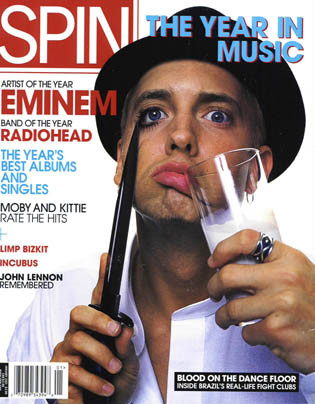
Eminem's latest album, the Marshall Mathers LP has been mired in a controversy since its release that overshadows the brilliance of its construction and the deeper examination of the complex meanings that emerge from its masterful delivery. Most of us would have heard the single from the album 'The Real Slim Shady'. For me, the song was a revelation that Saturday morning last year when JJJ played it while I was exiting off the M4. From the opening simple crude harpsichord ostinato came this torrent of dialogue so self aware and steeped in popular culture that I was astonished. Could rap really be the poetry of our generation? This prompted me to buy the album - and I quickly discovered that the 'Real Slim Shady' is the lightest track of the album. While The Marshall Mathers LP contains the same themes as the hit single it spawned - speaking to its culture, playing on Eminem's image, expressing the consciousness of neglected rejected poor white males across America - the tracks are often darker, shifting from heartfelt drama to ironic comedy. But it is certainly the disaffection, disengagement, mysoginy and homophobia reflected off the 'angry white man' that is disturbing to so many in the community. Or perhaps it was that this blonde artist too closely resembled the white middle class teenagers who so readily fell in love with Eminem's world. Or perhaps, Eminem is like the Spielberg of popular music, with an astonishing pulse on the Zeitgeist post Columbine - and we just don't want to face up to it.
Eminem's rap has always had a cinematic aesthetic
It is no surprise therefore to see
Eminem will be the subject of protests outside the Grammy awards.
Critics do have a point about how acceptable the album would have
been if Eminem attacked African Americans. But doesn't it equally
say something about us as a society that allows women and
homosexuals to be portrayed like this? Couldn't Slim Shady be a
magnification of prejudices a great proportion of our society
might hold? And let's not confuse Slim Shady with reality. Slim
was literally and appropriately conceived while Marshall Mathers
was sitting on a toilet seat.
I can only hope that the vicious critics and families outraged by
the album use it to speak to the youth culture of today. Indeed,
parental responsibility (or lack thereof) is one of the main
themes of The Marshall Mathers LP. As Eminem says in the
brilliant track "Who Knew":
"Quit tryin to censor music, this is for your kid's
amusement (The kids!)
But don't blame me when lil' Eric jumps off of the terrace
You shoulda been watchin him - apparently you ain't parents"
These words themselves prove the complexity of Eminem's message.
In three stanza's he argues against censorship, knows his albums
are devoured by impressionable children and turns the attack on
parents if the children take things too far. Eminem's mastery
comes from his answering his critics and within one breath giving
them more fuel in their arguments against him. When he says
"I never knew I could get him to slit his wrists" - he
says it with a tonal ambiguity - is it said with pride or
sarcasm?
Great art must challenge us. It can shock and disturb us. It
doesn't always have to be beautiful or aim to please the best in
us. It can appeal to our basest characteristics, expose our
prejudices, make fun of them, present them as they are. EMINEM
does all of this. He rapes his own mother and talks about
"ladies" in a very purile way but at the end says:
"I'm just playin ladies/you know i love you."
The Marshall Mathers LP is also an astonishing mixture of pop
culture aesthetics, with a particular love for horror films. From
the first track, the album has an underlying oepidal complex.
EMINEM is constantly abusing his mother in the album and in his
previous album he directly relates his behaviour to Norman Bates
from PSYCHO. From the first song, there are references to horror
films (including the sound of chainsaws). The album is also very
self aware, predicting exactly where critics will derive their
anger and almost salivating at the prospect of the joust. In
"The Way I am", he takes criticism and his fame more
seriously, wearing it as a cross in words reminiscent of Jesus
when he was brought before Pontious Pilot:
"And I am, whatever you say I am
If I wasn't, then why would I say I am?"
The post-modern sophistication of this album is sometimes amazing
to behold. The use of tone is just as impressive. Eminem is able
to sound like a young brat, a disillusioned but loving father and
a violent deranged man. His song Stan perhaps articulates the
underlying fears he has about the effects of his art on the
community. It is also a masterpiece - a mini movie that is so
good, the video clip is merely an exact visualisation of the
words. In fact, the whole album comes as close to a movie as I
think any album can come. Tracks are interrelated, a (fictional)
mileau inspired by reality is established and woven into that
fabric are references to other films and popular culture that
legitimise the world of the album in much the same way as
Spielberg quoting Chewbacca in the Halloween scene of E.T.
legitimises that fictional world of that film.
Eminem's music should make us examine our priorities. It should
make us work out where our boundaries lie, but in the end, it
should be an affirmation of the desirability for free speech. The
album is as complex as our world and to dismiss it as mysoginitic
homophobic trash would be to be a very naive and knee-jerk
reaction to the subtlety of the message, even if it is narrated
by a loud mouthed, often obnoxious lunatic. The world has a lot
to learn from the album, and it wouldn't surprise me if in many
years down the track, children will be buying study guides for
the Eminem rap as they do for Seamus Heaney's poetry. For these
reasons, The Marshall Mathers LP, being one of the most important
albums since Nirvana's Nevermind, should win Album of the Year at
the Grammy Awards.