 � � � � � � � � � � � � � � � �
|
DEVELOPERS� foundation, inc.� |
|
Walking Tour � � Home About DEVELOPERS Our Location Site Map Contact Us |
|
CASESTUDY #1
� � Tabon Island, Batan Municipality: Ruby Mesa & Myrna Damian Introduction Ruby is a mother of three who helps her fisherman/farmer husband to grow rice. She first learned about DEVELOPERS by participating in a training in November of 1997. Whereas, before going organic, their field only yielded 10-11 cavans per cropping, it now produces 20. Ruby reports that four farmers on Tabon Island are now growing rice without agro-chemicals, using only compost and herbals. The community now has a total of 8 people's organizations (P.O.'s), including one farmers' P.O. and two fisherfolk P.O.'s. Myrna and her husband, Boy, grow rainfed, lowland rice on 3/4ha(7500 m2) owned by Boy's mother. They own four carabaw, two adults and two juveniles, which they lend out to other farmers. The Damians use the carabaw themselves only for plowing the edges of the field. For the bulk of the field they rent a hand-pushed tiller for one week at the cost of P700 plus gasoline to operate it. The plowing goes much faster with the machine than with the carabaw. While before going organic they used High Yield Varieties (HYV's), they now use iTRV's. While they try different ones, the varieties they used in the recent season were BI, VM 44-11-1, and 2J. They rotate the varieties in the field so that the same variety is not grown in the same place two seasons in a row. They started growing organically without any transition in the June-September cropping in 1995. While the harvests were small at the beginning, they were never less with organic methods than the 60-70 cavans produced with chemical methods. Since 1995, the yields have overall been increasing each season. The latest harvest was 92 cavans, above the provincial average for rainfed rice, which would be 86 cavans for the same size field (3/4ha). Boy and Myma keep most of the rice for themselves, but they also sell some, give some away to the less fortunate, and sell 8-9 cavans of seed to other farmers. Soil management Before 1995, the Damians used chemical fertilizers, finding that they needed more and more eachseason. When they switched to organic,they started composting, but now they just scatter the rice straw from the previous harvest. Pest management As for weeds, Myrna and Boy used to spray the chemicals Sofit, Machete, and 2,4-D, but they still had problems with weeds to the extent that they paid workers to pull them. Now the Damians find that, with transplanting rather than direct seeding, they just weed the edges of the field manually and weeds are not a problem. Since 1995, they have not spent any money for weeding labor. As far as insect pests, Myrna used to hate lady beetles (Coceinellidae), but now she knows they are beneficial and she tells other farmers not to harm them. She used to spray spiders, but now she knows that spiders and wasps are helpful as well in controlling pests. Before going organic, they used to spend over P1,000 per season on pesticides, and they sprayed even when no pests were present. Now they scout the field to monitor pests and beneficials, and spread fresh cacahuate leaves at the edges of the field to keep pests out. Whereas before they used to spray Karate insecticide to control grain-sucking insects, now they practice the Indigenous Knowledge SRI of hanging dead animals such as frogs, rats or chickens at the edges and center of the field at the flowering stage to deter grain-sucking pests. In addition, during the earlier, vegetative stages, Myma and Boy use the "palas pas" method of walking the field before sunrise and knocking insects off the plant when the soil is wet. The insects are unable to climb back up the plants. Comparison Before going organic, the Damians used 8-9 cavans of seeds per cropping at a cost of P5OO- 600/cavan for direct seeding. Now that they transplant, they use only 1 1/2cavans of seed, which they grow themselves. More labor is needed now, with the time saved on weeding more than offset by the time now spent on transplanting. They pay now for laborers to help transplant: 3-5 people who work from 7 a.m. - 4 p.m. for 1 1/2weeks at P50/day each. Myrna and Boy never have difficulty in finding workers. They also do some of the transplanting themselves. In the "bayanihan" spirit, some of their neighbors help them transplant for free and the Damians in turn help out on the neighbors' farms or give them rice after the harvest. Overall, the planting-to-harvest expenses are similar to when they used chemicals, but the yields and quality have improved. The rice to tastes better now, and does not need to be washed before cooking. Before, they had to wash it 3-5 times to remove the strong smell of chemicals. Myrna finds that farming is more interesting now that they are using organic methods. She says, "When all farmers use this method, they can save money, save the environment, eat healthier food, and not get sick." Myrna was so enthusiastic about DEVELOPERS that she is now a community development worker and trainer for the Foundation. She likes that they show concern for the environment, improve the quality of life for people, and help farmers increase productivity while spending less on farming inputs. |
�
�
�
�
CASE STUDY #2 �
�
|
Barangay Aglucay, Makato Municipality: Pedro Sejera
Introduction
Before going organic, Tay Pedro used HYV seeds, but now he uses iTRV's such as 41-42 and 19NF. He saves seed from each crop, but he grows different varieties each season. As a farmer- trainer for DEVELOPERS, he operates the back-up station for iTRV's in Aglucay, which tries 25 varieties of rice each season, and he can get seed from other barangays. Tay Pedro tills his rice field with a turtle tractor that he has owned since about 1990. He also gets paid to till other local farms. Whereas before going organic Tay Pedro grew only rice, he now has 2000 m2 of his land devoted to tilapia and catfish, and he grows small amounts of vegetables such as sitao, okra, sweet potato and eggplant. He plans to start a few fruit trees. He also has chickens and 2 pigs. All but the rice are for family consumption only, but the fishponds may someday produce enough to sell. When fully stocked, the tilapia pond has 6000 fish. Soil management Before attending VICTO, Tay Pedro used five bags of 14-14-14 and four bags of urea every season, and he burned the rice straw. In '94 he stopped buying fertilizer. He ceased burning the straw except when the crop had tungro or another disease. He has been using compost made of rice straw, leaves of acacia and eacahuate trees (both legunies), and manure from neighbors' cows and carabaw. He recently started making verinicompost from worms dispersed by DEVELOPERS, which he will use for the first time on the next crop. Pest control Tay Pedro now scouts for pests and beneficials each morning and afternoon. For insect problems, he uses herbal compounds, and as a preventive he burns leaves and plastic at the edge of the field. He controls weeds mainly by water management. He notes that it's important for the land to be completely level to be able to control the water enough to kill the weeds. Transplanting the rice seedlings also helps limit the weeds. Comparison Whereas he used to spend more than P15,000 per season for labor and supplies, Tay Pedro now spends only about P6200 per season. This is divided into P1200 for labor for land preparation and P5000 for transplanting labor. He only transplants in the June planting, which is the rainy season. In the dry season October planting, he direct seeds the field himself. He spends nothing on material inputs now. Before going organic, the revenues from 90% of each crop were used to pay off bank loans for the agro-chemicals. The bank charged 18% per annuni interest. Now Tay Pedro sells only 2/3 of the harvest, keeping 1/3 for his family. His family consists of himself, his wife, a 24-year-old daughter and a 12-year-old, adopted son. Besides providing a better income, he also finds that the rice tastes better now, and that his health is better. Before he had frequent coughs and general poor health, and he had to go to the doctor sometimes, but now he doesn't. He finds that the organic method requires more work on his part, in making and spreading the compost, and transplanting in the rainy season. When he direct seeds he uses 120 kg of seed, and when he transplants he uses only 3 5 kg. The yields are lower now than before, averaging about 80 cavans for 1 ha compared to 1 08 cavans per ha before. The lower yield is more than compensated by the drastic reduction in costs. Not even counting for inflation, the difference in cost is about 59% for the rainy season when ~planting is done. In comparison, the reduction in yield is about 26%. |
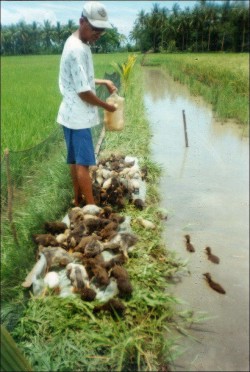 Tay Pedro farms 1.2 ha in the tranquil barangay of Aglucay. He owns 0.5 ha of rice land and the rest he rents at the rate of 8 cavans of rice per cropping. Although the land is irrigated, he grows only 2 crops per year of rice. He started using organic methods in 1994, with no transition. If the crop has a rampant disease or pest problem, he uses small, strategic amounts of chemicals, but for most croppings he uses no chemicals at all. Along with Henry Jamandron, he learned about LEISA methods from VICTO in '93, and became a farmer trainer for them. Like Henry, Tay Pedro learned additional organic methods from DEVELOPERS.
�
�
�
�
CASE STUDY #3 �
�
|
People's Participation in Local Governance Accelerates Sustainable Agriculture
Tabon Island, Batan Municipality
DEVELOPERS Foundation did not find out about opportunities for people's participation in local governance until late 1998. However, already there was a clear need for assistance and leadership in development to come from the Tabon barangay council. In spite of this need, the barangay council was not active and did not encourage people to participate. Development plans were made and approved unilaterally by the barangay captain, and rarely reflected people's development priorities. In late 1998, DEVELOPERS Foundation began to facilitate barangay development planning in Tabon, having provoked the interest in the barangay council in the possibilities for development that were available through the Local Government Code of 1991. DEVELOPERS and the barangay council solicited participation in development planning from the organized P0s for women, farmers and fisherfolk. A development planning series was convened involving the use of participatory rural appraisal (PRA) tools and processes, followed by practical visioning, goal setting and project identification. The P0s and BC members chose to participate because they believed the new three year development plan could help them set a clear direction and access more resources for projects they had selected but not started for lack of support. A key result of the barangay development planning process was the formation of a new barangay development council (BDC). The purpose of the BDC was to encourage and mobilize people's participation in development planning, draft plans and launch programs for barangay development that are approved by the barangay council, and monitor and evaluate development programs from national to municipal agencies that are implemented in barangay, like infrastructure projects. The BDC was required to include 25% PO and NGO representatives among its members. Their participation gave new energy and direction to development in Tabon. The BDP ultimately called for the integration of sustainable agriculture into the overall barangay development program to increase rice and vegetable productivity. This came about because the PRA process of barangay development planning had surfaced a number of problems. It became apparent that some of the problems of farm productivity could be addressed using sustainable agriculture practices. As a result, it became desirable to shift farming increasingly to sustainable agriculture. The main issues for members were that they were paying for expensive agro-chemicals and still not achieving needed yields. They were unable to repay their debts and did not make enough money from farming. In addition, chemicals that had been used to control predators in some of the fishponds were polluting the fishpond water. The introduction of sustainable agriculture in rice production has since helped raise productivity and save money for Tabon farmers. The BDP also set a priority on assisting women in starting or expanding backyard vegetable gardens. This idea had originated in the period of organizing of women's P0s, in which training had been given by DEVELOPERS on the technology of household food security, highlighting organic production methods. ne immediate benefits of organic vegetable gardening for the women were better nutrition for their families and possibly added income from the sale of vegetable crops. However, participation in the BDC was important for the women also because it could ensure that women's concerns were reflected in the BDP. Not only this; the women's P0s, if approved for a seat at the BDC and able to gain approval for their projects, could access five percent of the development funds of the barangay directly, as this money is earmarked for women's projects. As a result of their participation in the BDC, 52 women in Tabon have made plans to begin organic vegetable gardening with initial funding from the barangay council. Popular participation in local governance has not been without problems. For one, Tabon's barangay leadership belongs to a political party that rivals the party of the mayor of Batan, the municipality to which Tabon belongs. As a result of patronage politics in Batan, Tabon was not given any resources for ongoing development work apart from the normal allocation of IRA funds from Manda, over which Batan has no authority. The barangay development council would ordinarily be a good tool for accessing resources from the municipality. This option has not available. This has delayed a number of projects and scaled back others. Along the way, DEVELOPERS has agreed to help Tabon "shop around" its BDP to external funding agencies in the hope of accessing capital funds for the people's projects despite municipal opposition. In the next year DEVELOPERS Foundation will work with the people as they seek outside capital for new project implementation. The larger significance of people's participation in local governance in Tabon is that for the first time anywhere in the municipality of Batan, a barangay development plan is being driven largely by priorities of the people, rather than local officials. The participation of women, farmers and fisherfolk in the BDC has been decisive in directing development priorities and funding for the next three years. At this point, the people of Tabon are beginning to negotiate with absentee landowners for conversion of the land to sustainable agriculture development. It is clear that they see participation in the BDC as beneficial to them. Through this participation, they have been able not only to where their barangay is going over the next three years, but have helped set the direction themselves. They now are more invested and enthusiastic about implementing the BDP, and have been successful in landing capital funding for their own projects. |
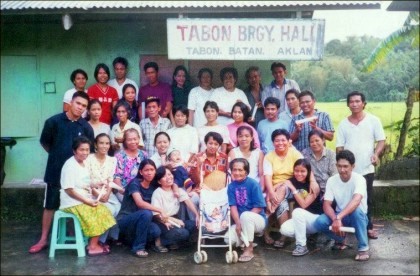 In 1996, DEVELOPERS Foundation began organizing farmers, women and fisherfolk on Tabon Island in order to set the stage for the people to increase their food and livelihood security. This process went forward as planned, but slowly. Within two years, new people's organizations had become organized around the pressing issues and concerns facing Tabon women, farmers and fisherfolk. However, few concrete changes had been made in the basic circumstances of members' lives.